

The folding chair across from Father Mateo’s desk in the back office of Resurrection Fellowship Church was still warm when Pearl Peralta sat down to talk to me. It was a Tuesday morning in late February 2026, and the pastor had called ahead to say she might be reluctant. She wasn’t. Pearl Peralta, 25, looked me in the eye and started talking before I had my recorder out.
I had been introduced to Pearl through Father Mateo, who had been quietly helping her navigate a financial crisis that started with a shoulder injury and spiraled outward from there. He described her, accurately, as someone who would sooner go hungry than ask for help. Getting her to agree to this conversation had taken him three weeks of gentle convincing.
A Raise, a Raise-Sized Mistake, and Then an Injury
Pearl had been a warehouse floor worker for a regional distribution company in Tucson since she was 21. In the spring of 2025, she was promoted to shift supervisor — a title that came with a $4.75-per-hour raise, bringing her to roughly $22.50 an hour. It was the most money she had ever made. It did not go as far as she expected.
“I finally started paying for my brother’s textbooks myself instead of making him take out loans for them,” Pearl told me. “I got a slightly better apartment. I thought, okay, I can breathe now.” Her younger brother, Dominic, 19, is a first-year student at Pima Community College. Pearl had been co-signing his financial aid applications and covering the gaps — roughly $400 to $600 a month — since he enrolled.
What Pearl did not account for was lifestyle creep — the quiet expansion of expenses that follows a raise like a shadow. The new apartment was $185 more per month. She leased a used car to get to the warehouse faster. Small things added up. By October 2025, she was saving less than she had been earning $4.75 less per hour.
Then, in November 2025, Pearl was moving a loaded pallet jack when a shelf bracket gave way. The impact knocked her sideways and she tore the labrum in her right shoulder. She was sent home the same day with a workers’ compensation claim form and a number to call.
The Claim That Was Denied
Pearl’s workers’ comp claim was denied in December 2025. The company’s insurance carrier cited a pre-existing notation in her HR file — a minor shoulder strain she had reported eighteen months earlier that required no treatment — as grounds to classify the new injury as a continuation of a prior condition rather than a new workplace incident.
“They basically said it wasn’t their fault because I’d hurt that shoulder before,” she told me, her voice flat and careful. “The first time I barely even noticed it. This time I couldn’t lift a coffee mug.”
Without workers’ comp, Pearl had no income replacement. Arizona’s short-term disability system offered limited help — the state does not mandate private short-term disability insurance for most employers, and Pearl had not purchased a supplemental policy. She filed for state unemployment, but because she had been placed on medical leave rather than formally laid off, her initial claim was delayed by nearly three weeks.
She burned through $1,200 in savings in less than a month. She fell behind on her car payment. She did not tell Dominic.
When the Stimulus Rumors Started to Sound Like a Plan
This is where Pearl’s story intersects with a broader pattern I have been reporting on for months. Starting in late 2024 and accelerating through 2025, social media and certain news outlets amplified claims about incoming federal stimulus payments — some tied to President Trump’s tariff revenue proposals, others appearing as straightforward misinformation. According to Fox 5 Atlanta’s fact check, claims about IRS direct deposits and tariff dividend checks spread widely through February 2026, with no federal authorization behind them.
Pearl saw the posts. She did what any financially desperate person might do — she tried to verify them, and the sheer volume of content made the rumors feel credible.
What Pearl was seeing were references to a proposal — not a law. President Trump had floated the idea of distributing tariff revenue directly to Americans as a kind of dividend, with figures like $2,000 per household circulating in commentary and speculation. As CNBC reported, those proposals had not been passed by Congress and carried no implementation timeline. The IRS had issued no guidance authorizing any new payment.
Pearl made financial decisions based on money that did not exist.
The Reckoning
By mid-January 2026, Pearl had deferred her car payment, asked Dominic to wait on the $380 she owed him for a textbook advance, and was eating mostly rice and canned beans. She was back at work on light duty, earning reduced hours while her shoulder healed, bringing in about $1,100 every two weeks instead of her normal $1,600.
When February came and went with no deposit, Pearl called a number she had found online that claimed to be an IRS helpline for stimulus check tracking. It was not affiliated with the IRS. She gave them her name, address, and partial Social Security number before the call disconnected. She has since filed a report and placed a credit freeze on her accounts.
“That was the worst part,” she said, and it was the first moment in our conversation that she looked away. “I wasn’t stupid. I was desperate. Those aren’t the same thing, but it felt the same after.”
Where Things Stand — and What Pearl Wishes She Had Known
When I spoke with Pearl in late February, she was in the early stages of appealing the workers’ comp denial with help from a legal aid clinic Father Mateo connected her with. Arizona allows injured workers to appeal a denial to the Industrial Commission of Arizona, and her attorney believes the pre-existing condition argument is weak given the documented gap between incidents.
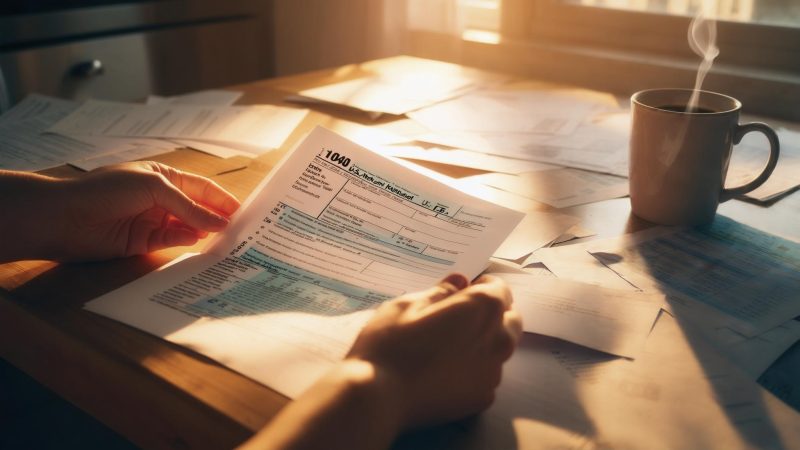
She is also filing her 2025 federal tax return. Pearl had not claimed the Earned Income Tax Credit in previous years because she was uncertain whether she qualified. For 2025, with her income level and filing status, she may be eligible for a credit of up to $632 as a single filer with no qualifying children — a modest but real number. She’s also checking whether any state-level relief programs in Arizona apply to her situation, as Kiplinger has noted that some states have moved forward with their own tax rebates and property relief while federal options remain stalled.
Pearl’s workers’ comp appeal is pending. Her car payment is two months behind. Dominic finished his spring semester registration — Pearl quietly borrowed $500 from a coworker to cover the gap. She has not told him the full story.
As I was leaving, I asked Pearl what she would tell someone in her position right now — not for advice, just her own reflection. She thought about it for a moment.
“Go to the actual IRS website. Not a link someone texts you. Not a news article with a headline that sounds like good news. The actual .gov address,” she said. “Real relief doesn’t get announced on Facebook first.”
Father Mateo walked me out to the parking lot afterward. He told me Pearl had helped three other church members navigate similar misinformation in the weeks since her own experience — translating what she had learned the hard way into something useful for someone else. That, he said, is exactly who she is.
I believed him.
Vivienne Marlowe Reyes is a Senior Tax & Stimulus Writer at American Relief. She covers federal economic relief programs, IRS policy, and the financial lives of working Americans.
Related: She’s 63, Uninsured, and Two Years Away From Medicare — This Is What That Actually Costs



Leave a Reply