
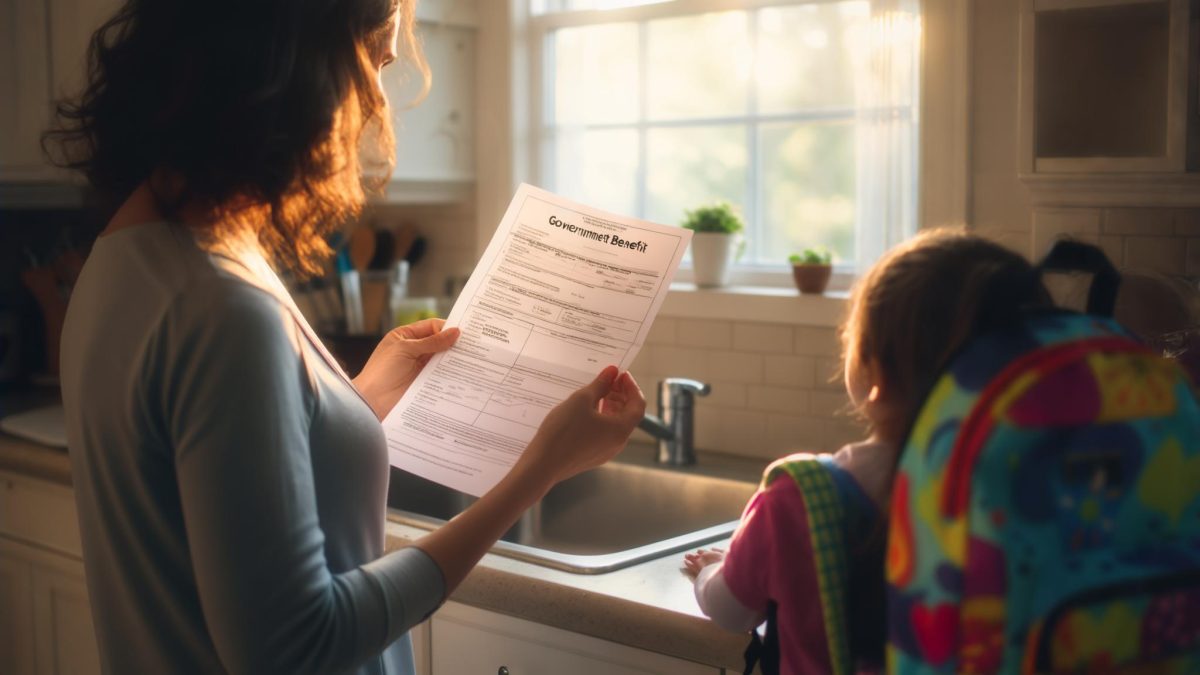
Roughly 1 in 6 American families raising a child with a disability never applies for federal Supplemental Security Income — not because they don’t qualify, but because they simply don’t know the program exists for children. That number has stayed stubbornly consistent for years, according to advocates who work with low- and middle-income families navigating the federal benefits system.
I first encountered Janine Reeves in January 2026, when she called into a segment on Portland’s KPOJ radio about federal relief programs. She wasn’t combative or demanding. She was careful, almost apologetic, as she described her family’s situation to the host. I was listening from my desk and something about the specificity of her circumstances — the graduate degree, the special-needs child, the failing roof — made me reach out through the station to track her down. She agreed to speak with me two weeks later over coffee in Portland’s Pearl District.
A Life Built on Sacrifice, Not Strategy
When I sat down with Janine Reeves, the first thing she said was that she didn’t want anyone to feel sorry for her. At 25, she carries herself with the composed practicality of someone a decade older. She manages the front desk at a mid-size hotel near Portland’s waterfront, a job she’s held for three years. Her husband, Devon, works in logistics. Together they bring in roughly $68,000 a year — enough to feel stable on paper, not enough to feel safe in practice.
Their son Marcus, now 4, was diagnosed with autism spectrum disorder in the spring of 2024. The diagnosis came with relief — finally, a name for what they were seeing — and immediately after, an avalanche of new costs. Specialized therapy sessions not fully covered by insurance. Adaptive equipment. Hours Devon had to cut at work to manage school pickups and therapy appointments that couldn’t be rescheduled.
Janine also carries $47,000 in student loan debt from a graduate program in hospitality management she completed in 2023. She doesn’t regret the degree — it got her a management-track position — but the $480 monthly payment is a fixture in a budget that has very little room for fixtures. The roof estimate she received in November 2025 came in at $13,400. She put the paper in a drawer.
What She Was — and Wasn’t — Claiming
Before we met, Janine had claimed the Child Tax Credit on her 2024 return and received a modest refund. She knew about the Earned Income Tax Credit but had assumed her household income disqualified her. She had never heard of Supplemental Security Income for children. She had never looked into whether Marcus’s diagnosis opened any doors at the federal level.
This is not unusual. As SSA.gov’s disability benefits page outlines, SSI is available to children under 18 who have a medically determinable physical or mental impairment resulting in marked and severe functional limitations. Autism spectrum disorder, depending on its documented severity, can qualify. The 2026 federal SSI payment rate for an eligible individual — including a child — is up to $967 per month, according to SSA’s official SSI payment amounts for 2026.
Janine told me she had gone down a brief internet rabbit hole after the radio show, trying to figure out if Marcus might qualify. But the SSA’s application process looked dense, the eligibility language felt layered, and she backed out. “I figured it was for families who were really struggling,” she said. “I didn’t want to take something from someone who needed it more.”
That instinct — the self-effacing retreat from programs she may have legitimately needed — came up repeatedly in our conversation. It’s a pattern I’ve seen before in middle-income families: too much income to feel entitled to ask, not enough income to absorb the shocks life keeps delivering.
The Radio Call That Opened a Door
The KPOJ segment Janine called into in January was broadly focused on economic relief programs — the kind of conversation that spikes in January as families process holiday spending and upcoming tax deadlines. The April 15, 2026 tax deadline, as many filers now know, carries real stakes: penalties for late filing can reach up to 25% of unpaid taxes, according to IRS guidelines.
Janine had called in specifically to ask whether any new stimulus money was coming. She’d seen headlines about a proposed $2,000 stimulus check tied to tariff revenue — a story that has circulated heavily online in early 2026. The reality, as reporting has consistently shown, is more complicated. According to Economic Times coverage of the April 2026 stimulus update, the proposal tied to tariff rebates lost momentum after key legislative support collapsed. No law had passed as of the time of our interview.
Janine already knew the stimulus check story was murky when she called in. What she was really asking, she told me later, was whether there was anything concrete she was missing. “I wasn’t sitting around waiting for a check,” she said. “I just needed to know if there was something real I could do.”
What the Application Process Actually Looked Like
After our first conversation, Janine agreed to walk me through what happened when she finally filed an SSI application for Marcus in early February 2026. The process took approximately six weeks from start to initial response — longer than she expected, shorter than she feared.
Janine was still waiting for a final determination when we last spoke in late March. SSI applications involving children can take anywhere from three months to over a year depending on case complexity and regional SSA office workloads. She understood this and was prepared for the wait. What surprised her was how much documentation already existed — therapy notes, school IEP records, a developmental pediatrician’s detailed evaluations — that she had never thought to leverage.
The Tax Picture She Had Partially Ignored
Alongside the SSI process, Janine worked with a volunteer tax preparer through a local VITA (Volunteer Income Tax Assistance) site to review her 2025 return. What they found was a combination of small misses that, together, added up to a meaningful difference.
She had claimed the Child Tax Credit — $2,000 per qualifying child — but had not claimed the Child and Dependent Care Credit, which can cover a portion of expenses paid for a qualifying child’s care while a parent works. She also had not fully explored whether any of Marcus’s unreimbursed medical and therapy expenses could be deducted, given they exceeded the 7.5% of adjusted gross income threshold for medical deductions.
Janine’s revised return, still being finalized as of early April 2026, was expected to result in a refund meaningfully larger than her original estimate — though she told me she was deliberately not counting on it until the check arrived. “Devon says I’m too cautious,” she laughed. “But I’ve been surprised by bills more often than I’ve been surprised by money.”
Where Things Stand — and What Remains Unresolved
When I spoke with Janine one final time in late March, the roof was still leaking. The $13,400 estimate was still in the drawer, though she’d pulled it out and photographed it — the first step, she said, toward taking it seriously. She had looked into whether the Department of Housing and Urban Development’s home repair assistance programs had any state-level equivalents in Oregon. The research was ongoing.
The student loan debt remained at $47,000. She is on an income-driven repayment plan, which has kept her monthly payment manageable, but she described it as “a bill that doesn’t get smaller, just less urgent.” She isn’t expecting loan forgiveness and has stopped tracking the political back-and-forth around it.
What strikes me most about Janine’s story is not the dollar amounts — though they are real and they matter. It’s the gap between what was available to her and what she knew to look for. That gap is not a personal failure. It’s structural. Programs like SSI for children, the Child and Dependent Care Credit, and VITA tax assistance sites exist precisely for families in Janine’s position. They are simply not advertised with the same energy as the problems they’re meant to solve.
Janine told me before we parted that she hoped her story would push another parent — someone who also assumed the programs were “for someone else” — to at least make the call. “I’m not a success story yet,” she said carefully. “But I’m at least in the right rooms now. That’s more than I was doing before.”
I left that conversation thinking about all the radio callers who don’t get tracked down. The ones who ask one careful question, don’t get a complete answer, and go back to managing. Janine was lucky that someone was listening closely enough to follow up. Most people don’t get that call back.



Leave a Reply