
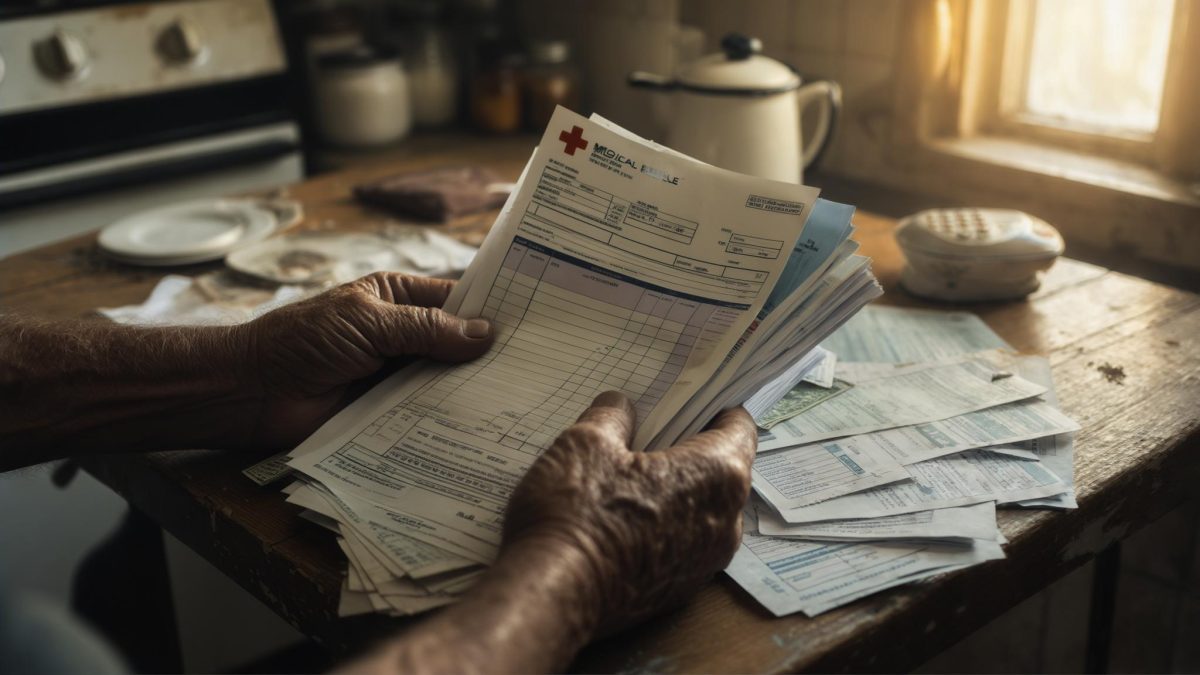
Roughly 28.2 million Americans were uninsured as of 2024, according to the CDC’s National Health Interview Survey — and a disproportionate share of them are self-employed workers who fell through the gaps between leaving an employer plan and finding an affordable alternative. Deshawn Parker, a 27-year-old freelance graphic designer from Detroit, was one of them. His story isn’t a cautionary tale about ambition. It’s a case study in how fast the financial floor can drop out when there’s no institutional safety net beneath you.
I first connected with Deshawn in February 2026 through a mutual contact who works with Detroit’s creative community. He’d been trying to get his credit rebuilt for almost a year. When I asked if he’d talk to me about what happened, he agreed immediately — partly because he wanted people to understand what freelancers actually face, and partly, I think, because he’d been carrying it alone for too long.
From the Warehouse to the Studio — and Into Thin Air
Deshawn spent three years loading freight at a distribution center outside Detroit. The pay was steady — around $38,000 a year — and the health benefits were standard: employer-subsidized premiums, a deductible he could manage. He wasn’t passionate about the work, but it covered the basics. Then, in January 2024, he quit to design full-time.
“I had clients lined up, I had a portfolio, I had momentum,” he told me, leaning forward in his chair. “I genuinely thought I had figured it out. The first three months I made more than I ever did at the warehouse.” Those months he cleared between $3,800 and $4,200. He bought software subscriptions, upgraded his monitor setup, and felt, for the first time, like he was building something real.
What he didn’t do was purchase health insurance. He’d looked at HealthCare.gov marketplace plans and found the premiums for his income bracket — at the time he was projecting roughly $45,000 annually — ran between $180 and $310 per month after subsidies. He decided to wait until a slower month when he had more mental bandwidth to compare plans.
That slower month arrived in July 2024 — except it arrived as a medical emergency, not a planning opportunity.
The Appendectomy That Rewrote Everything
Deshawn woke up at 3 a.m. on July 14th, 2024 with pain he initially dismissed as bad food. By 6 a.m., he was in an Uber to Detroit Medical Center. By noon, he was in surgery for a perforated appendix. He spent three days in the hospital. “I remember thinking, when they wheeled me out of recovery, that I was just glad to be alive,” he said. “The bill hadn’t hit me yet. Literally.”
The itemized hospital bill arrived in late August: $14,240. The breakdown included $8,100 for the surgical procedure, $3,400 for the three-night stay, and nearly $2,700 in anesthesiology and radiological services. There was a financial assistance application tucked inside the envelope — a standard inclusion under the CMS nonprofit hospital charity care requirements — but Deshawn set it aside during what he described as a particularly brutal dry spell for client work.
By November 2024, roughly 90 days after the bill was issued, the account had been transferred to a collections agency. Deshawn learned this not from a letter but from checking his credit score through his bank’s app — it had dropped 94 points overnight, from 668 to 574.
What He Found Out — Too Late, and Then Just in Time
When I spoke with Deshawn about what came next, he was candid about the spiral. December 2024 brought his worst income month — $810 total from two small logo jobs — and the psychological weight of the collections account made it harder, not easier, to hustle. “When your credit is wrecked and you’re barely making rent, you stop thinking about five-year plans. You just survive the week,” he said.
In January 2025, a friend in his design network told him to call the hospital’s financial assistance office directly — not the collections agency, but the hospital itself. He did. What he learned surprised him: Detroit Medical Center’s charity care program, administered under Michigan’s Indigent Care rules, would have covered approximately 80% of his bill if he’d applied within 240 days of service. That window had closed. But the hospital’s patient advocate told him something else: they could still negotiate the collections balance directly, and a settlement offer of 30–40 cents on the dollar was not unusual for accounts his age.
He also discovered — again, too late for the current situation but useful going forward — that he had likely qualified for a substantial Premium Tax Credit through the ACA marketplace. In 2024, a self-employed individual in Michigan earning approximately $32,000 (what Deshawn estimates he made that year after lean months dragged down his average) would have been eligible for subsidized coverage, potentially bringing his monthly premium below $50 under enhanced subsidy provisions extended through 2025.
A Mixed Resolution — and What Still Isn’t Fixed
By March 2025, Deshawn had negotiated his collections balance down to $5,400 — a settlement he paid over four months using income from a brand identity project that brought in $6,800. The collections account was marked “settled,” but it remains on his credit report and will for approximately five years from the original delinquency date, unless further regulatory changes affect medical debt reporting.
His credit score, as of early 2026 when we spoke, sits at 601. Functional, but bruised. “I can rent an apartment. I can’t get a car loan at a decent rate. I can’t think about a mortgage,” he said, with the kind of flat honesty that comes from having made peace with a situation you can’t fully undo. “The collections thing will follow me until 2029. That’s just the math.”
He is now enrolled in a bronze-tier ACA plan through HealthCare.gov, paying $67 per month after subsidy adjustments based on his estimated 2026 income. It has a $4,500 deductible, which he acknowledges is high. But it exists. It’s a floor.
The Version of This Story That Keeps Repeating
What struck me most about Deshawn’s situation wasn’t the medical emergency itself — it was the ordinary sequence of deferrals that preceded it. He wasn’t reckless. He was busy and optimistic and slightly overwhelmed, which describes most self-employed people I’ve ever spoken with. The ACA enrollment window didn’t feel urgent until it was catastrophically relevant.
According to the Kaiser Family Foundation, self-employed individuals are significantly more likely to be uninsured than workers with employer coverage — and among those earning irregular income, the rate of marketplace enrollment remains low despite available subsidies. The systems exist. The awareness of them, for people navigating the chaos of building something on their own, often doesn’t.
Deshawn is doing better now. He had two strong months in late 2025 — a $5,200 month in October and a $4,700 month in November — and he’s been more deliberate about building a cash buffer. “I keep three months of basic expenses in a separate account now. I don’t touch it. That’s new,” he told me near the end of our conversation. He smiled when he said it, but there was something measured in it, something earned the hard way.
His story doesn’t have a clean ending. The collections mark stays. The credit score climbs slowly. The ACA plan exists but carries a deductible that would still hurt. These are the terms he’s working within — not because the system is designed for people like him, but because he’s learning it one hard lesson at a time.
I left our conversation thinking about the 28 million uninsured Americans behind that statistic — each of them one ordinary morning away from an extraordinary bill. Deshawn Parker got through it. A lot of people don’t.
Vivienne Marlowe Reyes is a Senior Tax & Stimulus Writer at American Relief. This article is reported narrative journalism and does not constitute financial, legal, or medical advice.




Leave a Reply