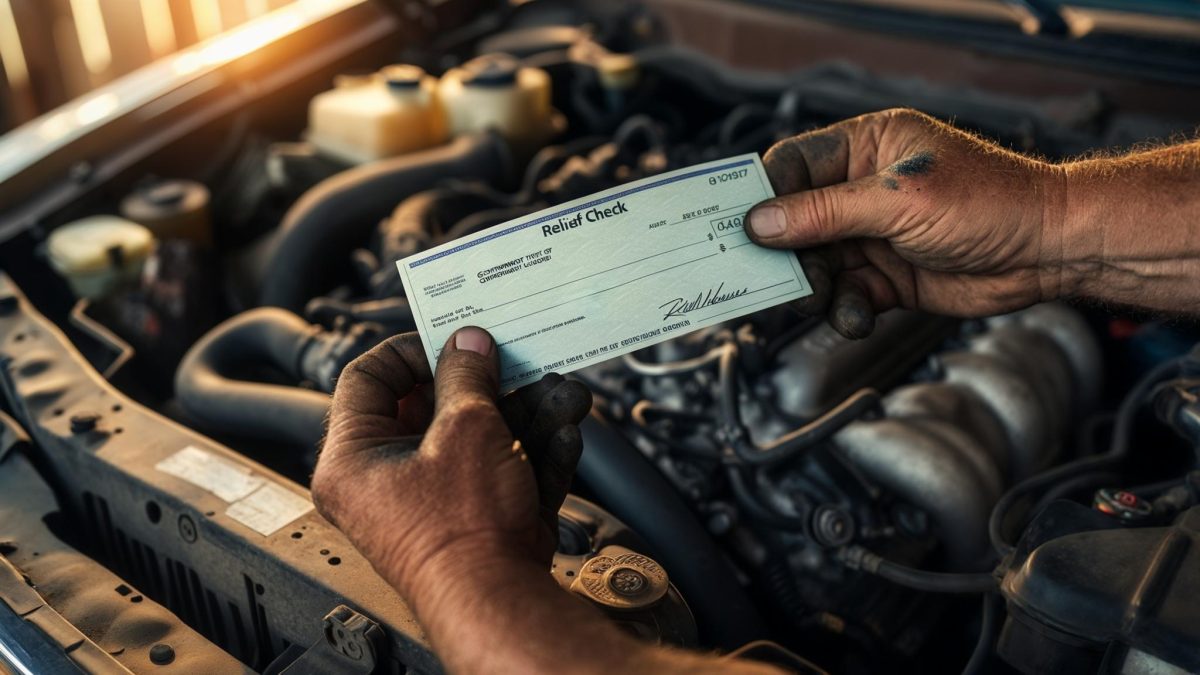
Most people assume that government economic relief is designed for the unemployed — people who lost jobs, filed claims, and waited by the mailbox. Robert Kowalski had a job. He owned the business. And that, he believed for years, meant none of it applied to him.
He was wrong. But the cost of that assumption, measured in unclaimed credits and missed deadlines, is something he’s still reckoning with today.
The Shop That Time — and Technology — Left Behind
When I sat down with Robert Kowalski at his shop on the northwest side of Milwaukee on a gray Tuesday in February 2026, the garage bays were quieter than they should have been for mid-morning. One vehicle was up on a lift. Two bays sat empty. He wiped his hands on a rag that had seen better days and gestured at the empty space like it explained everything.
Robert, 52, has run Kowalski Auto & Repair for 18 years. At its peak, the shop employed three mechanics and turned away work. He specialized in domestic vehicles — Fords, Chevys, the kind of cars Milwaukee’s working-class neighborhoods are built on. Business was steady, sometimes better than steady, right up until it wasn’t.
“It started with the software,” he told me, leaning against the service counter. “I’d get a 2021 or 2022 model in here, and I’d hook up my scanner, and it would just — it wouldn’t talk to me. The car would tell me to go to the dealer. I’m a mechanic. I’ve been doing this since before some of these engineers were born.”
The shift he’s describing is real and documented. Modern vehicles increasingly rely on proprietary diagnostic systems that independent repair shops cannot access without purchasing expensive OEM-licensed tools — sometimes costing $10,000 to $30,000 per manufacturer. For a small operation like Robert’s, that math doesn’t work.
A Son, a University, and a Number That Didn’t Add Up
The revenue decline was painful on its own. Then his son Daniel, 19, was accepted to a university in Minnesota last spring with a tuition bill of $45,000 per year. Robert told me the number with the kind of flat delivery people use when they’ve already processed something too many times to feel it freshly.
“My wife’s paycheck covers the groceries and the electric bill. That’s it. That’s the whole job of her paycheck,” he said. “I told Daniel I’d find a way. I don’t know what way that is yet.”
His wife, Carol, works as a school aide for Milwaukee Public Schools. Her income — roughly $34,000 a year — has become the household’s stability floor while Robert’s shop revenue fluctuates. The two incomes together place the family in a bracket that makes them technically ineligible for some need-based aid but still deeply strained by the actual cost of a four-year degree.
What Robert Didn’t Know He Could Have Claimed
Robert’s stubbornness about financial programs is something he owns openly. “That stuff is for people who need handouts,” he said early in our conversation. “I’m not a charity case. I built something.” It’s a posture I’ve encountered before in small business owners — the belief that self-sufficiency and government programs are mutually exclusive categories.
The reality is more complicated. When I walked him through what self-employed individuals were eligible for over the past several years, he went quiet in a way that was uncomfortable to sit with.
Under the Families First Coronavirus Response Act and subsequent IRS provisions, self-employed individuals were eligible for refundable tax credits covering paid sick leave and family leave equivalent — benefits that W-2 employees received automatically but that self-employed filers had to actively claim. According to the IRS guidance on FFCRA self-employed credits, eligible individuals could claim up to $15,110 depending on days unable to work and net self-employment income.
Robert told me he had been sick for nearly two weeks in early 2021 and had closed the shop. He didn’t claim anything. He didn’t know he could.
The American Opportunity Credit and the Gap Robert Is Still Navigating
On the college cost question, the picture is more mixed — and more immediately relevant. The American Opportunity Tax Credit, as outlined by the IRS, provides up to $2,500 per eligible student per year for the first four years of higher education. Up to 40% of that credit — $1,000 — is refundable, meaning it can reduce a tax bill below zero.
To be eligible, the filer’s modified adjusted gross income must be below $90,000 for single filers or $180,000 for married filing jointly, with the credit phasing out above those thresholds. Robert and Carol’s combined income in 2025 was approximately $251,000 on paper — but that number includes gross revenue before business expenses. His net self-employment income after deducting shop costs, equipment, and labor was considerably lower.
“I never thought of myself as someone who’d qualify for a credit like that,” he said. “My gross number sounds like a lot. It doesn’t feel like a lot when I’m buying brake rotors wholesale.”
The Retirement Question He Keeps Avoiding
Of everything we discussed, the retirement question was the one Robert least wanted to sit with. He has no IRA, no SEP account, nothing set aside specifically for retirement. His plan, stated plainly, is to keep working. He’s 52.
“I’ll work until I can’t. Then the shop is worth something, right? It’s an asset.” He paused. “At least I hope it’s still an asset by then.”
The uncertainty in that last sentence was telling. A shop whose revenue depends on being able to service vehicles that increasingly require dealer-exclusive diagnostics is not necessarily appreciating. He knows that. He just doesn’t want to say it out loud.
Self-employed individuals are eligible for several retirement savings vehicles that also carry tax advantages — including SEP-IRAs, which allow contributions of up to 25% of net self-employment income, and Solo 401(k) plans. These are factual program structures, not recommendations. Robert was aware neither existed in the form they do for self-employed filers.
What Changed — and What Didn’t
By the time I left the shop, Robert had agreed to bring his last three years of returns to a different tax professional — one who specializes in self-employed filers — to review what, if anything, could still be corrected. It was a small concession from a man who describes financial advice as “something for people who already have money.”
His son Daniel enrolled at the Minnesota university in fall 2025 and is finishing his first year. Robert is paying what he can and hoping Daniel’s work-study earnings cover the rest. The American Opportunity Credit, if Robert’s adjusted gross income qualifies after full deductions are calculated, could return up to $2,500 on his 2025 return — filed by April 2026.
Whether the shop survives another three years in its current form is a harder question. Robert is investing in one OEM diagnostic tool for Ford vehicles — a $12,000 expense he’s financing — and betting that specialization will compensate for what he loses in general volume. It might work. It might not.
When I asked him what he wished he’d known five years ago, he didn’t hesitate. “That the rules weren’t written against me just because I own something,” he said. “I always thought if you had a business, you were on your own. Turns out that’s not entirely true. I just found out too late for some of it.”
That last phrase stayed with me on the drive back. Too late for some of it. It’s not a story with a clean ending. It’s a story about a man who did everything right by the standards he was taught and still found himself standing in an emptier garage than he expected at 52. The programs existed. The information didn’t reach him. And that gap — between what’s available and what people like Robert actually know about — is a failure worth paying attention to.
Related: His Auto Shop Revenue Fell $54,000 in Three Years — Then the IRS Sent a Notice He Didn’t Expect




Leave a Reply