
The conventional story about retirement in America goes like this: work hard, save diligently, and your golden years will take care of themselves. Patricia Novak did exactly that — and it still wasn’t enough.
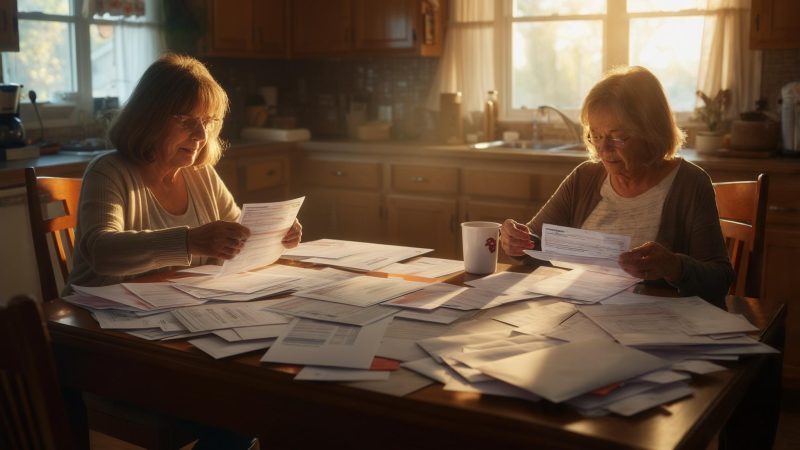
When I sat down with Patricia Novak at her kitchen table in Pittsburgh’s Brookline neighborhood on a gray Tuesday in March 2026, she was sorting through a folder of coupons she’d clipped the night before. She had a list, written in careful ballpoint pen, of which grocery stores had which deals that week. She drives 20 minutes to a discount supermarket every Thursday because the one around the corner, she told me, is simply out of her budget.
Patricia is 65 years old. She retired from the United States Postal Service after 32 years of service, carrying mail through Pittsburgh winters that she described — with some pride — as genuinely brutal. She owns her home outright. She has no credit card debt. By most measures, she did everything right. And yet, three years after her husband Gerald’s death, she told me she lies awake at night calculating whether her savings will outlast her body.
A Budget That Changed Overnight
Patricia’s situation is specific, but the pattern it represents is common. When Gerald died, Patricia’s household income dropped sharply and permanently. Gerald had been receiving Social Security retirement benefits of approximately $1,380 per month. Under Social Security’s survivor benefit rules, a widow can receive the higher of her own benefit or her deceased spouse’s — but not both. Patricia’s own Social Security benefit is higher than Gerald’s was, so she receives no survivor bump.
What that means practically: she lost $1,380 per month with no replacement. Her current monthly income is roughly $2,290 — a combination of her USPS federal pension of approximately $1,150 and her own Social Security benefit of $1,140. Her monthly fixed expenses, including utilities, groceries, medications, and home insurance, run close to $2,550.
The gap — roughly $260 a month — doesn’t sound catastrophic until you understand that Patricia’s home, a brick row house built in the late 1960s, needs a new roof estimated at $9,500 and a furnace replacement that a contractor quoted at $4,200. Her small savings account, which holds about $18,000, is designated in her mind for medical expenses she expects will come. She will not touch it for the house.
The Programs She Didn’t Know About
Patricia told me that for the first year after Gerald died, she told no one about her financial situation — not her two adult children, not her neighbors, not her parish priest. She described herself as “too proud, probably stupidly so.” It was a conversation with another retiree at her local senior center in early 2025 that changed things. The woman mentioned she’d received heating bill assistance through a federal program.
Patricia had never heard of LIHEAP — the Low Income Home Energy Assistance Program, administered federally through the U.S. Department of Health and Human Services. LIHEAP provides heating and cooling bill assistance to low-income households, including seniors on fixed incomes. In Pennsylvania, the program is administered through county assistance offices, and income eligibility thresholds for a single-person household can reach up to 150% of the federal poverty level — which, depending on the benefit year, can include households earning up to approximately $21,870 annually.
Patricia’s income of roughly $27,480 per year put her above the standard LIHEAP threshold for Pennsylvania in the 2025-2026 benefit year. She did not qualify. But the conversation led her to look further.
What She Actually Found — and What She Didn’t
The search Patricia began in early 2025 took months and involved more phone calls than she cared to count. What she found was a patchwork — some programs that helped modestly, others that turned her away, and a few she’s still waiting on.
The clearest win came through Pennsylvania’s Property Tax/Rent Rebate Program, administered by the Pennsylvania Department of Revenue. The program provides rebates to Pennsylvania residents age 65 and older with annual incomes below $35,000 (for homeowners). Patricia qualified. Her rebate for the 2024 claim year was $455 — not life-changing, she told me, but real.
- Pennsylvania Property Tax/Rent Rebate: Received $455 rebate for claim year 2024
- Medicare Savings Program (QMB): Applied in late 2025; application still pending as of March 2026
- Weatherization Assistance Program: Added to the waitlist in Allegheny County; no timeline given
- LIHEAP: Did not qualify due to income level exceeding threshold
- SNAP (Supplemental Nutrition Assistance Program): Gross income marginally above eligibility limit; denied
The Medicare Savings Program — which can cover Medicare Part B premiums of $185 per month in 2026, according to Medicare.gov — is the program Patricia said she’s most hopeful about. If approved for the Qualified Medicare Beneficiary (QMB) tier, she could save more than $2,200 annually on healthcare costs alone. Her application has been with the Allegheny County Assistance Office since November 2025.
The Structural Problem Patricia Exposes
What Patricia’s story illustrates is a gap that affects many seniors who fall into an economic middle zone — too much income to qualify for the most robust assistance programs, but not enough to absorb the real costs of aging in place. Housing repairs, rising prescription costs, and utility bills don’t adjust to pension income; they simply arrive.
I asked Patricia whether her children knew the full picture now. She paused before answering. Her daughter lives in Columbus; her son is in Pittsburgh but has three kids of his own. She’d told them “some of it,” she said — enough that they stopped buying gifts and started slipping cash into cards at Christmas. She is grateful and humiliated by it simultaneously.
Where Things Stand in March 2026
When I left Patricia’s house that Tuesday, the coupon folder was still on the table. She’d found a deal on chicken thighs that she was planning to use Thursday. The ceiling in the back bedroom, she’d mentioned in passing, had a water stain from last fall’s rain. She’d put a bucket there as a precaution.
The $455 rebate helped. If the Medicare Savings Program application is approved, the roughly $2,220 in annual Part B premium savings would close most of the monthly gap she currently faces. The Weatherization Program, if it ever comes through, could reduce her heating costs meaningfully in a house with decades-old insulation. These are not certainties. They are possibilities she’s waiting on.
What Patricia told me as I was putting on my coat was the line I keep thinking about. She said she didn’t feel sorry for herself — she was very clear about that. She felt something more specific. She felt like the rules she’d built her life around had quietly changed without anyone telling her, and that she’d been too proud for too long to notice.
Patricia Novak’s story is not a redemption arc with a tidy ending. It’s a woman in her mid-sixties doing careful, unglamorous work — filing paperwork, waiting on hold, driving across town — to access relief that the system says she may or may not deserve depending on which threshold she falls on which side of. She’s still waiting to find out.
The roof, for now, is still leaking.



Leave a Reply