

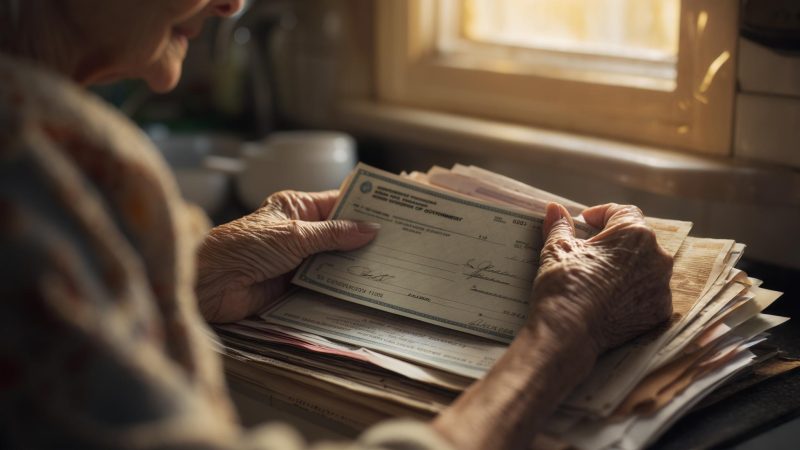
The kitchen table at Patricia Novak’s house in Pittsburgh’s South Hills neighborhood is covered in an organized chaos of papers — utility bills, Medicare statements, a grocery circular with items circled in red pen. When I sat down with her on a gray Tuesday morning in late March 2026, she poured coffee without asking and immediately apologized that she only had store-brand creamer. It was the kind of small, telling detail that said everything about how carefully she manages every dollar.
Patricia is 65 years old. She retired in 2019 after 32 years with the United States Postal Service, earning a modest federal pension she worked her entire career to secure. By any measure, she did everything right. But three years ago, her husband, Gerald, died of a heart attack at 71 — and with him went the $1,340 per month in Social Security income that had made their retirement feel, if not comfortable, at least stable.
The Math That Doesn’t Add Up
Patricia’s monthly income today comes from two sources: her USPS federal pension, which pays approximately $1,180 per month after deductions, and her own Social Security benefit of roughly $640 per month. That’s a combined $1,820 — before Medicare Part B premiums, which are automatically deducted from her Social Security payment and currently run $185 per month for 2026, according to Medicare.gov.
After that deduction, she effectively takes home around $1,635 a month. Her mortgage, which she’s carried on the 1960s-era house since long before Gerald died, runs $712 per month. Utilities in a Pittsburgh winter can top $280. That leaves roughly $640 for everything else — food, prescriptions, car insurance, and the growing list of home repairs she can’t afford to ignore.
“Gerald handled a lot of the finances,” Patricia told me, her voice measured and careful. “When he passed, I had to learn very fast what everything actually cost. And that was — that was a shock, I’ll tell you.”
The roof has been leaking around one of the chimney joints since 2024. A local contractor quoted her $11,500 to repair it properly. The furnace, installed in 2003, failed a tune-up inspection last fall. Her savings, she explained, are deliberately untouched — set aside specifically for medical emergencies that she knows, statistically, are coming.
What She Found When She Finally Started Looking
Patricia is the kind of person who considers asking for help a last resort. Her three adult children live within an hour of Pittsburgh, and by her own description, “they’d drop everything” if she called. She hasn’t called. What she has done, quietly and methodically, is research every government assistance program she qualifies for — on her own, using her local library’s computer when her internet connection feels too slow.
Her first significant discovery was Pennsylvania’s Property Tax/Rent Rebate Program. As a homeowner over 65 with an annual income under $35,000, Patricia qualified for a rebate of up to $1,000 on her property taxes, according to the Pennsylvania Department of Revenue. She filed her first application in 2023, the year after Gerald died, and received $850 back — money she used to cover a car repair she otherwise couldn’t have managed.
She also applied for the Low Income Home Energy Assistance Program, known as LIHEAP. The federal program, administered through states and detailed further by the U.S. Department of Health and Human Services, helped offset her heating bills during the winters of 2024 and 2025. In her case, the benefit covered approximately $480 of her heating costs over one season — not enough to solve the furnace problem, but enough to make the math work for a few months.
The Survivor Benefit She Almost Left on the Table
This is where Patricia’s story takes a turn that surprised even her. When I asked whether she had looked into Social Security survivor benefits after Gerald’s death, she paused for a long moment.
“I went to the SSA office about three months after he passed,” she said. “They told me that because my own Social Security benefit was higher than what I’d receive as a survivor on Gerald’s record, I didn’t qualify for an additional payment. I just — I accepted that and left.”
What she didn’t know at the time — and what she learned only recently from a Benefits Enrollment Center volunteer at her local Area Agency on Aging — was that this calculation can shift. Because Patricia claimed her own Social Security at 62, before her full retirement age, her benefit was permanently reduced. Gerald, who had worked in private-sector manufacturing for 28 years, had a higher earnings record. Depending on the specific figures, she may have been eligible for a survivor benefit switch that could have increased her monthly income.
She filed a new inquiry with the Social Security Administration in January 2026. As of our conversation in late March, she was still waiting for a formal determination. The outcome remains uncertain, and she is careful not to count on anything. But the possibility of even a modest monthly increase — she estimated it could be anywhere from $80 to $200 based on what the volunteer helped her calculate — has given her something she hadn’t had in a while: a concrete reason to hope.
A Roof, a Furnace, and the Limits of Relief Programs
The harder reality is that none of the programs Patricia has accessed — not the property tax rebate, not LIHEAP, not any potential Social Security adjustment — will fix her roof or replace her furnace. She knows this, and she says it without self-pity, in the same flat, practical tone she uses to describe her coupon strategy.
I asked her what she thought the biggest gap was — between what programs exist and what people in her situation actually need. She didn’t hesitate.
It’s a structural tension that affects millions of older Americans. According to the Administration for Community Living, more than 14 million adults over 65 live below or near the poverty line — a figure that doesn’t fully capture the vast number of seniors, like Patricia, who exceed official thresholds by a small margin but still face genuine material hardship.
For now, she has a plan — of sorts. She’s prioritizing the furnace over the roof because a furnace failure in a Pittsburgh winter is an emergency, and a slow roof leak, while serious, is survivable. She’s spoken to a local nonprofit that offers weatherization services and is on a waiting list. She’s applied for the property tax rebate again for 2025. And she is waiting on that SSA letter.
What Staying Independent Actually Costs
Before I left, Patricia walked me through the house briefly — showing me the water stain on the living room ceiling from the roof leak, the furnace in the basement with its hand-written maintenance notes taped to the side in Gerald’s handwriting. She hadn’t removed them.
She told me she thinks about selling the house sometimes. A smaller apartment would eliminate the repair burden, the yard work, the anxiety of owning something old and fragile on a fixed income. But the house is also the last place that still feels like the life she and Gerald built together. That calculation, she said, isn’t really about money.
Patricia Novak did everything she was supposed to do. She worked three decades for a federal agency, paid into every system, and planned carefully. The story she’s living now isn’t about failure — it’s about the distance between what a modest retirement income was designed to cover and what it actually costs to stay housed, healthy, and whole in 2026.
When I drove away from South Hills that Tuesday, I kept thinking about those grocery circulars spread across her kitchen table — the careful red circles around sale items, the quiet discipline of a woman who refuses to be defeated by arithmetic. It’s not a triumphant ending. But it’s not a surrender, either.
Related: Claiming Social Security at 62 Feels Smart Until You See What It Actually Costs You Over 20 Years



Leave a Reply