
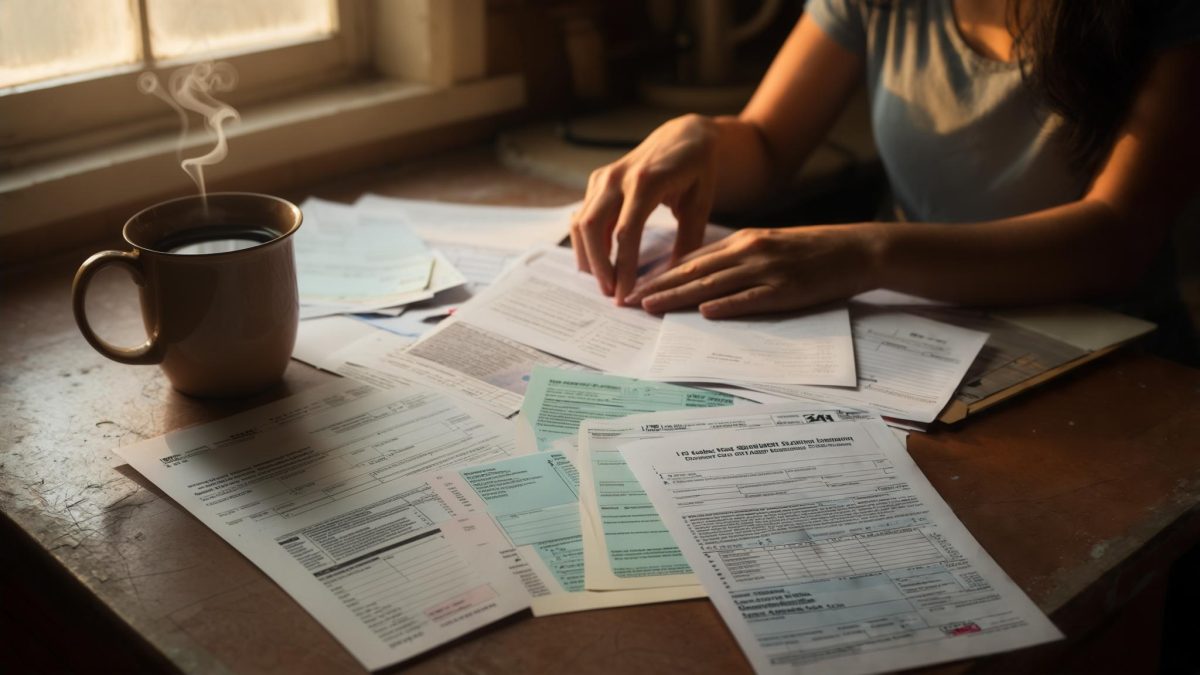
The first time I heard Lorraine Trujillo’s name, I was sitting across from a branch manager at a Tampa-area credit union who had spent the better part of an hour telling me about the clients she quietly worries about most. She described a woman who had come in on a Tuesday morning in January 2026, not to open an account or apply for a loan, but simply to ask whether there was anything — anything at all — that might help her avoid losing her home to a property tax lien. “She wasn’t panicking,” the manager told me. “That was the part that got me. She was just tired.”
I reached out to Lorraine the following week. She agreed to meet me at a diner near her home in Tampa’s Seminole Heights neighborhood, arriving in her security guard uniform after finishing an overnight shift. Her nine-year-old daughter was in school. Her ex-husband had not contributed financially in over two years. She ordered coffee and said, almost by way of introduction: “I have a master’s degree and I’m scared I’m going to lose my house. Make that make sense.”
A Degree That Cost More Than It Returned
Lorraine earned a Master of Public Administration from a Florida state university in 2017, borrowing heavily to finish what she had started in her late thirties. The plan made sense at the time — she had been working in nonprofit management and believed the credential would push her into a director-level role. Instead, the nonprofit folded in 2019. She pivoted to security work to keep income coming in while her daughter was still a toddler, intending it to be temporary.
Temporary became permanent. By early 2026, Lorraine was earning approximately $31,400 a year working for a private security contractor, a figure that put her above the poverty line but well below the financial stability she had envisioned. Her federal student loan balance sat at $67,200 — a number she told me she had stopped checking regularly because “it doesn’t go down no matter what I do.”
Her graduate loans were enrolled in an income-driven repayment plan, which had reduced her monthly payment to $187. That number sounds manageable in isolation. But Lorraine walked me through her monthly budget on a napkin, and the math left almost no margin. Rent for her three-bedroom house — she owns it, the mortgage is in her name alone — runs $1,240 after principal and interest. Utilities, groceries, her daughter’s after-school care, car insurance, and minimum debt payments consumed the rest.
The Business She Built and Watched Shrink
For three years after the nonprofit closed, Lorraine ran a small event coordination side business — mostly corporate luncheons, small fundraisers, and church anniversary celebrations — that supplemented her security income meaningfully. In 2022, she brought in roughly $19,000 from that work. As she explained it to me, corporate clients began cutting discretionary event budgets in 2023 and the bookings simply dried up.
By 2025, the business generated approximately $5,500 — not enough to be worth the time she was spending on it, but enough that she kept the LLC active, still hoping for a turnaround. “I kept renewing the registration because I thought, maybe next quarter,” she told me. “That was the optimism getting me in trouble. Every quarter I paid those fees instead of putting it toward the taxes.”
The property tax delinquency accumulated quietly. Hillsborough County’s property tax portal shows that homeowners who miss payments begin accruing interest at 18 percent annually under Florida statute, and after two years of nonpayment, the tax certificate can be sold to a third-party investor — a process that eventually can lead to a tax deed auction. Lorraine had missed partial payments across 2023 and 2024, and by the time she walked into that credit union in January 2026, she owed $4,200 in back taxes, interest, and fees.
What She Found When She Started Asking
Lorraine told me she had avoided asking for help for years out of what she called a “stupid pride thing” — a phrase she used twice, as though she needed to say it twice to believe it herself. The credit union manager referred her to a HUD-approved housing counselor, and she also connected with a volunteer tax assistance coordinator through a local community action agency.
Through those conversations, she learned several things she had not known. First, she may qualify for Florida’s Homestead Exemption property tax discount — which she had never applied for, believing homestead exemptions were only for older retirees. The Florida Department of Revenue notes that the standard homestead exemption can reduce assessed property value by up to $50,000 for qualifying primary residence owners, which could meaningfully lower her future tax bills. She was already a qualifying homeowner — she had simply never filed the paperwork.
The EITC finding stung. A volunteer tax preparer reviewing her 2023 return noticed she had filed as single but had not correctly claimed her daughter as a qualifying child for the full credit. The difference was approximately $680 — not life-changing, but enough to matter. She filed an amended return in February 2026 and was waiting on the adjustment when we spoke.
The Outcome — And What Still Isn’t Resolved
When I followed up with Lorraine by phone in mid-March 2026, she had made concrete progress on some fronts and was still waiting on others. She had filed for the Florida Homestead Exemption, which would not reduce her current delinquent balance but would lower her assessed value going forward. She had also entered a six-month installment agreement with the Hillsborough County Tax Collector, making a $700 down payment toward the $4,200 owed, with five remaining payments of roughly $500.
The amended EITC return had not yet been processed. The student loan balance remained unchanged — her income-driven plan keeps her current, but the $67,200 principal is not shrinking at her current payment level, and she told me she had given up expecting the federal loan forgiveness landscape to produce anything concrete for her specifically. “I stopped holding my breath on that one,” she said flatly.
What had changed, she told me, was less about the numbers and more about the posture. She now has a housing counselor she can call. She knows what forms exist. She knows the county has a tax payment plan and that the IRS has free filing assistance through the Volunteer Income Tax Assistance program. That knowledge costs nothing and could have saved her hundreds of dollars over multiple tax years. “I just didn’t know any of this existed,” she told me. “That’s what makes me angry. Not at the programs — at the fact that nobody tells you until you’re already behind.”
What Lorraine’s Story Reveals About the Gap in Economic Relief
Reporting on Lorraine’s situation, I kept returning to the same observation: nearly every relief mechanism she eventually found had existed for years. The homestead exemption, the EITC, the county installment plan, the VITA program — these were not new. The gap was not in the programs themselves but in the connective tissue between struggling households and the systems designed to help them.
For low-income earners who are not in poverty — who earn just enough to disqualify from some assistance programs but not enough to absorb financial shocks — that gap can persist for years. Lorraine fell behind on property taxes not because she was irresponsible but because the accumulation of small missed opportunities compounded quietly until the total was large enough to threaten her home.
When I left that diner after our first conversation, Lorraine was already on her phone checking her daughter’s school pickup schedule. She had three more hours before she needed to be there. She told me she was going to use them to sleep. There was no dramatic resolution to report — no sudden windfall, no forgiveness letter in the mail. Just a woman who had finally found a few of the right doors, still working to open them one at a time.
That, perhaps more than any specific dollar figure, is what Lorraine Trujillo’s story leaves with me. The relief exists. The access to it does not always follow.
Related: My Workers’ Comp Claim Was Denied — Now a Debt Collector Is Taking 25% of My Freelance Income
Related: He Was 57, Behind on Property Taxes, and Counting on a Refund the IRS Held for 11 Weeks



Leave a Reply