
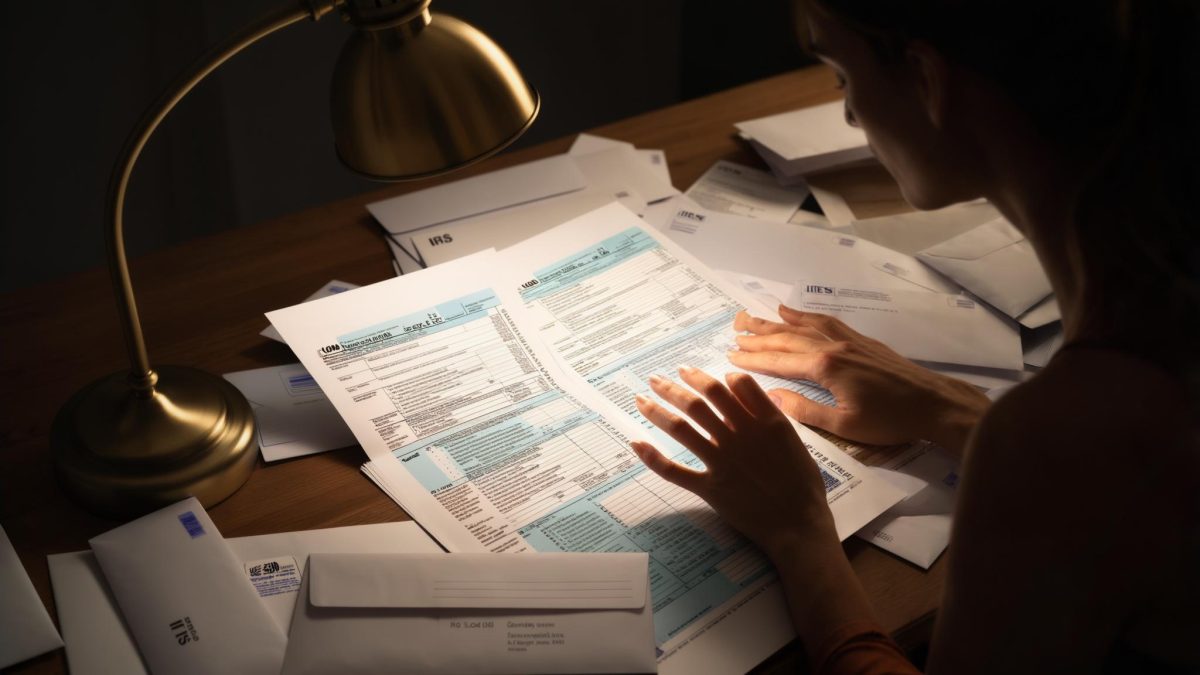
The conventional wisdom about economic relief programs is that they reach the people who need them most. After spending time with working middle-income families across the South, I’ve found that’s rarely true. The people who qualify for the most meaningful tax credits are often the last to know they qualify at all.
I met Bonnie Ramos on a warm Saturday evening in late February 2026, at a block party two streets over from my own neighborhood in Jacksonville. A mutual neighbor, Darlene Hutchins, pulled me aside and said, “You should really talk to Bonnie — she’s been through it this year with taxes and her loans.” Bonnie was standing near the folding tables, laughing at something her husband Marcus had said, holding a paper plate. She agreed to sit down with me the following Tuesday at a Panera Bread off Beach Boulevard.
A Single Income Stretched Across Five People
When I sat down with Bonnie Ramos, the first thing she told me was that she hadn’t opened a bank statement — paper or digital — since September 2025. “I just couldn’t look,” she said, wrapping both hands around her coffee cup. “Every time I opened one, I’d find something that made me feel like I was doing everything wrong.”
Bonnie is 58, a senior package delivery driver for UPS who has been on the same Jacksonville route for twelve years. Her annual salary sits at approximately $67,500. Her husband Marcus, 56, stopped working full-time in 2022 to care for their youngest child and manage the household after their middle daughter was diagnosed with a learning disability requiring specialized tutoring. Their three kids — ages 14, 17, and 22 — meant that childcare and education costs never fully disappeared.
The student loans came from a Master’s degree in Social Work that Bonnie completed at the University of North Florida in 2014. She earned the degree while working part-time, believing it would open new career doors. It didn’t — at least not the ones she expected. She ended up staying at UPS, where the pay and benefits were more reliable than entry-level social work positions. By January 2026, she still owed $47,200, making monthly payments of $383.
“I got the degree because I wanted to do something more,” she told me, and there was no bitterness in her voice, only a kind of tired clarity. “But the math just never worked out to leave. Marcus was home, the kids needed things, and UPS was the sure thing.”
When the Stimulus Talk Started, Bonnie Tuned It Out
By early 2026, social media was saturated with posts and short videos about tariff-related stimulus payments. Clips circulating on platforms like Facebook claimed that relief checks tied to new tariff policy were imminent — a claim that spread faster than any official government confirmation. Bonnie had seen the videos. She ignored them.
Her skepticism wasn’t unfounded. Reports from outlets including WGN Radio noted that while the Trump administration projected “very large refunds” for taxpayers in 2026, the reality for many working households was more complicated — withholding changes and shifting deduction rules meant refunds varied widely, and some filers were in for a surprise in the wrong direction.
Bonnie had filed her own taxes every year using a free online service. She never paid a preparer, never visited a tax office. Her returns had been straightforward: wages from UPS, standard deduction, done. What she didn’t know was that her situation had quietly become more complex — and more potentially valuable — than she realized.
The Night She Finally Looked
The turning point came on a Thursday night in early March 2026. Marcus had found a YouTube video explaining the Child and Dependent Care Credit — specifically how families paying for after-school programs and specialized care for children with learning disabilities might qualify for a credit they’d been overlooking. He left a sticky note on the kitchen counter: “Watch this before you file.”
Bonnie told me she almost threw the note away. “I thought it was going to be one of those things where you watch it and find out you don’t qualify for anything,” she said. “That’s usually how it goes.”
Instead, she sat at the kitchen table with her laptop and went through her 2025 expenses more carefully than she had in years. She tallied $13,800 in qualifying dependent care expenses for her 14-year-old’s after-school program and specialized tutoring. She documented her student loan interest payments — $2,190 paid in calendar year 2025. And for the first time, she cross-referenced her actual withholding against what she likely owed.
When she submitted her return through the IRS Free File program on a Sunday night in March, the refund estimate loaded on screen: $2,340. She had expected, at best, $500.
The Relief — and the Regret — That Came With It
Bonnie got her refund deposited directly to her checking account seventeen days after filing. She used $1,800 of it to make a lump-sum payment toward her student loan principal, bringing her balance below $45,500 for the first time. The remaining $540 went toward replacing a tire on the family’s 2018 Honda Pilot that had been dangerously worn for two months.
But the conversation at the Panera table didn’t stay celebratory for long. When I asked Bonnie what she wished had been different, she paused for a long time before answering. “I think about the last four or five years,” she said. “If I had actually paid attention — looked at my withholding, looked at what credits I qualified for — that money was there. I just didn’t go looking for it.”
She estimated — conservatively — that she had left somewhere between $6,000 and $9,000 on the table over the previous four tax years by filing without fully accounting for her dependent care expenses or correcting her withholding. That number sat between us for a moment before she shook her head and moved on.
The student loans, she acknowledged, remained the heaviest weight. At her current payment pace, she would be 65 before the balance reached zero — and that assumed no changes to income, no emergencies, and no missed payments. “People don’t think about a 58-year-old still paying off graduate school,” she told me. “But here I am.”
What Bonnie’s Story Actually Tells Us
After I left the Panera that afternoon, I kept thinking about the gap between what relief programs exist on paper and what working families actually capture. Bonnie wasn’t uninformed or careless. She worked twelve-hour days, came home to a household with real needs, and managed her anxiety the only way she knew how — by not looking at the thing causing the anxiety.
The 2026 tax season brought a lot of noise. Social media was loud with claims about tariff-linked stimulus payments and projections of record refunds, and as WGN Radio reported, many filers found their actual refunds fell short of the administration’s optimistic framing. For Bonnie, the opposite happened — but only because Marcus left that sticky note on the counter.
That’s a thin margin. One sticky note separating a $500 refund from a $2,340 refund. Years of available credits sitting unclaimed because the anxiety of looking felt worse than the certainty of not knowing.
When I asked what she would do differently next year, Bonnie said she had already updated her W-4 at UPS, had scheduled a free appointment with a VITA (Volunteer Income Tax Assistance) site for January 2027, and had finally started opening her monthly bank statements. “Not every day,” she added with a laugh. “But I’m not six months behind anymore.”
The student loans will still be there. The childcare costs won’t disappear until her youngest ages out of eligibility. But Bonnie Ramos is, for the first time in years, looking at the numbers rather than away from them. For a household running on one income and $47,000 in debt, that shift — small as it sounds — is not nothing.




Leave a Reply