
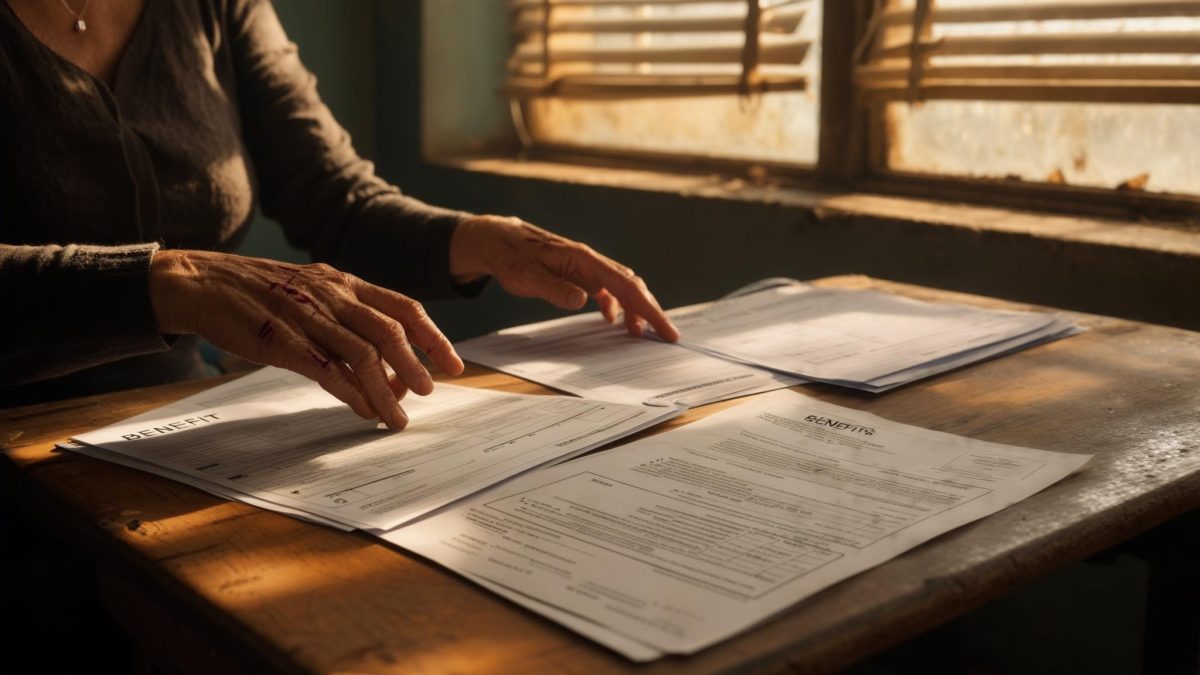
The folding table near the back of the Columbus Metropolitan Library’s meeting room was almost empty by 7 p.m. on a Tuesday in late February 2026. Most attendees had already collected their Medicare Part D brochures and left. That’s when Curtis Jennings approached me, still wearing his school lanyard, a thin stack of denial letters folded into his coat pocket.
I had been covering Medicare open enrollment outreach events for American Relief when Curtis introduced himself. He wasn’t there about Medicare. He was there, he told me quietly, because a librarian had mentioned the event might draw people who knew about government assistance programs — and he was running out of options.
A Classroom Injury That Changed Everything
Curtis Jennings, 55, has taught high school mathematics in the Columbus City Schools district for nearly 14 years. He and his wife, Patricia, are the primary caregivers for their teenage son, who has a developmental disability requiring full-time support. On a teacher’s salary of approximately $48,200 a year, the family has always lived carefully — but they managed.
That changed on September 11, 2025, when Curtis slipped on a wet floor near the gymnasium entrance during a fire drill. He landed hard on his lower back and left hip. The school nurse documented the fall the same day, and Curtis filed a workers’ compensation claim with the Ohio Bureau of Workers’ Compensation within 72 hours, exactly as the district’s HR office instructed.
Two months later, in November 2025, he received a denial notice. The claim was rejected on the grounds that his pre-existing lumbar disc condition was listed as the primary cause of his pain — not the fall itself. Curtis told me he stared at the letter for a long time before setting it on the kitchen table.
The Financial Pressure Behind the Denial
The denial wasn’t just a bureaucratic setback. Curtis missed 11 days of school during initial treatment and physical therapy, burning through his sick leave. Without workers’ comp covering his medical bills, approximately $3,200 in out-of-pocket costs landed on the family’s credit card between October and December 2025.
At the same time, the family’s home — a 1978 ranch-style house on the east side of Columbus — needed a roof replacement that three contractors had quoted between $8,100 and $9,400. A slow leak in the master bedroom had worsened through the fall rains. Curtis had been placing a plastic storage bin under the stain in the ceiling for months.
Patricia works part-time at a pharmacy, bringing in roughly $14,000 a year. Their son’s care coordination services, partially covered through Ohio’s Ohio Medicaid waiver program, require consistent family co-management. Taking on a second job wasn’t realistic for Curtis while still recovering from the injury — and pride kept him from asking family for help.
“My father worked his whole life without asking anyone for anything,” Curtis told me. “I know that’s probably not the smartest way to think about it. But it’s just how I’m wired.”
What the Library Event Actually Uncovered
Curtis hadn’t come to the library event with a checklist. He came because he’d overheard a colleague mention that someone at a similar event had gotten help filing an appeal for a denied benefits claim. He figured it was a long shot.
After we spoke for about 20 minutes, I connected Curtis with one of the benefits counselors present — a volunteer from the Ohio State Legal Services Association who was staffing a table nearby. What followed was a two-hour conversation that surfaced several programs Curtis hadn’t known were available to him.
Curtis told me he hadn’t known most of these programs existed. He’d assumed, as many people in similar situations do, that public assistance was for people with no income at all — not for working families caught in a gap.
The Appeal and What Came After
Curtis filed his workers’ comp appeal on February 26, 2026 — four days before his deadline. The Ohio Industrial Commission scheduled a hearing for late April 2026. As of the date of publication, that hearing has not yet occurred, and the outcome remains uncertain.
The CHIP home repair application was submitted in early March. Processing times for that program average 60 to 90 days, according to the Ohio Development Services Agency. Curtis is waiting.
What did change immediately was the HEAP enrollment. Curtis qualified and received a $740 credit applied directly to his gas bill — a modest but real reduction in monthly pressure. His son’s Medicaid waiver review was scheduled for mid-April, with a caseworker reaching out within two weeks of the library event.
The workers’ comp appeal is the piece Curtis thinks about most. The medical costs remain on the credit card. If the appeal succeeds, he may recover some of those costs. If it fails, he’ll have to decide whether to pursue further legal options — something he acknowledged he can’t easily afford.
What Curtis’s Story Reflects About Working Families and the Benefits Gap
Curtis Jennings is not, by any conventional measure, a person the public usually associates with economic relief programs. He has a stable job, a pension he’s been contributing to for over a decade, and a mortgage he’s paid on time. But a single denied claim, a leaking roof, and a child with high-needs care requirements put a family like his on the edge faster than most people outside that situation would expect.
According to the U.S. Bureau of Labor Statistics, workers in educational services reported roughly 69,000 injury cases requiring days away from work in a recent annual survey — a figure that doesn’t capture the broader financial fallout when those claims are denied or delayed.
What struck me about Curtis wasn’t desperation. It was the specific, quiet pride of someone who had done everything right — filed on time, kept documentation, followed instructions — and still ended up sitting in a library at 7 p.m. on a Tuesday, hoping a stranger could point him somewhere useful.
As I packed up my recorder that night, Curtis folded his copy of the appeal instructions into his coat pocket — right next to where the denial letter had been. He thanked me twice on the way out, then caught himself and said he wasn’t used to that. I believed him.
The roof still leaks. The appeal is still pending. But the plastic storage bin under the bedroom stain, he told me, now feels a little less permanent than it did last month. For Curtis Jennings, that’s something.




Leave a Reply