
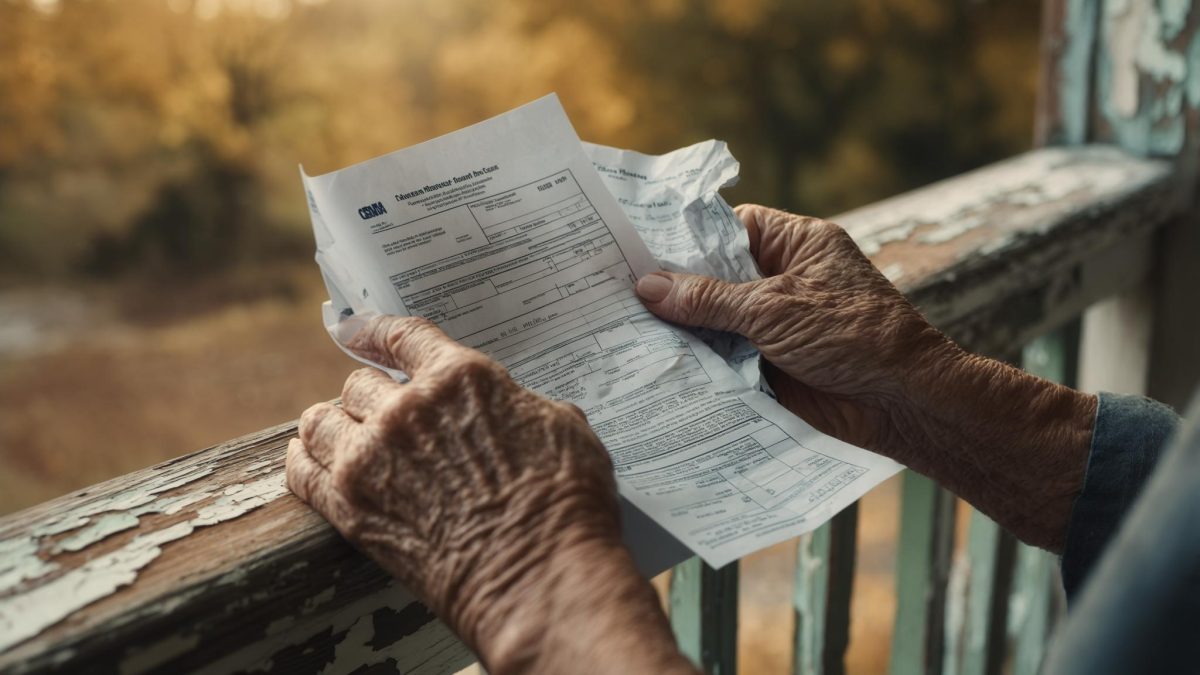
The financial safety net built for low-income Americans is often described as a last resort — but no one warns you that a single act of generosity can knock the ladder right out from under you. That’s the part of the story that rarely makes it into policy briefings or benefit pamphlets.
I first heard about Lester Jennings from a social worker named Diane at the Maricopa County Community Services office in central Phoenix. She had spent twenty minutes with him in early February 2026 and quietly told me afterward: “That’s someone you need to talk to.” She was right.
When I sat down with Lester Jennings at a diner on McDowell Road on a Thursday afternoon in late February, he arrived in his bank teller uniform — pressed collar, lanyard still around his neck. He had come straight from a shift. He ordered coffee, no food, and spent the first few minutes making clear that he was not someone who liked talking about his finances. “I’ve never asked my family for a dime,” he told me. “I’m not built that way.” He is 42. His daughter, Camille, is two years old. Her mother has not been involved since Camille was four months old.
A House That Was Falling Apart, Room by Room
The house Lester rents in a west Phoenix neighborhood started showing problems in the summer of 2025. First the HVAC unit began cycling irregularly. By August, it had failed entirely. Phoenix summers average well above 105 degrees Fahrenheit, and Lester spent three weeks running box fans and keeping Camille in the coolest corner of the house while he tried to figure out how to cover the repair estimate: $4,200 for a replacement unit.
Then, in November, water started coming through the ceiling of the second bedroom — the room Camille slept in. A roofing contractor gave him an estimate of $4,100 to patch and seal the damaged section. Combined with the HVAC replacement, he was looking at more than $8,000 in urgent home repairs on a gross annual income of roughly $34,000.
“I looked at my savings and I had maybe $600 after rent and daycare,” Lester told me, stirring his coffee without drinking it. “Six hundred dollars. I’m a bank teller. I literally count other people’s money for a living and I couldn’t cover a roof patch.”
He found out about Maricopa County’s emergency home repair program through a flyer posted inside the community center near his neighborhood. The program, administered through federal Community Development Block Grant funds, offers income-qualified homeowners and renters assistance for urgent health-and-safety repairs. Lester met the income threshold. He gathered the documents, took a half-day off work to submit the application in person, and waited.
The Cosigned Loan That Came Back to Haunt Him
In 2022, Lester’s childhood friend Marcus needed a personal loan to cover moving expenses and first month’s rent after a divorce. Marcus had poor credit. Lester, with a cleaner financial history, agreed to cosign a $14,500 personal loan through a private lender. “He was my friend since eighth grade,” Lester said. “I didn’t think twice about it.”
Marcus made payments for about fourteen months. Then, in March 2024, he stopped. By June 2024, the account was formally in default. The lender reported the delinquency under both names — Marcus’s and Lester’s. Lester said he didn’t find out until he received a collection notice at his home address in July 2024. By then, the damage to his credit profile was already logged.
When the county assistance office reviewed Lester’s application in December 2025, a caseworker flagged the delinquent cosigned account. Certain federally-administered repair programs cross-reference credit and debt records to assess financial stability. According to HUD’s CDBG program guidelines, eligibility decisions can involve broader financial assessments depending on how individual jurisdictions administer the funds. The flag didn’t automatically disqualify Lester — but it did pause his application and require additional documentation and review, delaying any potential disbursement by roughly eleven weeks.
Eleven Weeks of Waiting With a Leaking Ceiling
From December 2025 through mid-February 2026, Lester described an eleven-week stretch of what he called “quiet panic.” He had moved Camille’s crib into his bedroom after the roof leak worsened. He placed a plastic storage bin under the drip point and emptied it every couple of days. He bought a space heater. He kept working his shifts at the bank, where he said the irony of handling wire transfers and loan applications was not lost on him.
“I didn’t tell anyone,” he said. “Not my coworkers, not my mom. My mom is 67 and she’d worry herself sick. I just — I kept it inside and kept showing up.” That quiet pride, the social worker Diane had told me, was both Lester’s greatest strength and the thing that almost kept him from getting help at all.
During the waiting period, Lester submitted a formal written explanation of the cosigned loan — documenting that he was not the primary borrower, attaching the original loan paperwork, and providing a letter from the lender confirming Marcus’s identity as the borrower of record. He also submitted his last three pay stubs, two years of tax returns, and Camille’s birth certificate. The packet was 47 pages.
The Outcome — Partial, Complicated, Real
In mid-February 2026, Lester received a letter from the county program. His application had been approved — but only partially. He was approved for $4,100 to cover the roof repair, which the caseworker classified as an immediate health-and-safety issue given the presence of a minor in the home. The HVAC replacement request, totaling $4,200, was placed on a secondary waitlist pending available program funding.
“I cried in my car,” Lester told me. “I’m not ashamed of that. Four thousand dollars I didn’t have to find. Camille’s ceiling was going to get fixed.” He paused. “But I still don’t have air conditioning going into summer. So I’m not popping champagne.”
The cosigned loan itself remains unresolved. Lester told me he consulted a free legal aid clinic in January 2026 — he found them through a referral from the same county social services office — and was told he may have grounds to pursue Marcus in small claims court for the credit damage and any payments Lester might eventually be compelled to make. He has not yet filed. “Marcus has a kid too,” he said quietly. “I’m not sure I want to go down that road.”
He also learned, through that same legal aid appointment, that he may be eligible for Arizona’s Low Income Home Energy Assistance Program (LIHEAP) weatherization services, which can in some cases include HVAC-related work. According to the Arizona Department of Economic Security, LIHEAP weatherization assistance is available to qualifying households based on income and energy burden. Lester said he had submitted a preliminary inquiry but had not yet received a determination as of our conversation.
What Lester’s Story Reveals About the Relief System
Lester’s situation is not an edge case. According to the Consumer Financial Protection Bureau, cosigning a loan places full legal repayment liability on the cosigner — meaning a default by the primary borrower is reported identically to a default by the cosigner themselves. Most people who cosign do so without understanding that distinction, and the consequences can surface in unexpected places: rental applications, job screenings, and — as Lester discovered — government assistance eligibility reviews.
What struck me about Lester wasn’t his frustration. It was his precision. He described every dollar amount, every date, every document in the stack he submitted with the flat, organized recall of someone who had rehearsed it not to impress anyone, but because he’d had to hold it all in his head for months with no one else to share the weight. “I can’t afford to forget anything,” he said. “There’s no one else tracking this stuff.”
When I left the diner, Lester was finishing his coffee and pulling up the LIHEAP portal on his phone to check the status of his inquiry. Phoenix summer arrives early, and Camille would be turning three in May. He had eleven weeks, give or take, before the temperature in that house without a working HVAC unit would become the kind of number nobody should have to manage with a toddler and a storage bin.
He wasn’t asking for sympathy. He was asking the system to process his paperwork. There is a difference, and Lester Jennings understands it better than most.


Leave a Reply