

Have you ever looked at a pay stub that was bigger than anything you’d seen before — and still felt like you were drowning?
I met Phil Becerra on a Tuesday afternoon in February at a Kroger off Nolensville Pike in Nashville. He was standing in the meat aisle, holding two packages of chicken thighs and doing quiet arithmetic in his head. I’d been there myself enough times that I recognized the look. We struck up a conversation — I mentioned what I covered for a living, he laughed without much humor, and forty minutes later we were sitting in the café section of that same store, and he was telling me everything.
Phil is 50 years old, a machine operator at a manufacturing facility in the Antioch area, and he has spent the better part of his adult life doing everything right by modest standards. He shows up. He doesn’t quit. He takes overtime when it’s offered. In June 2024, after six years at the same plant, that consistency finally paid off — his hourly rate went from $18 to $22, pushing his gross annual income from roughly $37,400 to approximately $45,700.
By December 2024, he had less in savings than he’d had the previous December. By February 2026, when I met him in that grocery store, he was staring down a $5,200 repair bill and trying to figure out if a federal tax credit could save him from a third credit card.
When a Raise Becomes a Trap
The raise felt transformative at first. Phil told me he remembered the specific moment he opened that pay stub and saw the new number. “I called my fiancée — she’s finishing her nursing degree right now — and I said, ‘We made it. We actually made it.’ I genuinely believed that.” His fiancée, Dani, is in her final year of school, which means Phil is functionally the household’s only income until she graduates in December 2026.
What followed was a pattern that personal finance researchers have documented for decades but that feels abstract until you’re living it. Phil upgraded his truck — a 2021 Chevy Colorado he’d been eyeing — adding a $447 monthly payment. He and Dani moved into a slightly better apartment closer to her campus, adding $215 a month in rent. They started eating out more, got a streaming bundle, replaced a broken laptop.
None of it was reckless. Every individual decision made sense. Together, those decisions absorbed nearly $900 of the roughly $1,100 his take-home had increased. Then, in October 2024, the HVAC system in the small house he’d purchased in 2022 — a 1,100-square-foot ranch in Antioch — gave out entirely.
Three contractors quoted between $4,800 and $5,700 for a full heat pump replacement. Phil put $1,200 on a credit card he’d almost paid off, pulled $600 from a savings account he’d been building since 2023, and financed the rest through the HVAC company at 18.9% interest. “I told myself it was fine. I told myself I’d pay it off in six months. That was October,” he said, trailing off.
The Tax Credit He Almost Missed Entirely
Phil didn’t know about the Energy Efficient Home Improvement Credit — known under the tax code as Section 25C — until a coworker mentioned it at lunch in January 2025. The credit, expanded under the Inflation Reduction Act of 2022, allows homeowners to claim up to 30 percent of the cost of qualifying improvements, including heat pump installations, up to $2,000 per year specifically for heat pumps and heat pump water heaters, according to the IRS Energy Efficient Home Improvement Credit page.
When I asked Phil what his reaction was when he first heard about it, he paused before answering. “I thought my buddy was making things up. Like, why would the government give you money for buying a heat pump? I’ve been paying taxes for 30 years and nobody ever told me that was a thing.”
Phil spent two evenings in January 2025 trying to figure out whether his specific installation qualified. The heat pump his HVAC contractor installed had to meet certain efficiency standards — specifically, it needed to be on the ENERGY STAR certified products list to be eligible. Phil called the contractor and, after being transferred twice, confirmed the model installed was ENERGY STAR certified. That single phone call opened a door worth up to $2,000 on his federal return.
Filing Season 2025: What Phil Actually Got Back
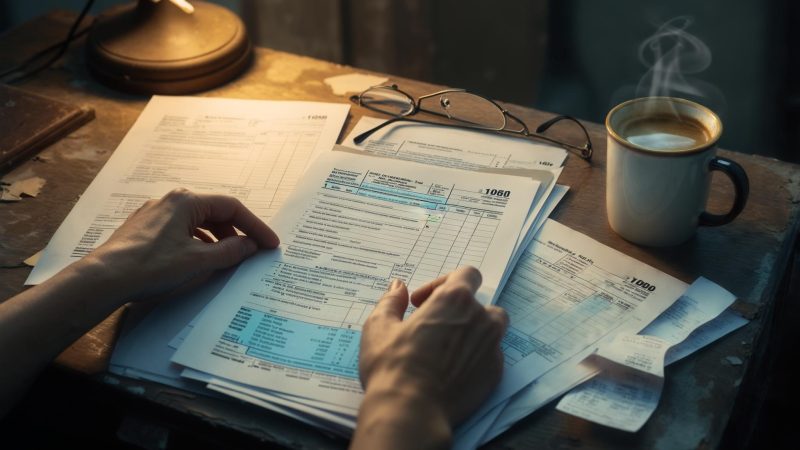
Phil filed his 2024 taxes in late February 2025 using a paid tax preparer he found through a colleague — someone who charged $180 for a full return. He brought the contractor invoice, the ENERGY STAR certification documentation, and his W-2. He also, for the first time, learned he’d been eligible for the Earned Income Tax Credit for workers without qualifying children, a benefit that in 2024 topped out at $632 for single filers and eligible joint filers without children, according to IRS EITC tables.
His final federal refund came to approximately $2,340. That included the $2,000 heat pump credit, a partial EITC claim, and standard withholding adjustments. It was not the full $5,200 repair bill. It was not a clean resolution.
Phil used $1,800 of his refund to pay down the HVAC financing balance and reduce his interest exposure. The remaining $540 went toward a roof inspection that had been delayed since summer 2024. The inspection found three sections of flashing that needed replacement — another $900 job he hasn’t yet scheduled.
The Longer Road: What Phil Is Still Navigating
When I asked Phil whether the tax credit had fixed things, he gave me an honest answer that I suspect a lot of people in his position would recognize. “It helped. It really did. But I’m not going to sit here and tell you I’m on solid ground. The truck payment is still there. The roof still needs more work. Dani’s got eight more months of school.” He paused. “I’m not panicking. But I’m not comfortable either.”
Phil told me he’s already gathering documentation for his 2025 taxes — specifically, he wants to be ready to claim the EITC again, and he’s looking into whether any roof repair materials might qualify under the same Section 25C credit for insulation or air-sealing improvements, which carry a separate $1,200 annual cap.
What struck me about that list — which Phil and I pieced together over a second cup of coffee — is how little of it he’d known about before a random conversation at work. He’d never heard of LIHEAP, the Low Income Home Energy Assistance Program administered through the U.S. Department of Health and Human Services, which provides heating and cooling assistance to qualifying low-income households. He wasn’t sure whether his income level would disqualify him. As of our conversation, he hadn’t applied.
What Phil’s Story Says About the Gap Between Earning More and Feeling Secure
After we finished our coffee, Phil walked me to his truck in the parking lot — the Chevy Colorado, clean, relatively new, the one purchase he mentioned with a specific kind of ambivalence. “I’m not ashamed of the truck. I earned it. I just didn’t think it all the way through,” he said.
That line has stayed with me. Phil Becerra is not someone who made catastrophic decisions. He didn’t gamble, didn’t take on a mortgage he couldn’t afford in a vacuum, didn’t run up consumer debt on things that evaporated. He got a raise, responded to it like most people would, and then got hit by the kind of durable-goods failure that no raise anticipates. The system that might have softened that blow — federal energy credits, income-based assistance programs — existed the entire time. He just didn’t know it.
Phil told me he’s planning to look into LIHEAP for the coming winter, and he’s hoping Dani’s income after graduation will finally give them enough margin to finish the roof. Whether that timeline holds depends on factors neither of them controls. What he has now, he said, is at least the knowledge that these programs exist — and that not knowing about them is a cost too.
I left that Kroger thinking about the people still standing in the meat aisle, doing the math, who haven’t had that conversation yet.
Related: She Owed $47,000 in Student Loans and Faced a 30% Rent Hike. Then a Tax Clinic Changed Her Math.


Leave a Reply