
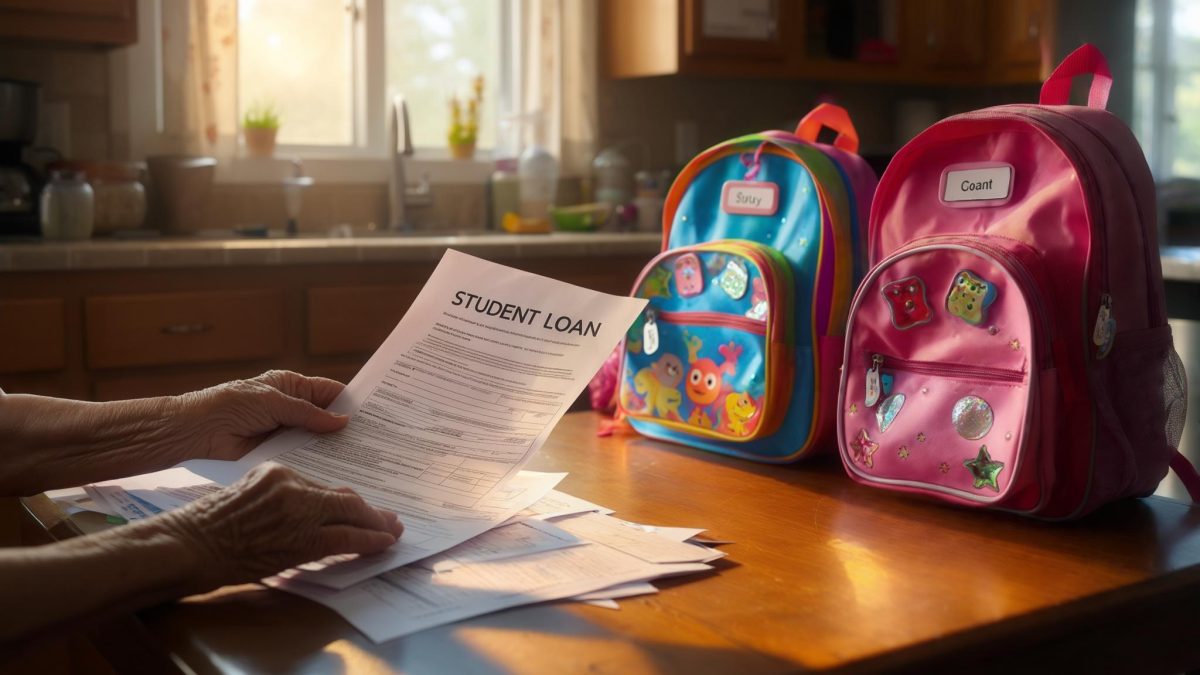
Have you ever avoided opening a bill, not because you forgot, but because seeing the number would make it too real? That kind of financial paralysis — quiet, habitual, almost logical — is more common than most people admit. And it’s exactly where I found Marcus Dillard when I first reached out to him in late February 2026.
Marcus is 34. He teaches high school math in Atlanta, Georgia. He has a master’s degree in education, two young children, and $62,000 in federal student loan debt that has followed him like a shadow since 2017. When I spoke with him over coffee at a diner near his school, he was calm — almost unnervingly so — until I asked him when he last checked his bank balance.
He laughed quietly. “Honestly? Maybe three weeks ago. I know that’s bad. I just — I know what’s in there, roughly, and sometimes knowing roughly is easier than knowing exactly.”
A Household Math Problem That Didn’t Add Up
The situation Marcus described to me was one I’ve heard variations of across dozens of interviews — but rarely laid out with such clarity. His base salary as a teacher in Georgia’s public school system sits at approximately $52,000 annually. His wife, Denise, worked full-time as a dental hygienist until their second daughter arrived in 2023. After that, she dropped to roughly 20 hours a week to manage childcare costs, which were running the family nearly $1,800 a month for two kids.
Do that math: $1,800 a month in childcare against a single full-time income of roughly $4,300 take-home. Then add a $620 monthly student loan payment, a mortgage, groceries, utilities. Marcus told me they’d been floating about $400 to $600 a month on credit cards just to cover the gap — and making only minimum payments.
“Growing up, we never talked about money,” Marcus told me, leaning back in his chair. “My parents paid the bills, we ate, we were fine. I had no model for any of this. When I got into grad school, I just signed what they told me to sign.”
That signing — $62,000 worth of it — was for a Master of Arts in Teaching from a Georgia state university, completed in 2017. He’d assumed the degree would unlock higher pay. In Georgia’s public school system, the salary bump for a master’s degree is real but modest: approximately $3,000 to $5,000 more per year depending on the district. Over ten years, that doesn’t come close to covering the loan cost when interest is factored in.
What He Didn’t Know Was Available to Him
When I asked Marcus what he knew about federal relief programs designed for people in his exact situation, he shrugged. He’d heard of Public Service Loan Forgiveness, or PSLF, in passing. But he’d never applied — partly because the program’s reputation for rejecting applicants had scared him off, and partly because the paperwork felt overwhelming on top of everything else.
That hesitation has a real cost. According to the Federal Student Aid office, PSLF forgives the remaining balance on Direct Loans after 120 qualifying monthly payments while working full-time for a qualifying employer — which includes public school teachers. Marcus, as a public school employee since 2017, may have already been accumulating qualifying payments without formally enrolling.
There’s also the SAVE Plan — Saving on a Valuable Education — which the Biden administration introduced as a replacement for the REPAYE income-driven repayment option. Under SAVE, borrowers pay no more than 5% of discretionary income on undergraduate loans and 10% on graduate loans. For Marcus’s household income, that recalculation could lower his payment considerably from the $620 standard amount he’d been paying.
As Marcus explained to me, nobody had ever walked him through any of this. “I assumed if I qualified for something, someone would have told me. That’s not how it works, is it.” It wasn’t a question.
The Tax Credits He Almost Left on the Table
Beyond loans, Marcus’s situation put him squarely in the crosshairs of two significant federal tax credits he’d been underutilizing — and in one case, missing entirely.
The first is the Child and Dependent Care Credit. Because Denise reduced her hours specifically to manage childcare for their two daughters, the family was spending well over $16,000 annually on childcare expenses. According to the IRS, taxpayers can claim up to $3,000 in care expenses for one child or $6,000 for two or more children when calculating this credit. The actual credit amount depends on income, but for a household at Marcus’s income level, that’s a meaningful offset.
The second credit is the Child Tax Credit. For tax year 2025, the CTC remained at up to $2,000 per qualifying child, with up to $1,700 potentially refundable through the Additional Child Tax Credit for lower and moderate-income filers, per the IRS guidelines. With two daughters under age 10, Marcus’s household could potentially claim up to $4,000 in CTC before phaseouts.
When I told him these numbers, Marcus set down his coffee. “We’ve been filing with TurboTax. I don’t think we’ve been getting everything. I honestly don’t know.” He paused. “That’s a hard thing to admit — that you teach math and you don’t know your own tax situation.”
What Shifted — and What Didn’t
The turning point in Marcus’s story wasn’t a dramatic windfall. It was a conversation with a colleague who mentioned she’d enrolled in PSLF three years earlier and had nearly 40 qualifying payments already logged. That conversation, Marcus told me, was what finally pushed him to sit down and actually look.
In January 2026, Marcus submitted his Employment Certification Form through the PSLF Help Tool on StudentAid.gov. He also switched from his standard repayment plan to an income-driven plan to lower his monthly payment while he pursues forgiveness. The change dropped his monthly student loan payment from $620 to approximately $280, based on his household’s adjusted gross income.
That $340 monthly difference in loan payments is real money in a household running on margins this thin. But Marcus was honest with me about the limits of what he’d found. “It helps. It genuinely helps. But we still have credit card debt accumulating interest, we still have the childcare costs, and I don’t know yet what the PSLF count actually looks like — some of my earlier payments might not have been on qualifying loans.”
That uncertainty is legitimate. The PSLF program has a complicated history of payment counting errors and servicer mistakes. The Department of Education has been working through a series of IDR account adjustments to correct historical miscounts, but borrowers like Marcus are still waiting for final confirmation of their qualifying payment totals.
The Reckoning Behind the Relief
Near the end of our conversation, I asked Marcus what he would tell someone younger — a new teacher, a grad student signing loan documents — if he could go back. He thought about it for a long moment.
What struck me most about Marcus wasn’t the debt figure or the monthly shortfall — it was the gap between his competence and his confidence. He is trained to think analytically. He spends his days teaching students to break complex problems into solvable steps. And yet, like so many people I’ve interviewed in this space, he’d avoided applying that same rigor to his own financial reality.
That avoidance has a cost. In Marcus’s case, it may have cost him years of uncounted PSLF payments, possibly some tax credits he didn’t fully claim, and almost certainly months of higher loan payments than he needed to be making. Whether amended returns or retroactive credit claims are possible in his situation is something he’s now working through with a tax professional — and it’s not something I can assess or advise on.
What I can say is that when I left that diner, Marcus looked different than when I arrived. Not fixed — his situation is still complicated, and the relief programs he found are not silver bullets. But he looked like someone who had finally decided to open the envelope.
“I used to think that not knowing was a kind of protection,” he told me as we wrapped up. “But it’s not. It’s just debt with a delay.”



Leave a Reply