
Most people assume economic relief programs exist for the unemployed, the unhoused, or the visibly desperate. Oscar Matsuda had a job, owned his home, and taught yoga three mornings a week. He was, by most measures, doing fine — until the numbers said otherwise.
I met Oscar through a mutual friend at a backyard barbecue in the Riverside neighborhood of Jacksonville last February. He was laughing, passing around a bowl of guacamole, telling a story about a student who fell asleep in savasana for forty minutes. He did not look like a man who had cried over a property tax notice the week before. But when my friend pulled me aside and said, “You should talk to him — he’s going through it,” I asked if he’d be willing to sit down with me. He said yes almost immediately. “Honestly,” he told me later, “I just needed someone to talk to who wouldn’t judge me.”
The Numbers Behind the Smile
When I sat down with Oscar Matsuda at a coffee shop on Hendricks Avenue a few days after the barbecue, the full picture came into focus quickly. He had purchased his Jacksonville home in 2019 for $187,000 — a modest two-bedroom with a detached garage he used as a makeshift studio. His mortgage payment was $612 a month. That part, he had managed.
Everything else had started to unravel in late 2024, when his hours at the yoga studio where he worked were cut from full-time to part-time. His income dropped from roughly $3,400 a month to approximately $2,200. He lost his employer-sponsored health insurance and enrolled in COBRA to maintain coverage. The COBRA premium: $847 per month.
“That premium was more than my mortgage,” Oscar told me, shaking his head. “I kept thinking, this has to be a mistake. I called the COBRA administrator twice to confirm. It wasn’t a mistake.” He was also sending his younger sister, Keiko, roughly $380 a month to help cover her junior-year expenses at the University of Florida. He had promised their late mother he would make sure Keiko graduated. That promise was non-negotiable.
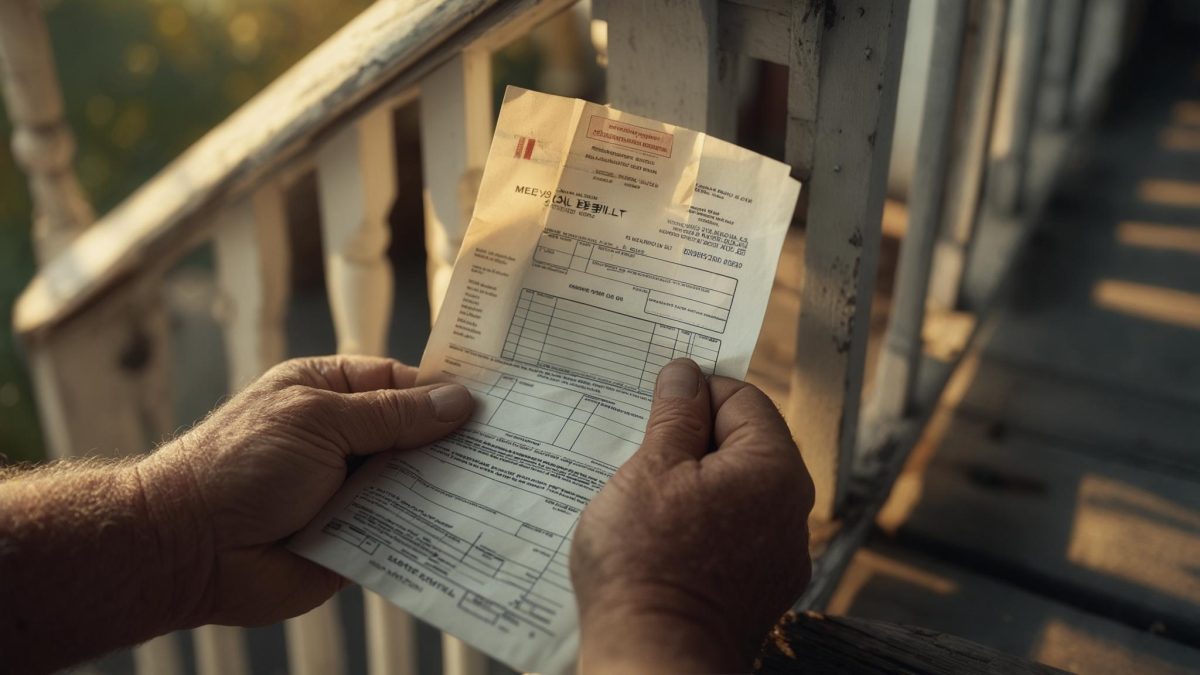
By January 2025, Oscar was $4,200 behind on his Duval County property taxes — two years of partial payments and missed installments stacking up. A notice arrived in November 2024 warning that if the balance wasn’t resolved, his property could become eligible for a tax certificate sale. He taped the notice to his refrigerator so he couldn’t ignore it. “I’d walk to the kitchen every morning and see it,” he said. “It was like a countdown clock.”
The Moment the Impulsive Spending Caught Up
Oscar is the first to admit that his financial habits made a bad situation worse. By his own description, he swings between what he calls “hustle mode” — picking up extra classes, selling online yoga content, doing corporate wellness gigs — and a kind of compensatory spending that follows the hustle like a shadow.
In the summer of 2024 — before the income cut — he had spent approximately $2,100 on a wellness retreat in Sedona, Arizona, charging part of it to a credit card he was still paying down. That credit card balance was sitting at $3,700 when his hours were cut. The timing, he acknowledged, was brutal.
Meanwhile, the roof on his house had been leaking in one corner of the bedroom since a storm in August 2024. A licensed contractor gave him an estimate of $8,500 to replace the damaged section. A second opinion came in at $9,200. He had neither amount. He was using a plastic bin to catch water when it rained hard.
What He Found — and What He Almost Missed
Oscar did not walk into a government office. He did not consult a financial advisor. What he did, in a three-hour stretch on a Sunday in late January 2025, was search online with mounting panic and gradually piece together a set of programs he had never heard of.
The first discovery was the Duval County Tax Collector’s installment payment plan for delinquent taxes. According to the Duval County Tax Collector’s office, property owners can sometimes negotiate structured repayment arrangements on past-due balances. Oscar called the office the following Monday morning, explained his situation, and was connected with a representative who walked him through the process. He was able to set up a structured payment arrangement that kept his property out of immediate certificate-sale territory while he worked down the $4,200 balance.
The second — and bigger — discovery was the Health Insurance Marketplace. Oscar had assumed that because he had employer-based COBRA available, he was locked out of ACA marketplace plans. He was wrong. A Special Enrollment Period triggered by the loss of his employer-sponsored coverage meant he had been eligible to enroll in a marketplace plan. He had simply not known it in time. When he ran his income through HealthCare.gov, the subsidized premium for a Silver-tier plan came back at $203 per month — a difference of $644 a month compared to his COBRA premium.
The roof was the hardest problem. Oscar looked into the HUD Community Development Block Grant program, which funds local home repair assistance in many Florida counties. He found that Duval County did administer a home repair assistance program for income-qualifying homeowners — but the waitlist, as of early 2025, was running six to eight months. He added his name.
The Turning Point — and the Regret That Came With It
By March 2025, Oscar had switched off COBRA and enrolled in the ACA marketplace plan. The $644 monthly difference went directly toward his property tax installment arrangement. He picked up two additional corporate wellness clients in February — bringing in roughly $600 extra that month — and put all of it toward the delinquent balance.
When I followed up with Oscar in March 2026, his property tax balance had been reduced to approximately $1,100 — down from $4,200. His sister Keiko was weeks away from graduation. The roof was still leaking in heavy rain; the county assistance waitlist had cleared some names but not yet reached him.
The regret is real and specific. Oscar paid full COBRA premiums from October 2024 through February 2025 — roughly five months. At $847 per month, that was $4,235 in health insurance premiums. Had he known about ACA marketplace eligibility and enrolled during his Special Enrollment Period in October, he estimates he would have saved approximately $3,220 over those five months. That money, he said, would have covered the remaining property tax balance outright.
What Oscar’s Story Actually Tells Us
Oscar’s situation does not have a clean resolution. The roof still needs work. The credit card balance is lower — around $2,100 as of our last conversation — but not gone. He is sleeping better than he was in January 2025, but the water stain on his bedroom ceiling is still there, expanding slowly after each hard rain like a bruise that won’t fully heal.
What changed was the bleeding stopped. The $644-a-month difference from switching health plans created enough breathing room to make real progress on the property tax debt. The installment arrangement kept the most serious consequence — losing the house — at bay while he worked the numbers down.
That assumption — that relief programs are for someone else, someone worse off — is one of the most persistent and expensive beliefs I encounter in this work. Oscar Matsuda is a homeowner with a job and a college degree. He is also a person who was nearly swallowed by a combination of reduced income, inflated insurance costs, and deferred maintenance, with no roadmap for navigating any of it.
When I left the coffee shop after our first interview in February 2025, Oscar paid for his own coffee, tucked his jacket under his arm, and said he had a 7 a.m. class the next morning. He looked tired. He looked like someone carrying something heavy and moving anyway. That image stuck with me longer than the numbers did.
The programs existed. The eligibility was there. The gap between those facts and Oscar’s reality was just information — and the five months it took him to find it cost him more than $3,000 he didn’t have.
Related: Travis Expected His $4,847 Tax Refund to Cover COBRA Premiums. The IRS Held It for 11 Weeks.




Leave a Reply