

Approximately 7.5 million Americans receive Supplemental Security Income or Social Security Disability Insurance — yet the average monthly SSI payment in 2025 sat at just $967, according to the Social Security Administration, while median rent in mid-sized U.S. cities like Charlotte had already surpassed $1,200. For anyone trying to piece together a life inside that math, the numbers simply do not add up.
I first heard about Dale Jeffries in early February 2026, through a tip from a branch manager at a Charlotte-area credit union who asked to remain unnamed. The manager told me a 26-year-old client had come in twice within the same month, each time asking about hardship lending options. “He was clearly smart,” the manager said, “but he was trying to solve a problem that loans weren’t going to fix.” That description was enough to make me reach out. Dale agreed to meet at a coffee shop in NoDa, a neighborhood he’d moved into two years earlier when his freelance business was doing well enough to afford it.
A Diagnosis Nobody Plans For at 25
When I sat down with Dale Jeffries, the first thing that struck me was the spreadsheet open on his laptop. Rows and rows of monthly expenses, color-coded by urgency. He’d built it himself — a graphic designer’s instinct applied to a financial crisis. He’d been tracking every dollar since March 2024, when a spinal MRI confirmed what months of worsening back pain had suggested: degenerative disc disease, significant enough to limit him to two or three hours of desk work before the pain became unmanageable.
“I was billing about $3,200 a month in late 2023,” Dale told me, not with pride but with the flat accuracy of someone citing a statistic about a stranger. “By August 2024, I was down to maybe $900 in a good month. My body just couldn’t keep the pace.”
He had applied for SSI in September 2024. The process took nearly four months. His approval came through in January 2025, with a monthly benefit of $843 — below the federal maximum because the SSA counted a portion of his continuing freelance earnings as income. His rent was $1,100. His prescription copays ran roughly $140 a month. The math was immediate and brutal.
The Gap Between What Benefits Promise and What They Pay
Understanding why Dale’s SSI landed at $843 rather than the federal maximum requires a brief look at how the SSA calculates benefits for people with earned income. Under SSI rules, the agency excludes the first $20 of any income and the first $65 of earned income, then counts half of the remaining earned income against the base benefit. So if Dale brought in $400 from freelance work in a given month, the SSA would calculate his countable income at roughly $157.50 and reduce his benefit accordingly. The formula was designed to encourage some work — but it left Dale in a narrow corridor, earning too much to receive the full benefit and too little to cover his bills.
Dale had done the math himself, multiple times. “I kept thinking I was making an error,” he said. “I’d redo it and get the same answer. There wasn’t a version where this worked on its own.”
Beyond the benefit calculation, Dale was also navigating a question many disabled freelancers face: how to structure his remaining work without inadvertently crossing the Substantial Gainful Activity threshold, which in 2026 sits at $1,620 per month for non-blind individuals, according to the SSA’s SGA guidelines. Earning above that ceiling in any given month could trigger a full eligibility review.
The Tax Return He Almost Didn’t File
By November 2025, Dale had been surviving on a combination of his SSI benefit, sporadic freelance income averaging $750 a month, and quiet financial help from his mother, who sent $200 most months without being asked. He was behind on two utility bills and had paused his renter’s insurance. That’s when the credit union branch manager pointed him toward a nonprofit tax preparation site operating out of a church hall in east Charlotte — a VITA location, which provides free tax prep for individuals earning under $67,000 annually, per the IRS VITA program.
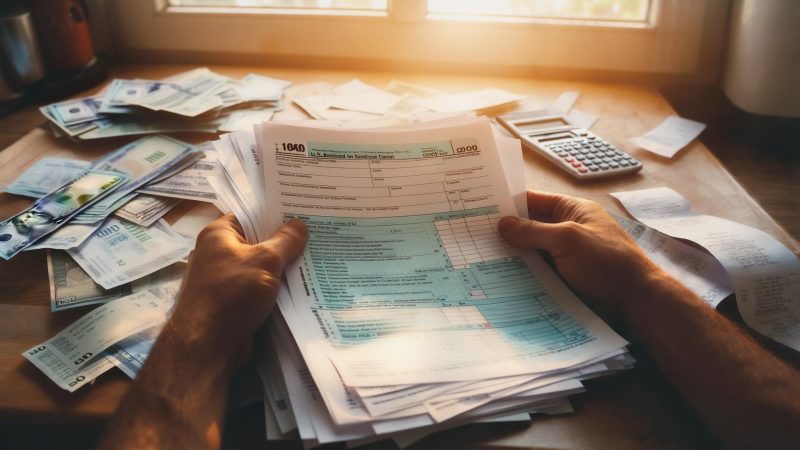
Dale hadn’t filed his 2024 taxes. He had assumed, given his income level and the complexity of his situation, there was nothing to recover. A VITA volunteer walked him through his return in approximately 90 minutes. The result stopped him cold.
The refund was driven primarily by the Earned Income Tax Credit. For tax year 2024, as a single filer with no children and approximately $11,200 in net self-employment income, Dale qualified for an EITC of roughly $632. The remainder came from federal withholding from a brief contract position he’d held early in 2024, a state-level refund from North Carolina, and the self-employment tax deduction, which reduced his adjusted gross income and increased the net refund amount. The VITA volunteer also flagged a potentially missed Self-Employed Health Insurance Deduction from a prior year’s return and noted it for a possible amended filing.
What Changed — and What Still Hasn’t
The $1,847 refund arrived in late February 2026. Dale used $1,100 to clear his utility arrears and reinstate his renter’s insurance. He put $400 toward a three-month emergency buffer — the first savings he’d held since his diagnosis. The remaining $347 went toward an ergonomic chair he’d been putting off purchasing for over a year. The relief was real. It was also temporary.
“It didn’t solve anything permanently,” Dale told me plainly. “But it gave me room to breathe for a minute. That matters more than people realize when you’ve been running at zero for this long.”
He also enrolled in North Carolina’s Low Income Energy Assistance Program (LIEAP) shortly after, a benefit he had qualified for but hadn’t known existed. His heating costs last winter were partially offset by a one-time LIEAP payment of $380. He learned about it from the same VITA volunteer who had prepared his taxes.
But Dale is candid about what remains unresolved. His freelance revenue has stabilized at roughly $700 to $900 a month — enough to keep him below the SGA threshold, but not enough to rebuild his client base or invest in updated design software. He’s researching the SSA’s Ticket to Work program, which allows certain disability beneficiaries to explore returning to work without immediately losing their benefits. He hasn’t enrolled yet. He’s still mapping the risks.
His longer-term goal — rebuilding his freelance practice closer to its 2023 peak — feels distant but not impossible to him. “I know what I’m capable of when my body cooperates,” he said. “I’m just playing a longer game now.”
Sitting across from Dale in that coffee shop, what stayed with me was not the refund check, or the utility bill, or the ergonomic chair. It was the fact that a 26-year-old managing a chronic illness, a recent divorce, and a steadily declining income had become — out of sheer necessity — his own caseworker, tax analyst, and financial planner simultaneously. The systems designed to help people in his position are real. They are just extraordinarily difficult to find from inside the fog of a crisis.
Dale walked out of that VITA appointment with a number on paper he hadn’t expected. That number didn’t rewrite his situation. It just gave him enough ground to stand on while he figures out what comes next. For now, that’s what he’s working with.
Related: The IRS Held Sylvia’s $2,847 Refund for 53 Days While Her Rent Climbed 30 Percent



Leave a Reply