

Have you ever watched someone do the math out loud — adding up what they owe against what they earn — and seen the exact moment the numbers stop working? I saw that look on Franklin Pruitt’s face in February of this year, standing in the prescription pickup line at a Walgreens on NE Broadway in Portland, Oregon.
I had gone in for a routine errand when I overheard him asking the pharmacy technician whether the store carried any patient assistance program forms for a cholesterol medication. His voice was calm but careful, the way people sound when they’ve learned to ask for help without letting it show too much. I introduced myself and handed him a business card. A week later, we sat down at a coffee shop two blocks from his apartment, and he told me everything.
A Budget Built on Overtime That Disappeared
Franklin Pruitt is 31 years old, a certified home health aide employed through a home care agency in the Portland metro area. He earns $18.75 an hour — a wage that sounds workable until you factor in that it only goes as far as the hours do. For most of 2024 and the first half of 2025, Franklin was pulling consistent overtime, sometimes six days a week, which added roughly $580 to $640 a month on top of his base take-home pay of approximately $2,650.
That overtime was not a bonus. It was the budget. It covered the gap between rent, groceries, utilities, and what his wife Delia brought in from her part-time administrative position at a nonprofit. Together, they were managing — not comfortably, but steadily.
Then in July 2025, Franklin’s agency restructured client assignments. The overtime evaporated almost overnight. “I went from working 50, sometimes 52 hours a week down to 38,” he told me, leaning back in his chair with the resigned posture of someone who has already spent months processing this. “I didn’t get a pay cut on paper. But losing that overtime was the same as a pay cut.”
He filed a complaint with his agency’s HR department and explored whether Oregon’s wage and hour protections offered any recourse. They didn’t — the overtime had been voluntary and the reduction was legal. He was left absorbing a hole of more than $600 a month in a budget that had no room to absorb anything.
The Medical Emergency That Put Everything on Plastic
Six weeks after the overtime cuts, in August 2025, Franklin’s appendix ruptured. He was taken by ambulance to a hospital in Northeast Portland and kept for three days. The surgery and recovery went well. The billing did not.
Franklin had insurance through his employer, but his plan carried a $2,000 deductible and significant coinsurance. After insurance processed the claim, he was left with $3,800 in out-of-pocket costs. He had no emergency savings left — those had been drawn down during the overtime gap — so the bill went onto a credit card at 24.99% APR.
He set up a minimum payment of $95 a month, which he knew — as he told me with a flat, tired laugh — barely touched the principal. At that rate, it would take years and cost him well over $1,000 in interest alone. But $95 was what the math allowed.
When Identity Theft Arrived on Top of Everything Else
In October 2025, Franklin applied for a small personal loan to consolidate the credit card debt at a lower rate. The lender denied him and provided a disclosure notice citing a credit score of 511. Franklin was stunned. Before the medical emergency, he estimated his score was around 680 — far from excellent, but functional.
He pulled his full credit report through AnnualCreditReport.com, the federally mandated free report portal, and found three accounts he had never opened: two credit cards and a short-term loan totaling nearly $7,400 in charges. Someone had used his Social Security number and personal information to open credit in his name.
Franklin filed a report with the FTC through IdentityTheft.gov and placed a fraud alert on his credit file. He also filed a report with the Portland Police Bureau, mostly to create a paper trail. The process of disputing the fraudulent accounts took until December 2025 — nearly two and a half months — during which the false negative marks remained visible to lenders. “I was doing everything right,” he told me, “and it didn’t matter. The damage was already sitting there.”
By January 2026, two of the three fraudulent accounts had been removed. One remained in dispute. His score had climbed back to roughly 598 — better, but still below the threshold most lenders use for favorable personal loan rates.
Delia’s Layoff and the Search for Relief Programs
Two weeks into 2026, Delia was laid off when her nonprofit employer lost a major grant and eliminated four positions. She filed for Oregon unemployment insurance immediately. According to the Oregon Employment Department, standard UI benefits replace approximately 60% of a claimant’s prior weekly wages up to a maximum of $783 per week. Delia’s part-time earnings had been modest — roughly $1,100 a month — so her UI benefit came out to approximately $420 every two weeks, or about $840 a month.
It helped. But the household had gone from roughly $4,200 combined monthly income to somewhere between $3,400 and $3,500, while carrying the credit card debt, a monthly rent of $1,450, and Franklin’s prescription costs, which ran about $140 a month before any assistance.
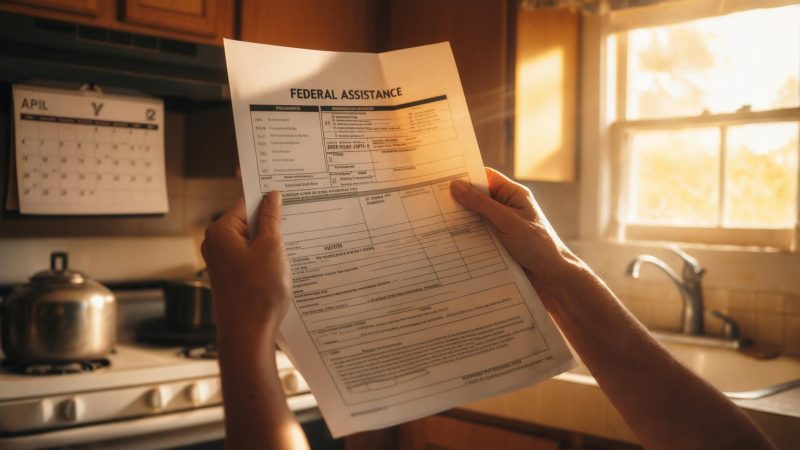
This was the moment that brought Franklin to that Walgreens counter, asking about prescription assistance. What he didn’t fully realize yet was how many other programs he might also qualify for. When we sat down, I asked him what he had already applied for and what he hadn’t gotten around to. The list of the latter was longer.
Franklin had not yet applied for SNAP. He assumed that because he was employed, he wouldn’t qualify. In fact, Oregon’s SNAP eligibility extends to households earning up to 185% of the federal poverty level, and working families with dependents or high medical costs often qualify even with a working adult in the home. For a two-person household in 2026, the gross income limit is approximately $2,706 per month — Franklin and Delia’s current combined income put them just at that threshold, depending on allowable deductions.
The SNAP approval came through in late February — $268 a month in food benefits. That alone freed up money that had been going to groceries. The prescription discount program he enrolled in through NeedyMeds dropped his monthly medication cost from $140 to $38. Small changes, but they compounded.
The Outcome: Partial Recovery, Ongoing Weight
When I followed up with Franklin by phone in late March 2026, the picture was mixed — more stable, but nowhere near resolved. The identity theft dispute was fully closed, with all three fraudulent accounts removed and his credit score sitting at approximately 621. Not a recovery, exactly. More like a floor to stand on.
His anticipated 2025 tax refund — roughly $1,150 including the Earned Income Tax Credit — had been filed and was processing. He planned to apply the bulk of it directly to the credit card balance, which still stood at approximately $2,900 after months of minimum payments. Delia had a second-round interview for an administrative role at a healthcare company. Nothing was certain.
What struck me most about Franklin wasn’t his resilience — though he had it — it was his exhaustion with having to deploy that resilience constantly. Every program he accessed required research, paperwork, follow-up calls, and waiting. The SNAP application alone involved two separate phone appointments and documentation of his income fluctuations going back six months.
Franklin’s story doesn’t have a tidy ending. The credit card debt is still there. Delia hasn’t found permanent work yet. The overtime is still gone. What changed was the margin — a few hundred dollars a month in recovered ground through programs that were always available but never obvious.
That pharmacy counter moment — a man quietly asking where the patient assistance forms were — turned out to be the beginning of a months-long accounting of what the American safety net actually looks like from inside a household that earns too much to seem poor but not enough to stay whole. Franklin Pruitt isn’t the exception. He’s the rule.



Leave a Reply