

The first thing Lonnie Reeves told me when we sat down at his kitchen table in Knoxville was that he almost didn’t respond to my social media post at all. “I saw it and thought, who wants to hear about my mess?” he said, laughing a little too quickly — the laugh of someone who’s only recently allowed himself to find any of this funny. I had put out a call on Facebook and Instagram looking for people who had navigated government benefits during a financial crisis, and Lonnie had typed out a reply, deleted it, then sent it anyway at 11:47 on a Tuesday night in February 2026.
I drove out to meet him on a Thursday morning. His landscaping truck was parked in the driveway, still muddy from a job the day before. His wife, Deja, kept their three kids — ages 4, 7, and 9 — occupied in the back of the house. What Lonnie shared with me over the next two hours was a story about what happens when a medical emergency, identity theft, and a complicated federal tax system collide at the same time for a family already living close to the edge.
A Medical Bill That Changed Everything
In March 2024, Deja Reeves was rushed to the emergency room with a ruptured appendix. The surgery and two-night hospital stay went smoothly — she recovered fully — but the financial aftermath was anything but smooth. The total bill came to just over $14,200. After their marketplace insurance covered its portion, the family was left with roughly $8,400 out of pocket.
Lonnie ran his landscaping business as a sole proprietor, earning approximately $38,000 in net income in 2023. There was no emergency fund. “I kept meaning to build one,” he told me, rubbing the back of his neck. “Every year I’d say this is the year I do it. Then something would come up with the kids or the truck needed work.” The $8,400 landed on two credit cards — one at 24.99% APR, the other at 21.5% — and immediately started compounding.
By June 2024, Lonnie noticed something wrong with a credit check he ran when trying to refinance his business vehicle. His credit score had dropped from 641 to 484 in roughly three months. When he pulled his full report, he found two accounts he had never opened — a store credit card and a personal loan — both delinquent. Someone had stolen his Social Security number and used it to open credit in at least two states. “I just stared at the screen,” he said. “I didn’t even know where to start.”
When the IRS Rejected His Tax Return
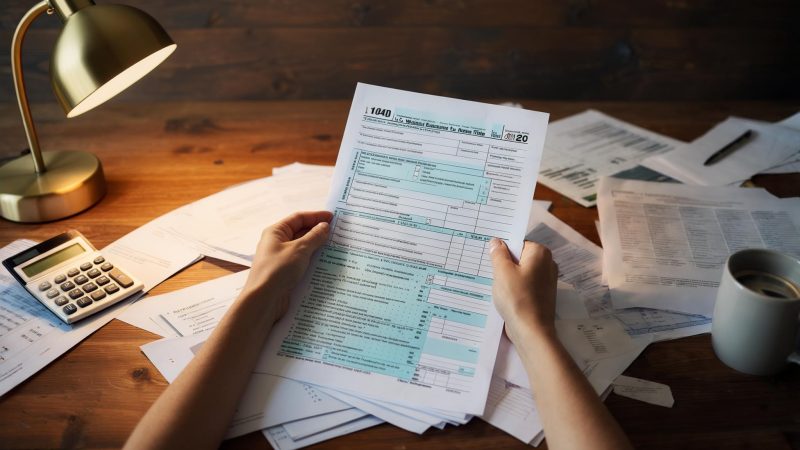
The identity theft situation became significantly more complicated the following January, when Lonnie sat down to file his 2024 federal taxes. He had been looking forward to it — with three qualifying children and a household income that placed him squarely within the eligible range, he expected to receive a meaningful refund driven largely by the Earned Income Tax Credit and the Additional Child Tax Credit.
Instead, his e-filed return was rejected within hours. The IRS system flagged that a return had already been filed using his Social Security number for tax year 2024. Someone had beaten him to it — and filed a fraudulent return claiming a refund in his name.
According to the IRS Identity Theft Central resource, tax-related identity theft — where a thief uses your SSN to file a return and collect a fraudulent refund — is one of the most common forms of federal tax fraud. The IRS received approximately 294,000 confirmed identity theft affidavits in fiscal year 2023 alone. For victims, the resolution process typically takes 18 to 24 months.
Lonnie had no idea any of this was coming when he submitted IRS Form 14039, the Identity Theft Affidavit, in late January 2025. He mailed in a paper copy of his actual 2024 return with supporting documentation — W-2s from a part-time delivery job he’d taken on, his self-employment records, and documentation for all three children. Then he waited.
The Credits He Was Owed — And the Long Wait to Receive Them
What made the delay so painful was the amount of money sitting in limbo. For tax year 2024, the maximum Earned Income Tax Credit for a married couple filing jointly with three or more qualifying children was $7,830, according to IRS EITC tables. Lonnie’s income — factoring in both his landscaping business and the part-time delivery work — placed him well within the eligible range for a substantial portion of that credit.
Additionally, the Additional Child Tax Credit, the refundable portion of the Child Tax Credit available to lower-income families, was worth up to $1,700 per qualifying child for tax year 2024. With three children, that was a potential $5,100 in refundable credits on top of the EITC. Together, Lonnie was looking at a refund in the range of $7,800 to $8,400 — money that, in his words, “would have wiped out the medical debt entirely.”
Lonnie called the IRS Identity Protection Specialized Unit eleven times between February and July 2025. He kept a spiral notebook with dates, representative names, and reference numbers. “Nine times I got hung up on or the call dropped after being on hold for over an hour,” he told me, sliding the notebook across the table so I could see the entries. “Two times I actually got through to someone.” Each representative confirmed his case was open and under review. Neither could give him a timeline.
The IP PIN and the Slow Road Forward
In August 2025, Lonnie received a letter from the IRS informing him that his case had been resolved in his favor. The fraudulent return had been flagged and removed from his record. More importantly, the letter included an IRS Identity Protection PIN — a six-digit number issued annually to confirmed identity theft victims that must be included on all future tax filings to prevent further fraud.
The refund — $7,840, which included the EITC and Additional Child Tax Credit for all three children — arrived by direct deposit in October 2025, roughly nine months after Lonnie had first tried to file. It was less than the maximum he might have received under different circumstances, partly due to his self-employment income calculations and a modest amount of taxes owed on freelance earnings. But it was real money, and it arrived.
He paid off the smaller of the two medical credit card balances entirely — $3,100 — and put $2,000 toward the larger one. The remaining $2,740 went into a savings account. “The first time I’ve had a savings account with more than $200 in it in probably four years,” he said, and this time the laugh felt genuine.
What Lonnie’s Story Reflects About Low-Income Tax Credit Access
Lonnie’s case is not unusual in its shape, even if its specific details are his own. The EITC is one of the largest anti-poverty programs in the United States — the IRS estimates that roughly one in five eligible workers fails to claim it each year. For self-employed workers in particular, the documentation requirements can be a barrier, and the intersection with identity theft adds layers of complexity that the system is not always designed to handle quickly.
What struck me most sitting with Lonnie was not the dollar amount — though $7,840 matters enormously when you’re carrying $8,400 in medical debt at 24% interest — but the sustained effort required to get there. Eleven phone calls. A spiral notebook full of dead ends. Nine months of not knowing. And through all of it, Lonnie kept the business running, kept the kids fed, and kept not looking at the bank statements he told me make his stomach turn.
He’s already enrolled in the IRS’s opt-in IP PIN program for 2025 taxes, which means he’ll receive a new six-digit code each January. He’s also working with a nonprofit credit counselor in Knoxville to dispute the fraudulent accounts on his credit report — a process he was told could take another six to twelve months. Retirement savings remain at zero. Some things don’t resolve in nine months.
“I used to think this stuff was for people who had it more together than me,” Lonnie told me as I packed up my notes to leave. “Like, tax credits are for people who know what they’re doing. But I qualified. I just had to get through all the other stuff first.” He walked me out past the landscaping truck in the driveway. Spring work was picking up. He had three jobs scheduled for the following week.



Leave a Reply