

A raise is not a rescue plan. That’s the uncomfortable truth most personal finance content refuses to say out loud — and it’s exactly what Harvey Trujillo, a registered nurse in Oklahoma City, discovered after a promotion that should have changed everything instead kicked off one of the most financially chaotic stretches of his adult life.
I first connected with Harvey in late January 2026, through a social worker at a county assistance office in Oklahoma County. She mentioned him carefully — not by name at first — as someone who had “fallen through a crack that surprises people.” When I finally sat down with Harvey at a coffee shop near his apartment in Midwest City, he arrived five minutes early, ordered black coffee, and immediately said: “I know what this looks like from the outside. A nurse with a good job who messed up. I’ve made my peace with that framing.”
He hadn’t, entirely. But that tension — between self-awareness and lingering bitterness — made his story one of the more honest ones I’ve reported in years of covering economic relief for working Americans.
The Raise That Quietly Broke His Budget
In March 2023, Harvey received a promotion to charge nurse at a hospital system in the Oklahoma City metro. His annual salary jumped from roughly $58,000 to $74,200 — a $16,200 increase that felt, at the time, like a turning point after a difficult divorce finalized the previous fall.
He upgraded his apartment almost immediately. The new unit cost him $1,490 per month, compared to the $1,090 he’d been paying. He signed a lease on a 2022 Honda CR-V — $382 per month. He started eating out more, picking up shifts on weekends less often, and generally spending at a pace that matched his new income rather than cushioning it.
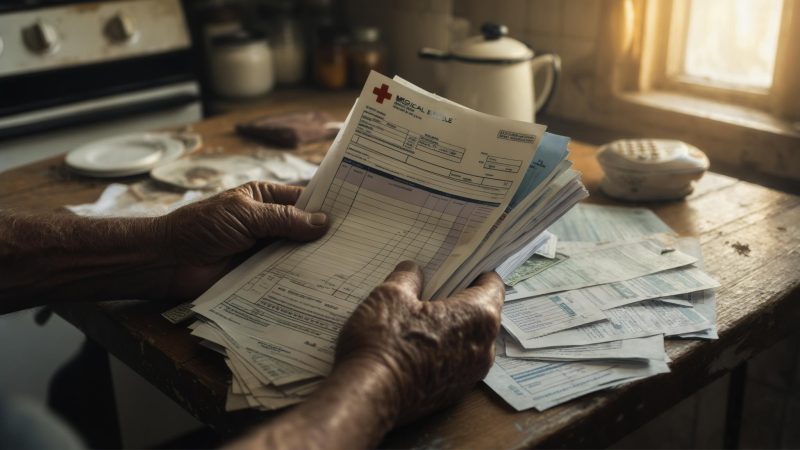
The property taxes were a different story. Harvey had purchased a modest home in 2021, using a first-time homebuyer program, and he’d been managing the property tax payments separately — a habit that worked when money was tight and he was paying close attention. Once the raise came and his spending expanded, the discipline eroded. He missed the November 2024 property tax installment of $1,480. Then the April 2025 payment. By October 2025, he owed approximately $2,960 in delinquent property taxes plus accruing penalties.
“I wasn’t broke,” Harvey told me. “That’s the worst part. I just stopped watching. The money was coming in and I assumed it was fine. It wasn’t fine.”
The Irregular Income Problem Nobody Talks About
Harvey’s base salary sounds stable on paper. In practice, his take-home pay fluctuated significantly because his hospital system offered per diem shifts — extra hours paid at a premium — that he picked up inconsistently. Some months he brought in $5,200 net. Other months, closer to $3,800.
That kind of variance, he explained, made budgeting feel almost meaningless. “I would budget based on a good month, and then a slow month would blow the whole thing up,” he said. “I’ve used four different budgeting apps. None of them solve the problem of not knowing what you’re going to make.”
This is a pattern the social worker who introduced us had seen repeatedly among healthcare workers — particularly nurses and home health aides who supplement their base pay with variable hours. The instability isn’t poverty; it’s precarity in a different register. Too much income to qualify for most assistance programs, too little predictability to build real financial stability.
By the time Harvey reached the county assistance office in November 2025, he wasn’t looking for a handout. He was looking for information — specifically, whether there were any property tax relief programs in Oklahoma County, and whether his 2025 tax return might generate enough of a refund to cover what he owed.
What He Found — and What Disappointed Him
Oklahoma does offer a property tax relief program, but Harvey’s income level — even in a slow month — placed him above the threshold. That door closed quickly. What the social worker at the county office pointed him toward instead was a conversation about his federal tax situation, and specifically about what might be coming in 2026.
Harvey had seen the viral posts about new stimulus checks. He told me, flatly, that he had almost believed them. “Someone sent me a link about a $1,390 payment from the IRS,” he said. “I looked into it for about two days before I found out it wasn’t real. That was a bad two days.”
The real picture — less exciting but more useful — involved what analysts were projecting for 2026 tax refunds. According to CNBC’s reporting on the One Big Beautiful Bill Act, certain retroactive changes enacted through the legislation could produce larger-than-usual refunds for many filers, with some analysts projecting what they called a “record tax refund season.” The Tax Foundation’s analysis of the bill noted that the refund impact would vary significantly based on income level, filing status, and deductions claimed.
For Harvey, the relevant factors were his single filing status, his home ownership (which opened up the mortgage interest deduction), and his overall income bracket. A tax preparer he consulted in January 2026 estimated his federal refund could fall between $1,750 and $2,200, depending on how his per diem income was reported and whether he had properly tracked deductible work-related expenses.
The Math of Catching Up
When I asked Harvey to walk me through what a $2,000 refund would actually cover, he pulled out his phone and read from a note he had clearly written before our meeting. The property tax delinquency — $2,960 — was the first line. Below it: a $640 balance on a credit card he had used during the slowest months of 2025. Below that: a $300 penalty he had accrued for late property tax interest.
“Even in the best case, a $2,000 refund doesn’t close everything,” Harvey told me. “It gets me close on the property taxes, but I’m still going to need a payment plan for the rest. What it does is stop the bleeding. That matters.”
Harvey also told me he had looked briefly into whether Oklahoma might follow other states in issuing a tax rebate for 2026. Some states — Georgia, for example — moved forward with rebate checks of up to $500 for eligible residents, as Economic Times reported on state-level relief payments. Oklahoma has not announced a comparable program. That was another door that didn’t open.
The Part He Wished Someone Had Told Him Earlier
Harvey’s refund — once it arrives — will largely go toward the property tax payment plan he negotiated. He’ll likely clear the delinquency by June 2026. That’s a better outcome than he was facing in October 2025, when the county treasurer had sent a formal notice of potential lien proceedings.
But Harvey was candid with me about something that didn’t fit neatly into a relief story: the damage to his sense of financial competence. He’s a registered nurse managing complex medical care for patients every shift. The idea that he couldn’t manage his own finances — even when earning well above median income — had been genuinely humbling.
What he wished he had known earlier, he said, was the specific mechanics of how withholding adjustments work — and that the IRS’s own tools allow workers to recalibrate their W-4 to better match their actual liability when income is irregular. He also didn’t know, until last November, that the IRS Premium Tax Credit reconciliation process could affect filers whose income shifts year-to-year — a detail that had quietly cost him money in a prior tax year when his income dropped unexpectedly mid-divorce.
“There’s a lot of machinery in the tax code that I just didn’t understand was running in the background,” Harvey told me. “Some of it helps you. Some of it doesn’t. You only find out which when something goes wrong.”
As I left the coffee shop that afternoon, Harvey flagged down the server for a refill instead of a second cup — a small, self-correcting gesture I probably read too much into. He’s 33, divorced, and still carrying the weight of a financial misstep that happened during what should have been a good year. The refund is coming. The lien notice is on hold. The bitterness is real but measured, held at arm’s length by someone who has clearly decided that being a cautionary tale is at least better than being a silent one.



Leave a Reply