

The conventional wisdom says that if you own your own business, you’re ahead of the game — building equity, writing off expenses, living the American dream. Robert Kowalski would like a word with that idea. When I sat down with him on a Tuesday morning in late February 2026, his waiting room had two cars in it. On a good day three years ago, he told me, there would have been six.
Robert, 52, has run Kowalski Auto Service in Milwaukee, Wisconsin for 18 years. He opened his shop with a $40,000 loan and a reputation for honest work. Business was steady, occasionally great, until it wasn’t. The culprit wasn’t a bad economy or a bad location. It was the car sitting in everyone’s driveway.
When Computers Started Running the Cars — and the Competition
The shift has been gradual enough that many people outside the auto industry haven’t fully registered it. Newer vehicles increasingly require manufacturer-specific diagnostic software — systems that independent shops simply cannot access without expensive licensing agreements that automakers are not required to make available. For Robert, the effect has been direct and measurable.
“I can still do brakes, tires, oil changes,” he told me, wiping his hands on a shop rag that had seen better years. “But when someone drives in with a 2023 or 2024 model and a warning light, I have to send them to the dealer. That used to be my bread and butter.”
Over three years, his gross revenue has declined by roughly 30 percent. His wife, Sandra, works as a dental receptionist, and her paycheck covers groceries, utilities, and the car insurance. Robert’s shop income covers the rest — or tries to. There is no retirement account. There is no emergency fund worth speaking of. What there is, Robert said with a short laugh, is stubbornness.
“I never thought I needed a plan,” he said. “The shop was the plan.”
The College Letter That Changed the Calculation
Robert’s son, Marcus, is 18. He applied to several universities and was accepted to a school in Minnesota — a strong program in engineering, the kind of opportunity that doesn’t come twice. The price tag is $45,000 per year in total cost of attendance, including tuition, housing, and fees. Robert found out about the acceptance the same week he had to defer a supplier payment for the second time in a year.
“My first instinct was to tell him to go to community college,” Robert told me. “But my wife looked at me and said, we are not doing that to our kid because I didn’t plan.” He paused. “She was right. That stung.”
It was Sandra who pushed Robert to call a nonprofit financial counseling organization in Milwaukee. He resisted for two months. When I asked him why, his answer was immediate: “I always thought that stuff — tax credits, retirement accounts — that’s for people with accountants and investment portfolios. Not for a guy with grease under his fingernails.”
What the Counselor Found — and What Robert Had Been Missing
The counselor Robert eventually spoke with went through his last three years of tax filings. What she found, Robert told me, was not reassuring in terms of what he’d already lost — but it opened his eyes to what he could claim going forward.
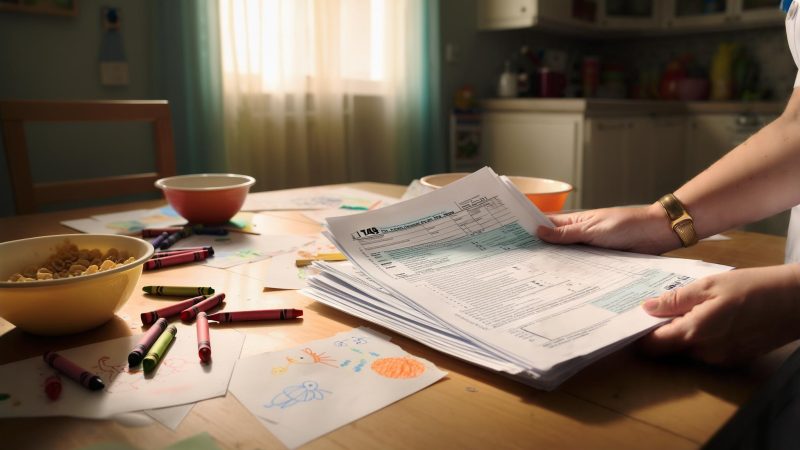
For self-employed individuals, the IRS self-employed tax center outlines a range of deductions and credits that are frequently underutilized — including the deduction for self-employment taxes, the self-employed health insurance deduction, and contributions to a Simplified Employee Pension (SEP-IRA). Robert had been taking none of these consistently.
On the college side, Marcus’s enrollment could make the family eligible for education-related tax credits. According to the IRS education credits page, the American Opportunity Tax Credit (AOTC) provides up to $2,500 per eligible student per year for the first four years of higher education, with up to $1,000 of that amount refundable. Income phase-outs apply, and eligibility depends on the family’s modified adjusted gross income.
The Outcome — and What Still Isn’t Resolved
Robert filed an amended return for tax year 2023 after the counseling session, capturing deductions he had missed. He declined to tell me the exact refund figure he received, saying only that it was “more than I expected and less than I needed.” For 2024 taxes, he worked with a preparer for the first time in years and anticipates a meaningfully lower tax bill.
Marcus is enrolled at the university in Minnesota. He qualified for a combination of institutional aid, a federal Pell Grant, and subsidized federal student loans through the Federal Student Aid program, which reduced the out-of-pocket cost to a figure the family could manage — barely, Robert said.
The retirement gap is another matter. Robert has not opened a SEP-IRA yet as of the time we spoke. He said he was thinking about it. When I pressed gently, he admitted he wasn’t sure he trusted himself to leave the money alone. “If business gets bad again and it’s just sitting there, I know I’d dip into it,” he said. “That’s the honest answer.”
The shop’s situation hasn’t materially improved. Robert has been looking at whether he can invest in some aftermarket diagnostic tools that access data through the OBD-II port — a workaround that some independent shops have used — but those systems cost between $3,000 and $8,000 depending on coverage. He has a quote sitting on his desk. He’s been looking at it for six weeks.
What Robert’s Story Says About the Self-Employed Safety Net
Robert Kowalski is not a unique case. According to the Bureau of Labor Statistics, approximately 16 million Americans are self-employed. A significant portion of that group carries no workplace retirement plan, no employer health contribution, and no institutional structure to catch them if revenue drops.
The tax code does contain provisions designed to partially offset those disadvantages. The problem, as Robert’s story illustrates, is that awareness of those provisions is uneven — and the people most likely to benefit from them are often least likely to have the time, trust, or resources to navigate them.
Before I left the shop that morning, I asked Robert what he would tell someone in a similar position — another small business owner watching revenue slide, afraid to look too closely at the financial picture. He thought about it for a moment.
He walked me out through the garage bay, past the two cars on lifts and the diagnostic equipment he can no longer use on half the vehicles that pull in. The shop smelled like oil and cold concrete. Outside, a newer model sedan with a dealer sticker drove past without stopping.
Robert watched it go. He didn’t say anything. He didn’t need to.
Related: My Financial Planner Said I Was Leaving Money on the Table — She Was Right



Leave a Reply