
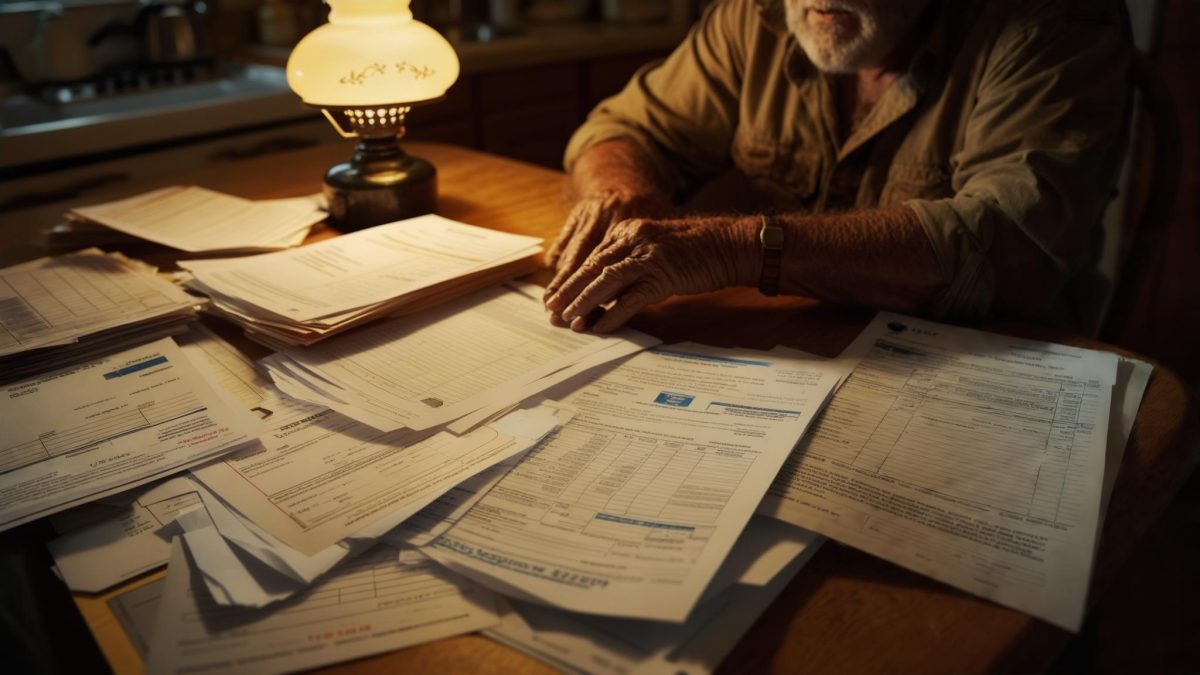
Most people assume that if a child qualifies for government disability benefits, the financial pressure on the family eases. That assumption is wrong — and for families like the Hargroves of Omaha, Nebraska, it can be a quietly devastating one. When I met Phil Hargrove through a referral from a local community resource coordinator at the Heartland Family Service center in central Omaha, he had a socket wrench in one hand and a stack of SSA correspondence in the other. He looked like a man holding two different problems he couldn’t solve with the same tool.
Phil is 25 years old, married to his wife Dana, and the father of a four-year-old son named Marcus. Marcus was diagnosed with autism spectrum disorder at age two. Phil owns a small auto repair shop — six bays, two employees, mostly older-model vehicles — and by every conventional measure, he is a working, tax-paying small business owner. By the measure that actually mattered to his household in early 2026, he was roughly $1,300 short every single month.
How I Found Phil — and Why His Story Matters
The Heartland Family Service coordinator, who asked not to be named, told me Phil’s file had sat on her desk for two weeks before she called him. He had come in asking about emergency home repair assistance — his HVAC system had failed the previous November, during one of Omaha’s colder stretches — and when she started reviewing his household income against his expenses, she described the picture as “a slow leak in a tire that nobody’s noticed yet.”
When I sat down with Phil Hargrove at a diner two blocks from his shop on a Tuesday morning in late March 2026, he ordered black coffee and didn’t touch it for the first twenty minutes. He had the posture of someone who had rehearsed what he was going to say and then decided to just say the real version instead.
Marcus was approved for Supplemental Security Income in September 2024. The monthly payment came to $943 — close to the federal maximum at the time. Phil had anticipated something closer to $1,400 or $1,500, a number he’d arrived at by reading online forums rather than SSA documentation. The reality landed differently.
The Numbers That Don’t Add Up
Phil walked me through his monthly household budget on a napkin, the way mechanics often explain an engine problem — methodically, like it was a system with a clear fault rather than a set of impossible choices. His shop clears between $3,000 and $3,800 per month after payroll, depending on volume. The lower end of that range happens more often than he’d like to admit.
The $2,240 monthly figure wasn’t arbitrary. Phil broke it down: $860 for a part-time behavioral aide who works with Marcus three mornings a week, $410 for speech therapy copays not covered by Medicaid, $320 for specialized food and sensory supplies, and roughly $650 in miscellaneous costs — transportation, adaptive equipment, the occasional emergency. These were conservative numbers, he said. He’d already cut the aide’s hours from five days to three.
On top of the care costs, the house itself was deteriorating around them. The HVAC failure in November 2025 forced Phil to finance a replacement unit through a local contractor — $7,400 financed at 18.9 percent interest over 36 months, because his credit score had dipped below the threshold for better terms. There was also a section of roof above Marcus’s bedroom that a contractor had flagged in October 2025, estimating repairs at $4,200. Phil had taped a blue tarp over it and moved on.
The Tax Credit He Didn’t Know He Had
This is where Phil’s story takes a turn that is less triumphant than it sounds. In February 2026, a volunteer tax preparer at a VITA site in Omaha reviewed Phil’s 2025 return and flagged something Phil had never claimed: the Child and Dependent Care Credit. Phil had been paying for Marcus’s behavioral aide entirely out of pocket, and a portion of those expenses qualified. The preparer also identified that Phil likely qualified for the Earned Income Tax Credit as a low-to-moderate income earner with a qualifying child — a credit he had left unclaimed for two consecutive tax years.
The combined value on Phil’s 2025 return came to approximately $2,800. For context, that’s roughly three months of the gap he’d been covering every month. According to the IRS, the EITC is one of the most under-claimed credits among self-employed filers, in part because irregular business income makes eligibility calculations more complex.
The $2,800 refund arrived in mid-March 2026. Phil used $1,900 of it to pay down the HVAC loan’s principal. The remaining $900 went toward the roof repair — not enough to fix it, but enough to hire someone to do a proper temporary seal before spring rains arrived. He described it as “patching the patch.”
What the Impulsive Decisions Cost Him
Phil is self-aware in the way that people who’ve made costly mistakes tend to be — not defensive, but slightly exhausted by the pattern. He told me about a stretch in summer 2024, before Marcus’s SSI was approved, when he was operating in what he called “hustle mode.” He’d taken on three extra vehicles he didn’t have bay space for, promised turnarounds he couldn’t meet, and then — when a parts supplier offered him a deal on a used alignment rack — bought it on impulse for $3,200 using the shop’s emergency credit line.
The alignment rack sits in the back of the shop. He’s used it four times.
He doesn’t frame the alignment rack as a stupid decision, exactly. He frames it as what happens when someone who runs on adrenaline and anxiety tries to solve a structural problem with a one-time fix. “When things get bad I want to do something,” he told me. “Even if the thing I do makes it worse later. At least I did something.”
Where Things Stand — and What’s Still Broken
As of late March 2026, Phil’s household is stable in the narrow sense of that word. The HVAC works. The roof isn’t leaking. Marcus is making incremental progress with his speech therapist. Dana has taken on part-time bookkeeping work from home, adding roughly $700 a month to household income. The monthly gap has narrowed from $1,297 to closer to $600, which Phil describes as “survivable, not comfortable.”
The Heartland Family Service coordinator has connected Phil with information about Nebraska’s ABLE account program — a tax-advantaged savings account for individuals with disabilities, available through the Nebraska State Treasurer’s office — which could allow the family to set aside funds for Marcus’s long-term care costs without affecting his SSI eligibility. Phil told me he’d read the brochure twice and still wasn’t sure he understood it. He’s planning to bring it to the VITA site next tax season.
There are also federal and Nebraska-specific home repair grant programs Phil may qualify for. The USDA’s Section 504 Home Repair program provides grants of up to $10,000 for low-income homeowners to remove health and safety hazards — a category that could potentially include his roofing situation. Whether Phil qualifies depends on income thresholds that sit uncomfortably close to what his shop earns in a good month.
When I left Phil at the diner, he finally drank his coffee — cold by then — and said he needed to get back to the shop. There was a 2009 Chevy Tahoe on the lift that had been there two days longer than it should have been. He said it like an apology to the Tahoe, not to me.
Phil Hargrove is not a cautionary tale or a success story. He is a 25-year-old man who is holding a family together with shop income, a monthly SSI check that doesn’t stretch far enough, and a growing understanding — partly earned, partly painful — that the systems designed to help families like his were built with paperwork, not people, in mind. The gap between what those systems promise and what they deliver is real, it is measured in dollars, and for Phil, it is measured every single month.
Related: A Milwaukee Teacher Paid $1,147 a Month for COBRA. It Cost More Than His Rent — and Just Expired
Related: His Tax Refund Was Supposed to Cover His Son’s Prescriptions — The IRS Took 11 Weeks to Decide




Leave a Reply