
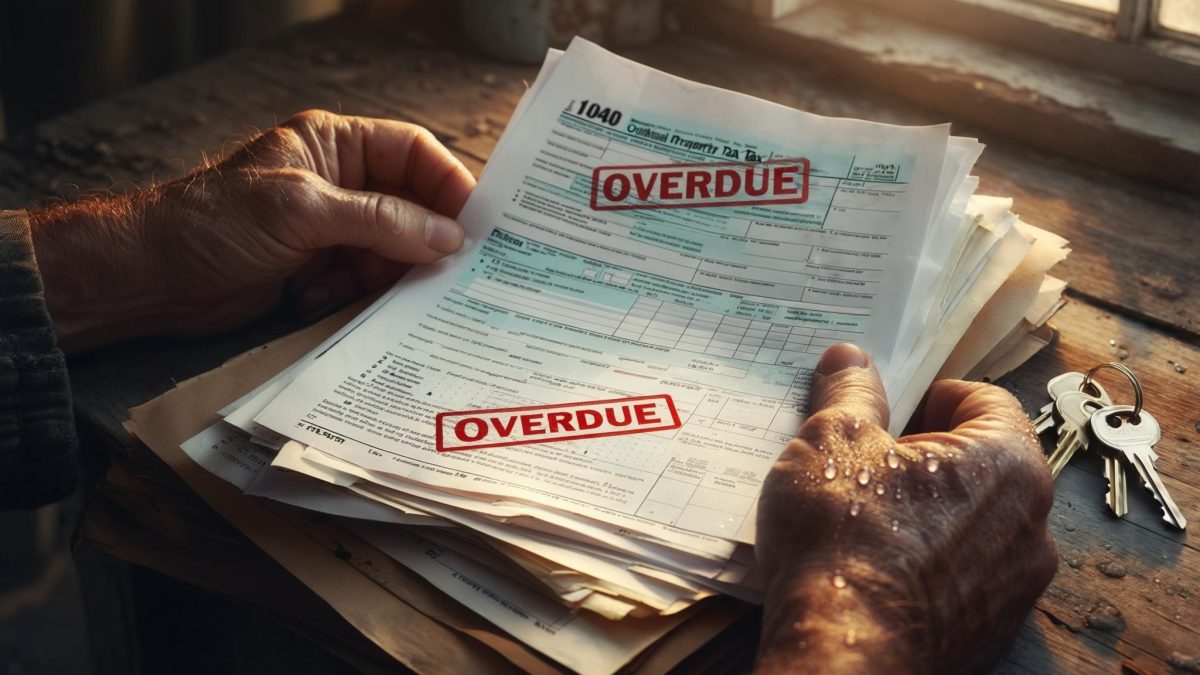
The deadline that matters most is often the one you don’t see coming. For homeowners behind on property taxes in North Carolina, a delinquency can escalate to a lien — and eventually a forced sale — on a timeline that moves faster than most people expect. That urgency was still written on Lester Blanchard’s face when I first sat down with him in early February 2025 inside a small conference room at the Wake County Department of Social Services office in Raleigh.
A social worker there, who asked not to be named, had suggested I speak with Lester after I mentioned I was reporting on middle-income homeowners navigating post-pandemic financial strain. “He’s got a story worth telling,” she said simply. She was right.
A Financial Picture That Looked Stable — Until It Didn’t
Lester Blanchard is 35 years old and works as an insurance claims adjuster for a regional carrier in the Raleigh-Durham area. It’s steady, professional work — the kind of job that, on paper, suggests a person has things under control. When I asked him how he ended up at a county assistance office, he let out a short, humorless laugh.
“People assume that if you have a real job and you own a house, you’re fine,” Lester told me. “But the divorce cost me more than I ever thought it would. Not just emotionally. I mean financially, completely.”
Lester and his ex-wife finalized their divorce in March 2023. Under the settlement, he kept the house — a three-bedroom ranch in East Raleigh he’d purchased in 2020 for $271,000. By late 2024, the outstanding mortgage balance sat at approximately $258,000. The home had appreciated modestly, appraising closer to $299,000, but that equity was largely inaccessible because Lester had taken out a home equity line of credit of $38,000 during the marriage to cover renovation costs. Combined, his secured debt was pressing against the home’s value in a way that left him with almost no cushion.
The property tax situation had been building quietly for two years. Wake County’s 2023 tax bill on his property came to roughly $3,100. Lester paid part of it — about $1,400 — and deferred the rest, telling himself he’d catch up. He didn’t. A second bill arrived in 2024. By October of that year, he owed $4,200 in back property taxes, plus accruing interest at a rate of 2% per month under North Carolina General Statute § 105-360.
The Letter That Finally Made It Real
Lester described receiving a delinquency notice from the Wake County Tax Administration office in November 2024 as the moment the situation became undeniable. “I knew I owed it. I just kept pushing it down the priority list,” he told me. “When the official letter came saying they could pursue a tax lien, I actually felt sick.”
Under North Carolina law, counties can sell delinquent tax liens to third-party collectors, a process that can accelerate the path toward foreclosure. Lester knew enough to understand the stakes. What he didn’t know was that a federally funded relief program — the North Carolina Homeowner Assistance Fund — had been specifically designed to help homeowners in his position.
The NC HAF program was established through the American Rescue Plan Act of 2021 and administered by the North Carolina Housing Finance Agency. At its peak, it offered eligible homeowners up to $40,000 in assistance covering mortgage arrearages, property tax delinquencies, homeowner’s insurance, and utility arrears. Eligibility was tied to pandemic-related financial hardship, income thresholds at or below 150% of the area median income, and primary residence status.
Finding the Door — and the Paperwork Behind It
Lester didn’t find NC HAF on his own. He found it through the same social worker who later connected us. He had walked into the Wake County DSS office in December 2024, originally looking for information about a utility assistance program. The social worker asked him a few questions about his housing situation and immediately flagged his property tax delinquency as something the HAF program might address.
“She basically said, ‘You need to apply for this before the end of the year,'” Lester recalled. “I didn’t even know the program existed. I felt equal parts relieved and embarrassed that I hadn’t found it myself.”
The application process, as Lester described it to me, was more involved than he anticipated. He needed to gather:
- Documentation of a COVID-19-related financial hardship (he used records of reduced overtime during a company-wide freeze in 2021)
- Two years of federal tax returns (2022 and 2023)
- Most recent mortgage statement and HELOC statement
- Wake County tax delinquency notice
- Proof of primary residence
- Recent pay stubs showing current income
His gross annual income at the time was approximately $67,400. Wake County’s area median income for a single-person household in 2024 was roughly $79,000, placing him well within the 150% AMI threshold for eligibility.
What the Approval Actually Looked Like
Lester submitted his application in the second week of December 2024. He told me the wait was excruciating — not because it was especially long, but because he was watching his property tax interest accrue in the meantime. He received a conditional approval notice in January 2025, roughly five weeks after applying.
The approved amount covered his full $4,200 property tax delinquency, plus $380 in accrued interest and penalties, for a total disbursement of $4,580 paid directly to Wake County Tax Administration. The program did not address his HELOC or primary mortgage — those fell outside the scope of what remained available in his county’s allocation by that point.
When I spoke with Lester again in late March 2025, about six weeks after our first meeting, his tone had shifted. The tax lien threat was gone. But he was candid about what remained unresolved.
“The mortgage situation isn’t fixed,” he told me plainly. “I’m current on my payments right now, but I don’t have a lot of room. If something breaks in the house, if my car needs major work — I don’t have a cushion. That part scares me.”
The Part of the Story That Doesn’t Have a Clean Ending
What Lester’s experience illustrates is something I’ve seen repeatedly in reporting on middle-income households and relief programs: the gap between eligibility and awareness is often the deciding factor. Lester makes a living wage. He is not in poverty. He is also not in a financial position that leaves room for compounding emergencies, and the divorce reset a stability he had spent years building.
Programs like NC HAF were not designed to solve structural over-leverage or insufficient savings. They were designed to prevent a single point of failure — a missed tax payment, a delayed mortgage — from becoming an irreversible loss. In Lester’s case, they did exactly that. But the underlying pressure remains.
According to the NC Housing Finance Agency, the NC HAF program disbursed assistance to more than 14,000 households during its operational period, with an average award of approximately $14,700 per household. Lester’s award was smaller than average because only his tax delinquency was addressed — a reflection of both his specific situation and the program’s diminishing funds by late 2024.
The last thing Lester said to me before we wrapped up our second conversation has stayed with me. It wasn’t triumphant. It was honest in the way that only people who have been genuinely frightened tend to be.
Lester Blanchard is still in his house on the east side of Raleigh. His property taxes are current. His mortgage is current. The HELOC balance sits at $31,000, and he’s working to pay it down at roughly $400 a month above the minimum. He told me he’s started an emergency fund — $50 a paycheck, automatically transferred. It’s a small number. He knows that. But it’s a start, and after the last two years, a start feels like something.
Vivienne Marlowe Reyes is a Senior Tax & Stimulus Writer at American Relief. She covers economic relief programs, tax credits, and the financial experiences of American households navigating government assistance systems.
Related: She Retired from USPS at 33 With a Spine Condition — Then Her Health Insurance Bill Hit $612 a Month
Related: Your IRS Refund Tracker Went Blank After Filing — Here’s What That Actually Means in 2026



Leave a Reply