

The voicemail sat unopened on Nolan Becerra’s phone for eleven days. It was from the IRS Taxpayer Assistance Center in Boise, Idaho, and every time he saw the notification, he set his phone face-down on the counter and walked out of the room. “I kept telling myself I’d deal with it tomorrow,” he told me when we finally spoke this past March. “Tomorrow kept not coming.”
Nolan, 63, is a registered nurse at a mid-sized hospital in Boise, and he found me after I posted a call-for-sources on social media asking to hear from people navigating government benefits on their own. He messaged me privately — not publicly — and prefaced our first exchange with a note that he had “never talked about this with anyone.” That detail stayed with me throughout our reporting.
A Raise That Quietly Complicated Everything
When Nolan received a merit-based pay increase in the spring of 2024, his annual salary climbed from roughly $74,000 to $89,500. On paper, it signaled stability. In practice, it silently disrupted how he thought about what he was owed.
For nearly two years, Nolan had been the primary caregiver for his 87-year-old mother, Rosario, who has moderate dementia and requires daily assistance. He brought in a part-time home health aide at $18 per hour — roughly $14,400 per year — while covering the remainder of her care himself on evenings and weekends. When his salary increased, he assumed, without verifying, that he had crossed some threshold that made him ineligible for any tax relief. He never checked. He just stopped looking.
“I just assumed that because I made more money, I didn’t qualify for anything,” Nolan told me, picking at the rim of his coffee cup. “Nobody tells you there’s a sliding scale. I thought it was a cliff — you’re over the limit, you get nothing.”
That assumption cost him. He hadn’t claimed the IRS Dependent Care Tax Credit on his 2023 return, leaving approximately $600 in federal credits unclaimed. When his income rose in 2024, he assumed the situation had only gotten worse.
The Credit He Didn’t Know Applied to Him
The Dependent Care Tax Credit — filed on IRS Form 2441 — is not limited to childcare. It also covers qualifying expenses paid to care for adults who are physically or mentally incapable of self-care and who are claimed as a dependent on the taxpayer’s return. Rosario met that definition. According to IRS Publication 503, qualifying expenses can include home health aide costs, adult day programs, and certain in-home care services.
The credit rate slides between 35% and 20% depending on adjusted gross income. At Nolan’s 2024 income of $89,500, the applicable rate is 20%, applied against up to $3,000 in qualifying expenses for one dependent — producing a credit of $600. This is a nonrefundable credit, meaning it reduces tax owed rather than generating a refund, but it does not disappear above a specific income threshold the way many people assume.
Nolan didn’t learn any of this on his own. The voicemail he’d avoided for eleven days turned out to be a follow-up from a Taxpayer Advocate appointment a hospital colleague had quietly helped him schedule. When he finally returned the call in early February 2025, a representative walked him through the credit structure. It was the first time anyone had explained it to him directly.
The Financial Weight Beneath the Surface
To understand why Nolan had gone so long without asking for help, I had to understand everything he was quietly managing. His financial picture was more complicated than a single pay stub could convey.
Nolan had been briefly married in his late 40s. His ex-wife had a teenage son from a prior relationship, and after the divorce, the boy’s biological father consistently failed to pay court-ordered child support. For several years, Nolan covered that gap informally — not legally obligated, but unwilling to let the kid go without. By the time he stopped, he was years behind on retirement contributions and carrying roughly $9,200 in credit card debt accumulated during a stretch when his income and his spending had quietly drifted apart.
The 2024 raise had also triggered expenses he hadn’t mapped carefully. A newer used car with higher monthly payments. A home security system. A gym membership he rationalized as preventive care for a man working 60-hour combined weeks. None of these were reckless in isolation. Together, they meant his financial margin was narrower than his income number suggested — and he was too embarrassed to investigate whether benefits he’d written off might still apply.
His embarrassment wasn’t irrational. It was the specific shame of a middle-income professional who believes that needing help is evidence of failure. “I talk to patients every single day about what they qualify for, about asking for help,” he told me. “And then I go home and don’t do any of that for myself. There’s a word for that, I think.”
What the Numbers Actually Looked Like in the End
After the February phone call, Nolan worked with a volunteer preparer through a local VITA site to file an amended 2023 return and prepare his 2024 taxes correctly. The amended return recovered the $600 credit he’d missed on his original 2023 filing. His 2024 return, which claimed $3,000 in documented home health aide expenses under Form 2441, generated another $600 credit against his federal tax liability.
Total recovered or preserved across two filing years: $1,200. Not a transformation. But not negligible, either — particularly for someone carrying $9,200 in credit card debt at an average interest rate of around 21%.
Nolan also learned, through the same VITA session, that his mother might qualify for the Medicare Savings Program, which can reduce or eliminate Medicare Part B premiums for low-income beneficiaries. That application had been submitted but was still pending at the time we spoke in March 2026.
The Part That Still Sits With Him
When I asked Nolan whether he felt relieved, he paused for a long time before answering. “I feel stupid,” he said. “I spent two years paying for something I could’ve gotten partial credit for and just never bothered to check, because I was too proud to look like I needed it.”
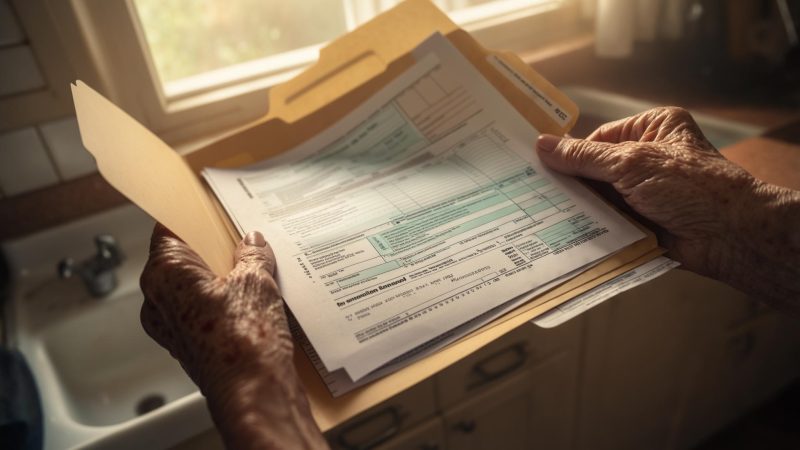
He’s started keeping a physical folder in a kitchen drawer — tax documents, home health aide receipts, a printed copy of IRS Publication 503. It took him the better part of two years to build the habit of not looking away from his own paperwork. The Medicare Savings Program application may or may not produce anything. He’s trying not to count on it.
What reporting Nolan’s story made plain is that the distance between eligible and claiming is rarely a policy gap. Most of the time it is a knowledge gap, reinforced by shame. Nolan earns a middle-class income, holds a professional license, and counsels patients daily on navigating systems that confuse people. He still managed to leave $1,200 on the table because he was too embarrassed to check whether he qualified.
That’s not a personal failure. It’s a predictable outcome of a system that puts the burden of discovery on the people least likely to go looking — those who believe, without evidence, that they’ve already been ruled out.



Leave a Reply