
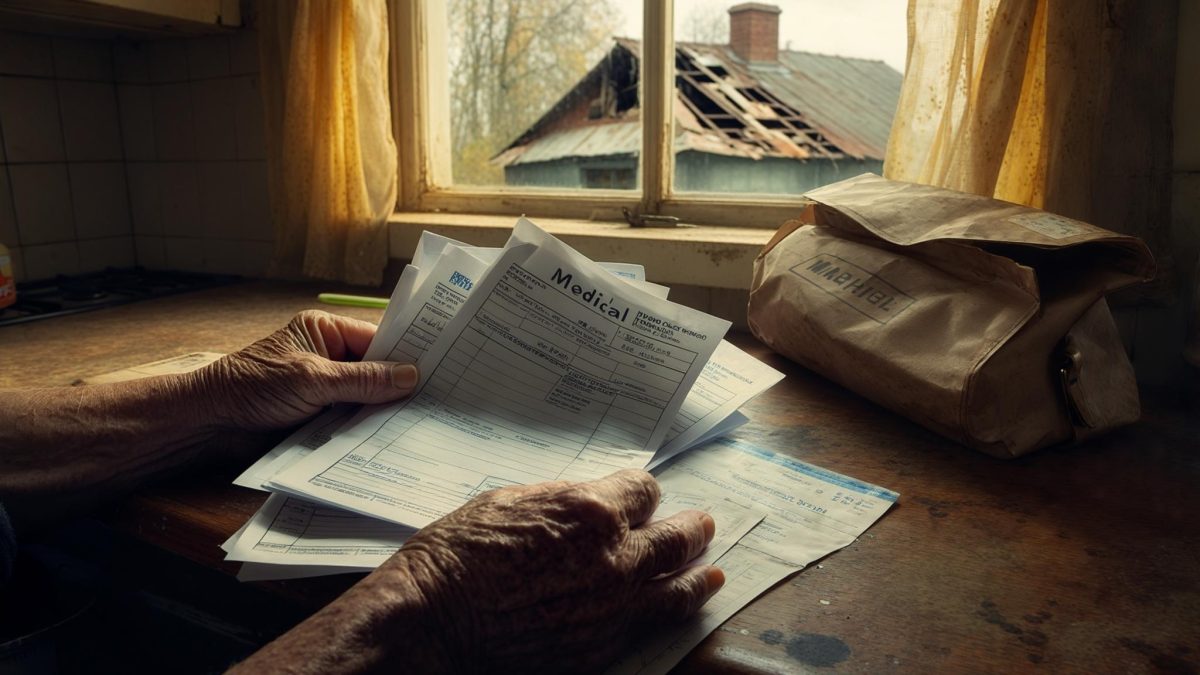
Patricia Novak’s kitchen table had a yellow legal pad on it covered in handwritten numbers. When I visited her Pittsburgh home on a gray February morning, she was doing the math — for what she told me was the third time that week — trying to figure out whether she could cover her January heating bill and still make her prescription co-pays before the end of the month.
She offered me coffee. She apologized that she only had the store-brand creamer. Then she sat down, folded her hands, and said, simply: “I’ve always been fine. I just need to keep being fine.”
A Pension, a Loss, and a Widening Gap
Patricia, 65, worked for the United States Postal Service for 32 years before retiring in 2018. Because she was hired before 1984 and enrolled in the Civil Service Retirement System (CSRS), she receives a CSRS pension — approximately $1,740 per month after deductions — rather than a full Social Security benefit. She is, however, eligible for a partial Social Security survivor benefit following the death of her husband, Gerald, in January 2023.
Gerald’s own Social Security check had been $1,380 per month. When he died after a brief illness, that income vanished. Patricia now receives a survivor benefit of roughly $690 per month — half of what Gerald collected — which, combined with her pension, brings her monthly income to approximately $2,430.
On paper, $2,430 a month might sound manageable. But Patricia’s mortgage, utilities, insurance, medications, and groceries consume nearly all of it — especially in a Pittsburgh winter, where her gas bills regularly reach $280 to $320 a month. “Everything just keeps going up,” she told me, smoothing the edge of her legal pad. “My income doesn’t.”
She is not alone in this position. According to the Social Security Administration’s annual statistical supplement, more than 4.4 million Americans receive Social Security survivor benefits — and many, like Patricia, are women over 60 who face sharply reduced household income after a spouse’s death.
The House That Holds Her History — and Her Biggest Fear
Patricia has lived in her 1960s-era brick rowhouse in Pittsburgh’s Beechview neighborhood for 29 years. She and Gerald raised two children there. She knows every creak in the floor. She also knows the roof is failing.
A contractor assessed the damage last fall: the roof needs full replacement, estimated at $11,500. The furnace, original to the house, is running on borrowed time — a second contractor quoted $6,200 for a new high-efficiency unit. Together, those two repairs add up to roughly $17,700.
Patricia does have savings — about $21,000 accumulated over her working years. But she won’t touch it for the house. “That money is for if I get sick,” she told me plainly. “If I need a procedure or something goes wrong. I saw what Gerald’s last few months cost. I can’t be without that.”
Her daughter, who lives in Columbus, has offered to help with the repairs. Patricia has declined twice. “I don’t want to be a burden on my kids,” she said, with a firmness that made clear this wasn’t up for discussion. “They have their own families. I managed before. I’ll figure it out.”
Hunting for Help on a Fixed Income
After the second contractor visit, Patricia began researching assistance programs. She described the process to me as “trying to find a door in a wall with no handles.” She started with a Google search, moved to calling 211 Pennsylvania, and eventually spent two afternoons at her local library’s computer terminals.
What she found was a patchwork of programs, each with different income thresholds, application windows, and documentation requirements. As Patricia explained, the information wasn’t hard to find once she knew what to look for — but knowing what to look for was the hard part.
Here are the four programs Patricia investigated:
- Pennsylvania’s Property Tax/Rent Rebate Program — For Pennsylvanians 65 and older with annual income below $45,000. Rebates can reach up to $1,000 depending on income bracket. Patricia qualified and received $650 in rebates last year.
- LIHEAP (Low Income Home Energy Assistance Program) — A federally funded program administered by Pennsylvania’s Department of Human Services. Patricia applied and received a one-time benefit of approximately $580 toward her heating costs in the 2024–2025 benefit season.
- HUD Section 504 Home Repair Program — Grants up to $10,000 for homeowners age 62 or older who meet very low-income criteria (typically below 50% of the Area Median Income). According to HUD’s program documentation, funds can be used for essential repairs including roofing. Patricia learned she might be near the income cutoff and began an inquiry.
- Pennsylvania Weatherization Assistance Program (WAP) — Federally funded through the Department of Energy, WAP can cover furnace replacement and insulation improvements for income-eligible households. Patricia submitted a referral application through her Area Agency on Aging.
What She Found — and What She Didn’t
When I spoke with Patricia about the results of her research, the picture that emerged was mixed. The programs exist. Some of them helped her in real, tangible ways. But the gap between what she needed and what was available remained large.
The LIHEAP benefit helped with one month of heating costs. The property tax rebate offset some of her annual tax burden. But neither program touches her roof or her furnace — the two repairs that keep her awake at night. The HUD Section 504 grant inquiry, which she submitted in October 2025, was still pending a site visit as of our conversation in February 2026.
The waiting is perhaps the hardest part of Patricia’s story. The programs she found require time — time for site visits, time for income verification, time for waitlists. According to Benefits.gov’s WAP program listing, weatherization waitlists in some Pennsylvania counties can extend six months to over a year depending on demand and funding allocation.
Her furnace ran through the 2025–2026 winter. Barely, she said. The pilot light went out twice. Each time, she waited until the house dropped to 58 degrees before calling her neighbor’s son — a plumber — to come relight it for free. “I hate asking,” she told me. “But I hate being cold more.”
The Timeline Patricia Navigated
Where Patricia Stands Now
When I left Patricia’s home that February afternoon, she walked me to the door and pointed up at a corner of the eave where a dark stain had spread across the wood. “That’s new since last week,” she said quietly. She wasn’t asking for sympathy. She was documenting it, the way she’s been documenting everything — on that legal pad, in pencil, in rows.
In the three years since Gerald’s death, Patricia has received roughly $1,230 in combined relief from LIHEAP and the property tax rebate program. That represents real money to her. But against $17,700 in deferred repairs, it is a fraction. The programs that could make the biggest difference — the HUD Section 504 grant and the Weatherization Assistance Program — remain in bureaucratic limbo.
Patricia told me she’s grateful for what she found. She’s also clear-eyed about what she didn’t. “I don’t feel sorry for myself,” she said at the door. “I just think there are a lot of people in houses like mine, with numbers like mine, and nobody ever told them these things existed. And by the time they find out, half the windows are closed.”
She’s right about the numbers. The Administration for Community Living’s profile of older Americans estimates that approximately 10 million Americans age 65 and older live in poverty or near-poverty — many of them homeowners who, like Patricia, are asset-rich and cash-poor, sitting in aging homes they cannot afford to repair.
Patricia is still waiting on her site visit. She still clips coupons and drives 20 minutes to the Aldi in Carnegie for groceries. She still hasn’t touched the $21,000. And every morning, she checks the ceiling of her bedroom for new water stains — the same way, she told me, that she used to check her mail routes for icy patches. Methodically. Quietly. Alone.



Leave a Reply