
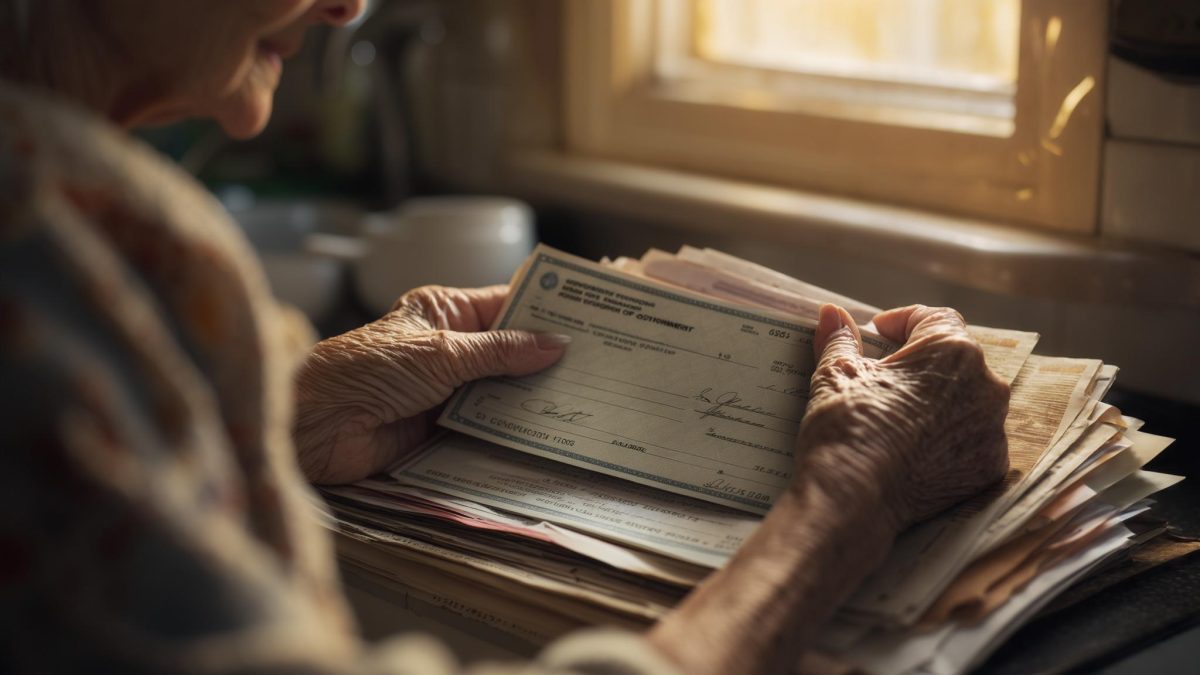
Patricia Novak was at her kitchen table in Pittsburgh’s Beechview neighborhood, a stack of grocery circulars fanned out in front of her, when the dripping started again — slow and patient, from somewhere above the upstairs hallway. She got up, placed a pot under it, and came back to her coupons. The third pot she’d positioned in that house that winter. “I just kept telling myself, one more season,” she told me when I sat down with her at that same table last February. “One more season, and I’ll figure something out.”
She had been saying that for three years.
The Month His Check Stopped Coming
When Patricia’s husband Gerald died in February 2023, the financial loss arrived with the kind of precision that grief rarely prepares you for. Gerald had worked 28 years in manufacturing before retiring, and his Social Security check — $1,190 a month — had been woven into every part of how they’d managed the house, the utilities, the property taxes. Patricia’s own income was steady but narrow: a USPS pension of approximately $1,460 a month after 32 years of service, plus her own Social Security retirement benefit of about $940 a month, which she had claimed at 63.
When I asked her what those first months felt like, she was quiet for a beat. “You don’t realize how much you budget around two people until it’s just you,” she told me. “Suddenly I’m looking at the same bills, the same house, the same property tax — and $1,190 less coming in every single month.”
That drop — from roughly $3,590 to $2,400 a month — wasn’t catastrophic on paper. But Pittsburgh’s cost of living had been climbing steadily, and Patricia’s home, a brick row house built in 1967, had quietly been accumulating problems. Her property taxes ran about $2,800 a year. Her gas bills spiked in winter, sometimes reaching $285 a month. And then there was the roof.
Three Years of Duct Tape and Deferred Dreams
Patricia walked me through the house during my visit. The upstairs hallway ceiling had a brown watermark roughly the size of a dinner plate. The furnace — installed in 2003 — rattled audibly when it kicked on. A roofing contractor had given her an estimate in late 2024: $13,800 for a full replacement. A separate HVAC company had quoted $4,100 for a new furnace. She had folded both papers and put them in a drawer in the kitchen.
Patricia had not applied for any government assistance program since Gerald’s death. She is not someone who reaches out easily. Her son in Cleveland and her daughter in Maryland had each offered money. She had turned both of them down. “I’m proud of what I built,” she said. “I worked 32 years. I earned my pension. I don’t want to be calling my kids asking for help at 65.”
So instead, she drove 20 minutes each week to a Giant Eagle farther from her house because its weekly sales were better. She had dropped cable. She had stopped eating out entirely. She clipped every coupon she could find and tracked grocery prices across three different store flyers.
The Senior Center Appointment She Almost Skipped
The turning point, as Patricia described it to me, was nearly accidental. A neighbor mentioned a free benefits screening session at a local senior center in the fall of 2024. Patricia almost didn’t go. “I didn’t think I’d qualify for anything,” she told me. “I have a pension. I thought those programs were for people who had nothing. Not for someone like me.”
She went anyway. A benefits counselor at the center helped her apply for three programs she had not known she was eligible for.
The first was the Low Income Home Energy Assistance Program (LIHEAP), a federally funded initiative administered through Pennsylvania’s Department of Human Services. Patricia qualified for the heating component and received a benefit of $576, applied directly to her gas utility account for the 2024–2025 heating season, according to Pennsylvania DHS.
The second was the Department of Energy’s Weatherization Assistance Program (WAP). According to DOE’s WAP program, eligible low-income households receive free energy efficiency upgrades — insulation, air sealing, and in many cases, heating system replacement — averaging approximately $6,500 in services per home. Patricia was placed on a waiting list, and her aging furnace qualified for replacement under the program.
The third was Pennsylvania’s Property Tax/Rent Rebate Program. Under the program, administered by the Pennsylvania Department of Revenue, homeowners age 65 and older with annual income under $45,000 can claim a rebate on property taxes paid. Patricia had never applied in the three years since Gerald’s death.
The benefits counselor also raised something Patricia had not considered: Social Security survivor benefits. As a widow whose husband had paid into Social Security for 28 years, Patricia may be eligible to claim survivor benefits based on Gerald’s work record — potentially up to 100% of his benefit once she reaches her full retirement age of 67. According to the Social Security Administration, surviving spouses can switch between their own retirement benefit and a survivor benefit, whichever is higher. The counselor encouraged her to consult directly with the SSA before her 67th birthday in 2028 to evaluate her specific options.
Partial Relief, and the Roof That Remains
When I asked Patricia how she felt walking out of that senior center for the first time, she paused, and something shifted in her face — relief mixed with something that looked unmistakably like frustration. “I was grateful,” she told me. “But I was also angry with myself for waiting three years. Three winters with that furnace rattling, worrying every time it got cold. I could’ve done something sooner.”
The property tax rebate — $380 — had already arrived by the time I visited her. She’d used a portion of it to have the upstairs ceiling patched as a stopgap. The furnace replacement through the WAP program was scheduled for spring 2025. That alone represented roughly $4,100 in services she would not have to pull from her medical savings.
But the roof itself — the $13,800 estimate — remained unaddressed. No program she had found fully covered it. Her benefits counselor was still researching Allegheny County community development programs that might help. “I’m not done looking,” Patricia told me, with the same practical calm she’d used to describe her coupon strategy. “There might be something through the county. We’re still working on it.”
What Patricia’s Experience Reveals About Senior Benefits Awareness
Patricia’s situation is not unusual in the ways that matter most. The income cliff that follows a spouse’s death — that sudden loss of one Social Security check from a household that had counted on two — is a financial reality for millions of older Americans, and it often arrives without any formal guidance or outreach from government programs. Patricia went three years without knowing what she might qualify for, not because she was uninformed, but because she had never been told to look.
Her story also illustrates how pride and independence, which served her well through 32 years of federal service, can sometimes work against a person’s material interests. She turned down her children. She stretched her savings. She deferred repairs that were only getting more expensive. None of that was irrational — it was the behavior of someone who had always handled her own problems. It just meant the help she needed sat unclaimed for three winters.
I left Patricia’s house the same way I’d come in — through the front door, past the narrow hallway, past the pot still sitting on the floor beneath the leak. She stood at the doorway and pointed up at the roofline where the flashing had failed, the corner where water had been finding its way in since 2022. “It’s been there three years,” she said. “Another year probably won’t kill it.” Then she laughed, soft and dry, the way people do when they’ve made a careful, unsentimental peace with something they haven’t yet solved.
She was still going to figure it out. She just wasn’t going to do it alone anymore.




Leave a Reply