

Have you ever felt like you were doing everything right financially — paying your bills, filing your taxes, showing up every day — and the system still found a way to knock you sideways? That question sat in my mind for weeks after a Meals on Wheels volunteer named Carl mentioned a woman he’d been delivering to in west Omaha. He didn’t give me her name at first, just said: “She’s the kind of person who should catch a break but keeps getting the opposite.”
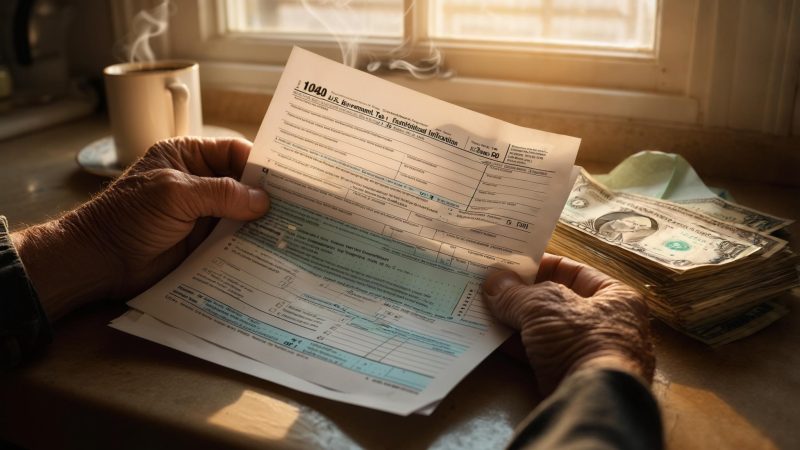
That person turned out to be Deborah Trujillo, 41, a warehouse supervisor at a regional distribution center outside Omaha, Nebraska. I met her on a Tuesday afternoon in February 2026 at her kitchen table, surrounded by a stack of documents she’d been sorting since January. Her teenager, Marcus, 17, was doing homework in the next room — heading off to the University of Nebraska–Lincoln that fall. The house smelled like coffee and something baking. Nothing about it looked like a family in financial crisis. But the paperwork told a different story.
How One Insurance Claim Started a Financial Slide
The trouble started in August 2024. A slow leak behind the first-floor bathroom wall had gone undetected for months, eventually warping the subflooring and damaging drywall in two rooms. Deborah filed a homeowner’s insurance claim for $7,400 in repairs — her first claim in eleven years with the same carrier. The insurer paid out $5,900 after the deductible. Then, sixty days later, they sent a non-renewal notice.
“I didn’t even know that was legal,” Deborah told me, still visibly frustrated eighteen months after the fact. “One claim. One. After eleven years of paying every month.” According to the Nebraska Department of Insurance, insurers in the state are permitted to non-renew policies following a claim, provided they give the required 45-day written notice — which hers did.
Finding replacement coverage wasn’t simple. Because the prior non-renewal was now on her CLUE (Comprehensive Loss Underwriting Exchange) report, two carriers declined her outright. She eventually landed a policy through a surplus lines insurer at $2,340 per year — roughly $900 more annually than her previous premium.
Compounding the insurance problem was a 2022 auto loan Deborah’s husband, Ray, had taken out on a used pickup truck for his landscaping side work. They owed approximately $14,800 on a vehicle that Kelley Blue Book now valued at roughly $9,500 — leaving them about $5,300 underwater. Refinancing wasn’t an option at favorable terms, and selling the truck would mean absorbing that gap in cash they didn’t have.
The Side Hustle Mentality That Kept Her Searching
What struck me most about Deborah in our conversation was that she wasn’t passive about any of this. She described herself as someone who is “always running the numbers on something” — selling handmade wreaths on Etsy in the fall, doing bookkeeping for two small businesses on weekends, and picking up overtime at the warehouse whenever the floor manager offered it. Her base salary as a supervisor ran about $38,000 annually. With Ray’s part-time landscaping income, the household brought in approximately $53,500 in 2025.
For three consecutive years — 2022, 2023, and 2024 — Deborah and Ray had filed their federal taxes using a free online software platform. They reported their income accurately, but they consistently missed a key box: the Earned Income Tax Credit. A small data entry error in 2022, where Ray’s self-employment income had been entered incorrectly, had triggered a software flag that they interpreted as meaning they didn’t qualify. They simply didn’t claim it the following years either, assuming nothing had changed.
What the Tax Preparer Found — and What It Meant
In January 2026, a coworker convinced Deborah to see a paid tax preparer at a local firm instead of using the software again. The preparer, working through her 2025 return, flagged the EITC within the first fifteen minutes.
For the 2025 tax year, the IRS EITC tables showed that a married couple filing jointly with one qualifying child and an adjusted gross income of approximately $53,500 was eligible for a credit in the range of $1,100 to $1,400, depending on exact figures. In Deborah’s case, after accounting for Ray’s Schedule C income and applicable deductions, the preparer calculated an EITC of $1,180.
The Child Tax Credit added another $2,000 to the picture. Marcus, 16 at the end of 2025, met the age and residency requirements under current IRS rules. The family’s income fell below the phase-out threshold for the full $2,000 credit for a single qualifying child.
Combined, the two credits produced a federal tax refund of $3,200 — a number Deborah said she had to ask the preparer to repeat. “She showed me the screen and I just sat there,” Deborah told me. “Three years. We left that money behind for three years because of one wrong click in a software program.”
Looking Ahead: College Costs and the American Opportunity Credit
The $3,200 refund wasn’t the end of the conversation in that tax preparer’s office. With Marcus enrolling at UNL in the fall of 2026, the preparer walked Deborah through the American Opportunity Tax Credit — a credit worth up to $2,500 per year for the first four years of a student’s post-secondary education, as described by the IRS AOTC guidelines. Forty percent of the credit — up to $1,000 — is refundable even if the family owes no tax.
Deborah admitted the AOTC conversation was overwhelming. “I didn’t even know that existed,” she said. “I was already trying to figure out financial aid forms for Marcus. Now there’s a tax credit too? It’s a lot to track.” That tension — relief mixed with frustration at how complicated the system is — ran through every part of our conversation.
What Deborah Plans to Do With the Refund — and What She Regrets
The $3,200 refund landed in the family’s bank account in late February 2026. Deborah told me she’d already decided how it would be used before the direct deposit cleared: $1,400 toward the gap on the auto loan principal, $900 to pre-pay one year of the higher insurance premium, and the remaining $900 into a dedicated savings account for Marcus’s first-semester expenses.
It was practical, methodical — very much in keeping with the person Carl the Meals on Wheels volunteer had described to me. But Deborah didn’t frame any of it as a win, exactly. The regret over the prior three years was still raw.
She’s already talking to her coworkers about the EITC. She sent a group text to four colleagues in January with the IRS’s EITC Assistant tool, a free eligibility screener available on the IRS website. Two of them, she told me, had similar filing histories. “I felt like I had to tell someone,” she said. “Because clearly nobody tells you this stuff.”
As I drove away from the west Omaha neighborhood that Tuesday, I thought about Carl’s words from the delivery ride-along: she should catch a break but keeps getting the opposite. What struck me most was that the break, when it finally came, wasn’t a new program or a government windfall — it was a correction of years of quietly going unclaimed. For Deborah Trujillo, $3,200 wasn’t a lottery. It was money her family had already earned, waiting on a form she hadn’t known to fill out.
Related: His Tax Refund Was Approved for $2,847 — Then the IRS Froze It for 11 Weeks Over a Single Form Error



Leave a Reply