

According to the IRS, more than one in five eligible working families fails to claim the Earned Income Tax Credit every year — leaving billions of dollars sitting uncollected. For many of those families, the reason isn’t laziness or indifference. It’s that nobody told them they qualified.
I met Darlene Becerra at a block party on a humid Saturday evening last September. A mutual neighbor mentioned, almost in passing, that Darlene and her husband had been going through “a really rough stretch.” She said it quietly, the way people do when they’re protecting someone’s privacy. When I introduced myself and explained what I cover, Darlene looked at the ground for a moment. Then she said, “Okay. If it helps somebody else, okay.”
We sat down the following Tuesday at her kitchen table in Tampa’s Seminole Heights neighborhood, two glasses of iced tea between us, her younger son’s drawings taped to the refrigerator behind her. She was careful with her words at first. Embarrassed, clearly. But once she started talking, the story came out in full.
A Budget That Was Already Stretched Before the Shock Hit
Darlene Becerra is 60 years old. She teaches yoga part-time at two studios in the Tampa Bay area, picking up between 14 and 18 classes a week depending on the season. Her husband, Marcus, works part-time at a local hardware supplier. Together, their household income runs roughly $48,000 a year — enough to get by in most years, not enough to absorb surprises.
They have two children: a 10-year-old daughter and a 7-year-old son. Darlene went back to school in her late forties to earn a graduate degree in kinesiology, hoping to move into physical therapy work. That degree left her with $47,000 in federal student loan debt. When pandemic-era forbearance ended and payments resumed in late 2023, she was suddenly sending $310 a month to her loan servicer on top of everything else.
Then came January 2025. Their landlord sent a lease renewal with a new monthly figure: $1,885. Their previous rent had been $1,450. That is a jump of $435 a month — 30% — effective in 60 days. “I read it three times,” Darlene told me. “I kept thinking I was misreading it.”
They could not move easily. With two kids enrolled in a school they liked, and Marcus’s work schedule tied to that side of town, relocating felt like tearing the family apart for an uncertain outcome. They signed the renewal. Then Darlene started cutting everything she could find to cut.
The Silence That Made It Worse
What struck me most, sitting across from Darlene, was how completely alone she had kept all of this. She has friends from the yoga studios, neighbors she genuinely likes, a sister in Orlando she talks to every week. Not one of them knew what was happening inside that house.
She described calculating whether she could afford a $22 field trip permission slip for her daughter in February. She described telling her son his birthday dinner would be homemade instead of at the pizza place he’d been talking about for months. She described none of it to anyone in her life, carrying the weight of it through her yoga classes, smiling at students and adjusting their postures while silently running the numbers in her head.
This pattern — the financial distress that goes unspoken because of shame — is more common than most people realize. Many families in similar income brackets qualify for federal tax relief programs they never pursue, partly because the information doesn’t reach them and partly because asking for help feels like admitting failure.
The Turning Point: A Free Tax Clinic and a Number She Wasn’t Expecting
In late February 2025, a flyer appeared on the community board at one of Darlene’s yoga studios. It advertised a VITA site — Volunteer Income Tax Assistance — operating out of a local library branch on Saturday mornings. The IRS funds VITA to provide free tax preparation for households earning roughly $67,000 or less. Darlene had never heard of it.
She almost didn’t go. “I thought it would be embarrassing to sit there with a volunteer and go through all our stuff,” she told me. “I kept talking myself out of it.” Marcus pushed her. He had been doing their taxes himself for years using a paid software product, and he had a feeling they might be leaving something behind.
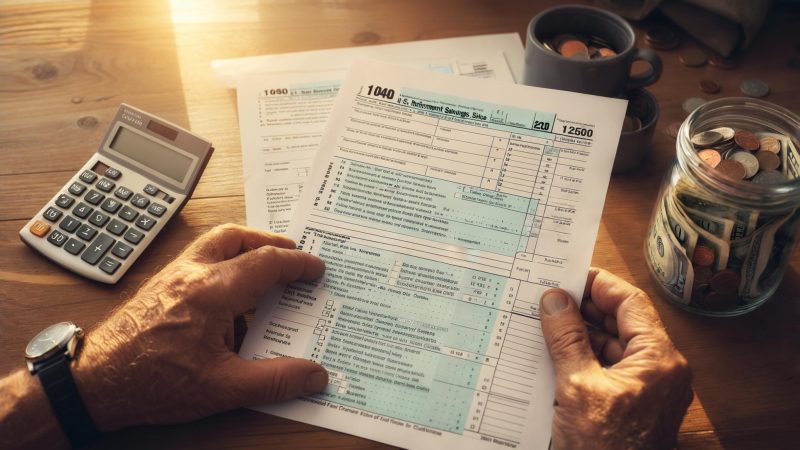
She went on a Saturday in early March 2025. The volunteer, a retired accountant named Gerald, spent about 90 minutes with her. By the end of the session, Darlene was looking at a projected federal refund of $6,847.
“I asked him to check it again,” she said. “He checked it again.”
What the Numbers Actually Looked Like
The refund came from several sources stacking on top of each other — a combination that Darlene’s previous self-filed returns had missed almost entirely.
According to the IRS EITC eligibility guidelines, a married couple filing jointly with two qualifying children and earned income between $25,511 and $53,120 in tax year 2024 may qualify for the credit. The Beccerras fell squarely within that range — a fact that had gone unnoticed across multiple prior filing years.
What the Money Actually Did — and What It Didn’t Fix
The $6,847 refund arrived via direct deposit in mid-April 2025. Darlene was direct with me about where it went. It did not feel like a windfall. It felt like oxygen after a long time underwater.
She is still paying $1,885 a month in rent. The student loans are still there. Marcus is still working part-time, and she is still teaching yoga classes at a rate that, as she put it, “keeps the lights on but doesn’t leave anything extra.” The refund bought breathing room, not resolution.
What clearly changed, though, was her relationship to information she’d previously ignored. After her VITA appointment, Gerald gave her a worksheet for tracking self-employment expenses through 2025. She has been using it. She also applied, that same spring, for a Hillsborough County emergency rental assistance program that her neighbor — the same one who introduced me to Darlene — had mentioned. That application was ultimately denied because the household income fell just above the program’s threshold, a fact she shared without bitterness but with a tired kind of resignation.
What Darlene Wants People to Take From Her Story
Near the end of our conversation, I asked Darlene what she wished she had known three years ago. She thought about it for a moment longer than I expected.
She has since told one friend — a single mother who also teaches at one of her studios — about the VITA site. That friend, Darlene told me, ended up with a refund of her own. Darlene seemed genuinely glad about that. More glad, maybe, than she was about her own money.
There is no tidy ending to her financial picture. The rent is still high. The loans are still there. She is still doing the math on field trip permission slips. But she is paying attention now in a way she wasn’t before — to the credits she qualifies for, to the deductions she’d been leaving behind, to the programs she’d been too proud to look at. That shift, quiet as it is, is its own kind of turning point.
As I drove away from Seminole Heights that Tuesday afternoon, I kept thinking about all the other Darlenes — the ones who never see a flyer on a library board, who never get pushed by a spouse to go on a Saturday morning, who carry the silence of financial strain alone because asking for help feels like losing something. The tax code is full of provisions written for people in exactly their situation. The information gap between those provisions and the people who need them most remains, in many communities, stubbornly wide.



Leave a Reply