The conventional wisdom around debt relief says the system is built for people who do everything right — file on time, maintain pristine credit, never miss a payment. Marcus Velasquez did most of those things. He still spent the better part of two years drowning anyway.
Marcus reached out to American Relief in January 2026, about three weeks after we published a story about a Houston restaurant owner who used SBA economic injury programs to stay afloat during a slow stretch. He sent a short email — just two sentences — that said he was a mechanic in El Paso trying to figure out if any of the programs we wrote about applied to him. I called him the next morning.
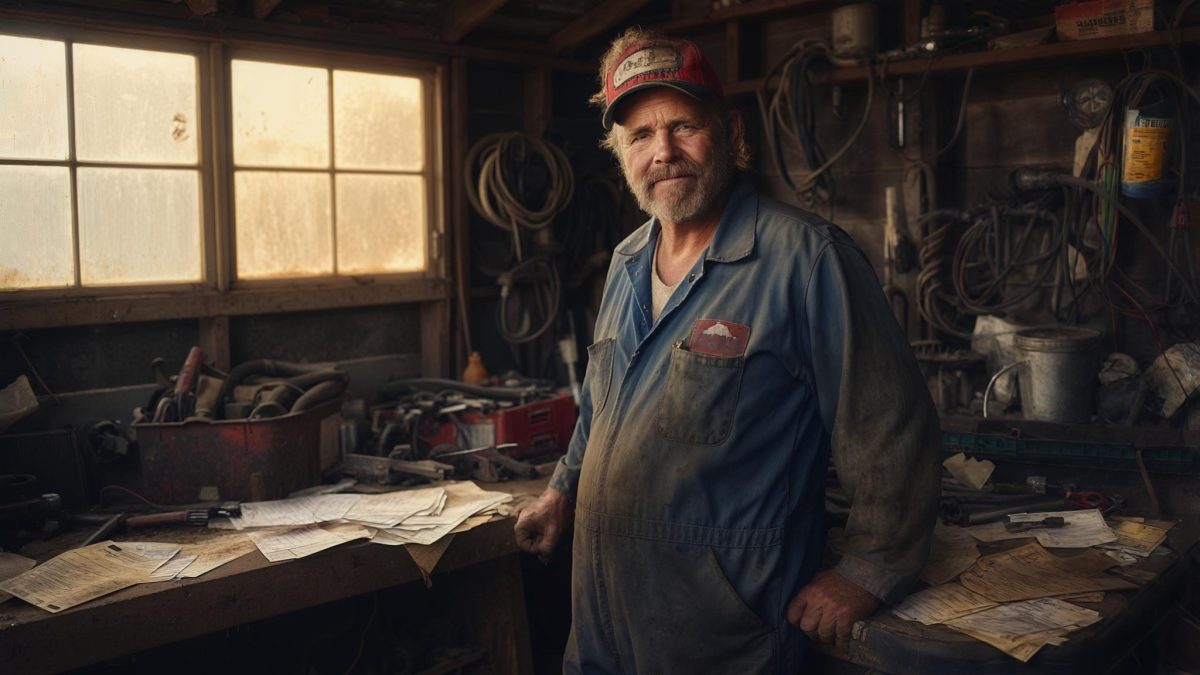
When I sat down with Marcus Velasquez at his shop on Alameda Avenue on a cold Tuesday in February, he was elbow-deep in a 2019 Ford F-150’s transmission. He wiped his hands on a rag that had seen better decades and offered me a folding chair near the tool bench. The shop was tidy but unmistakably a one-man operation — two bays, a wall of organized wrenches, and a dry-erase board tracking four current jobs.
The Debt That Followed Him Home from School
Marcus is 31 and holds a master’s degree in business administration from a regional university in New Mexico — a credential he pursued because he believed, at 24, that he’d eventually run a dealership group rather than a solo shop. The degree cost him $34,000 in federal graduate PLUS loans. By early 2024, with interest, that balance had climbed to $38,400.
He came back to El Paso after school, opened the shop in 2021, and found that the degree gathered dust while the work kept coming. The MBA was never the problem. The monthly payment was.
On a standard 10-year federal repayment plan, Marcus’s loan servicer had him at $412 per month. On top of that sat a 2021 Ram 1500 he’d financed for $32,000 — a work truck he genuinely needed — with a current loan balance of $26,900 against a Kelley Blue Book value of roughly $18,000. He was underwater by approximately $8,900.
His shop grossed around $52,000 in 2024 after expenses. After taxes, truck payments, student loans, insurance, and a modest rent for the bays, there wasn’t much left. He hadn’t taken a real vacation in three years. His divorce in 2023 had drained a small savings account he’d built during the pandemic years.
That detail — covering his mother’s electric bill at the expense of his own groceries — is the kind of thing Marcus mentioned almost as an aside, as if it were an obvious thing to do. He’s the eldest of four siblings. His mother lives ten minutes from the shop. When I asked how often he stepped in financially for family, he shrugged and said, “Whenever they need it.”
What the SBA Programs Actually Looked Like for a Shop His Size
Marcus had heard about SBA relief programs during the pandemic but assumed they’d closed or that a shop his size wouldn’t qualify. He was partially right and partially wrong — and the distinction mattered significantly.
As he explained to me, his first call to the U.S. Small Business Administration in March 2024 was disorienting. The representative he spoke with walked him through several program categories, but most of the large-scale pandemic-era funds — EIDL grants, PPP — had long since closed. What remained were loan options, not direct relief.
Marcus did qualify for an SBA 7(a) working capital loan — but took a week to decide whether to pursue it. He was wary of adding more debt to a balance sheet already strained by the truck loan and the student loans. He ultimately chose not to apply for it in 2024, a decision he described with more ambivalence than regret when I pressed him on it.
“Looking back, I think I was scared of the application more than I was scared of the loan,” he told me, leaning back against his tool chest. “I didn’t know what my financials were supposed to look like. I didn’t have a bookkeeper. I was just — winging it, honestly.”
The Income-Driven Repayment Shift That Changed His Monthly Math
The more concrete turning point came not from the SBA but from a change Marcus made to his federal student loan repayment structure in mid-2024. After reading about income-driven repayment options on the Federal Student Aid website, he applied for an income-driven repayment plan — specifically the SAVE plan, which the Biden administration had expanded and which had been the subject of significant legal challenges through 2025.
The difference between $412 and $198 per month is $214. That number sounds modest until you understand what it meant in Marcus’s specific household: it was the difference between a negative monthly cash flow and a slightly positive one. He started rebuilding a small emergency fund — about $3,200 as of the day I visited — for the first time since his divorce.
The Auto Loan Problem — and Why It Hasn’t Been Solved
The truck is the unresolved chapter. When I asked Marcus directly what he planned to do about being $8,900 underwater, he was quiet for a moment longer than I expected.
He’s explored refinancing — rates in early 2026 haven’t moved favorably enough to make a meaningful difference on a loan already at 7.4%. He looked briefly at trading down to a cheaper vehicle, but the negative equity would have rolled into the new loan. He’s currently staying put: making payments, maintaining the truck meticulously (he’s a mechanic, after all), and waiting for the equity gap to narrow as he pays down principal.
There’s no federal program specifically designed for consumers underwater on auto loans — a gap Marcus discovered after spending several hours on the CFPB’s website in late 2024. The Consumer Financial Protection Bureau offers guidance and complaint resources, but direct relief for upside-down auto loans doesn’t exist at the federal level in any meaningful form for someone in Marcus’s income bracket.
It’s one of the more frustrating asymmetries in the federal relief landscape: student loan debt, mortgage debt, and small business debt all have structured federal intervention mechanisms. Auto loan debt, which affects millions of working Americans, largely does not.
Where Marcus Stands Now — and What He Wishes He’d Known Earlier
By February 2026, Marcus’s financial picture looks like this: $38,400 in student loan debt (slowly decreasing, IDR payment of $198/month), $24,100 remaining on the truck loan (down from $26,900), and roughly $3,200 in savings. He’s not thriving. He’s stabilized.
The shop is doing better — he brought in a part-time assistant two days a week last fall, which freed him to take on more diagnostic work at a higher labor rate. His 2025 gross revenue came in at approximately $61,000, a meaningful step up from 2024. He’s recertifying for IDR in March 2026 and expects his income-based payment to adjust upward slightly.
He has no regrets about the degree, he told me — just about the timing of decisions that came after it. He also has no regrets about helping his family. When I asked whether he wished he’d kept that money instead, he looked at me like I’d asked whether he wished he’d become a different person entirely.
“That’s not really a question for me,” he said. And then he went back to the transmission.
Sitting in that folding chair watching him work, I found myself thinking about how many people there are like Marcus — not broke in the dramatic, headline-ready sense, but quietly grinding against debts that compound faster than income grows, largely unaware that the federal programs designed to help them exist. The information gap isn’t glamorous. It doesn’t make for easy policy. But for Marcus, discovering even one program — an income-driven repayment plan that took 45 minutes to apply for — freed up $214 a month and, by his own account, let him breathe again.
This article is not intended as financial or legal advice. If you are navigating federal loan programs, consider speaking with a HUD-approved housing counselor or a nonprofit credit counseling organization for guidance specific to your situation.
Related: Your IRS Refund Tracker Went Blank After Filing — Here’s What That Actually Means in 2026



Leave a Reply