
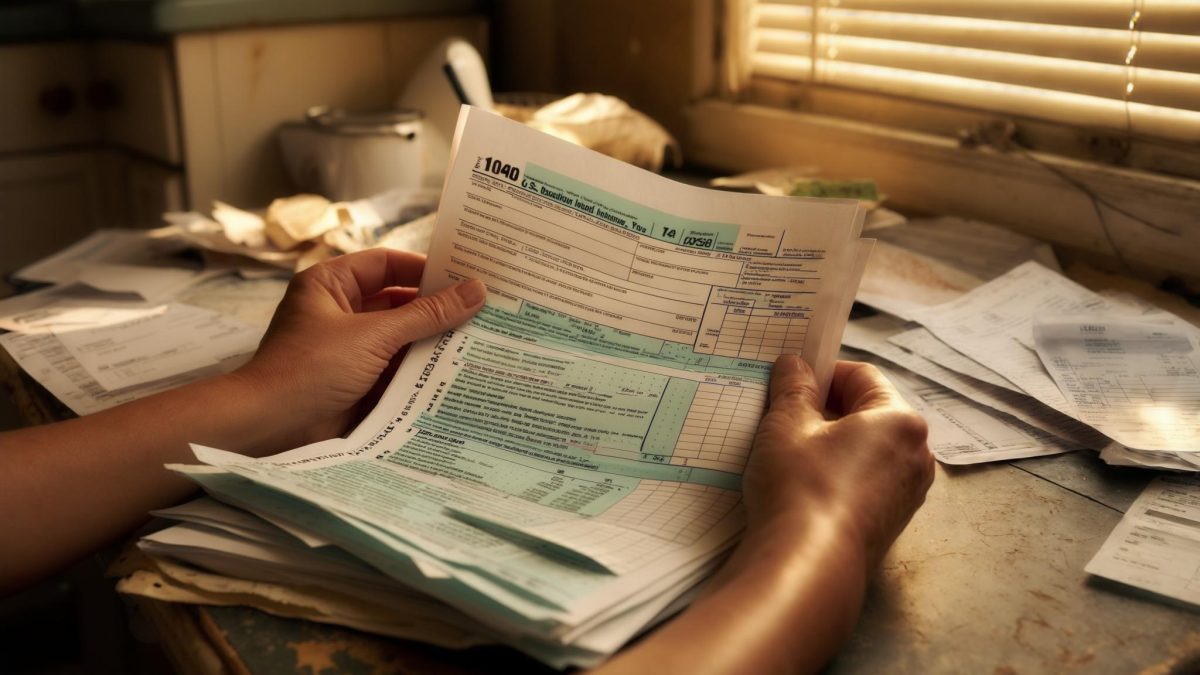
Roughly 20 million Americans fail to claim the Earned Income Tax Credit every year, leaving an estimated $7 billion uncollected, according to IRS data. Most don’t know they qualify. Some are too afraid to try. Tanya Jennings, a 63-year-old security guard from Miami, Florida, fell into both categories — until a pastor in Liberty City changed the equation.
I was introduced to Tanya in February 2026 through Pastor Raymond Okafor of Greater Grace Tabernacle Church, a small congregation in Miami’s Liberty City neighborhood. Okafor had read my previous reporting on unclaimed tax credits and called me directly. “I have a woman in my congregation,” he said, “who is scared to file her taxes and doesn’t realize what she’s walking away from.” He was not exaggerating.
When I sat down with Tanya on a Tuesday afternoon in the church fellowship hall — she was still in her security guard uniform from the morning shift, hands wrapped around a paper cup of coffee — she looked more tired than nervous. I sensed both.
A Security Guard, a Pastor, and a Pile of Unopened Mail
Tanya raises her 10-year-old son, Darius, alone. Her ex-partner has not contributed financially since 2019. She works overnight and weekend shifts at a commercial building in downtown Miami — irregular hours that cause her take-home pay to swing by as much as $400 a month. In a city where the average rent for a two-bedroom apartment has surpassed $2,400 a month, that unpredictability is more than uncomfortable. It is destabilizing.
“Some months I’m okay,” Tanya told me. “Some months I’m robbing Peter to pay Paul and praying nobody gets sick.”
She had not filed a federal income tax return for tax years 2023 or 2024. Not because she was hiding from the IRS — she was emphatic about that — but because a bad experience over a decade ago had made the whole process feel like a trap. In 2015, she paid a local tax preparer $180 to file her return. That preparer made errors resulting in a $1,100 bill from the IRS, which Tanya spent three years paying off in small monthly increments.
“After that, I figured it was safer to just not deal with it,” she said. “At least I wouldn’t owe anybody anything.”
What Tanya Was Owed — and Why She Almost Walked Away
As Tanya walked me through her situation, the numbers began to clarify. For tax year 2024, she had W-2 income of approximately $27,400 from her security guard position, one qualifying dependent in Darius, and no investment income. That profile made her eligible for two of the most significant credits in the federal tax code: the Earned Income Tax Credit and the Additional Child Tax Credit.
According to IRS EITC eligibility guidelines, a single filer with one qualifying child and earned income around $27,400 lands close to the maximum credit for that income bracket. The VITA volunteer who eventually prepared her return put the combined refund — EITC, ACTC, and overpaid withholding — at approximately $5,800.
Tanya had walked away from that money for two consecutive years, not out of ignorance of its existence, but out of a learned distrust of the filing process itself. The rough math of what that avoidance cost her — potentially $11,000 or more across both years — is difficult to sit with.
The Fear of Filing: When Past Experiences Poison the Present
When Pastor Okafor first suggested speaking with a journalist, Tanya declined. Then she declined again. “I figured it was another person trying to sell me something,” she told me with a short, dry laugh. It took three conversations — and the pastor vouching for me personally — before she agreed to meet.
That skepticism runs deep, and for understandable reasons. Beyond the 2015 preparer incident, Tanya described a pattern of financial experiences that had taught her, over time, that institutions rarely work in her favor. A bank had once frozen her account during a direct deposit dispute, leaving her without access to her paycheck for 11 days. A rent-to-own furniture company had charged her $2,800 for a living room set she later found selling for $690 at a retail store.
The IRS offers free filing help through the Volunteer Income Tax Assistance (VITA) program for taxpayers earning roughly $67,000 or less annually. Tanya had never heard of it. She had been paying between $180 and $200 each filing season to a preparer she no longer trusted — and in the years she didn’t file at all, the money she was owed simply sat unclaimed.
When I asked her whether she had ever looked into free filing options, she paused for a moment. “Nobody ever told me there was such a thing,” she said. “That’s the honest answer.”
The Turning Point: A Library Three Miles Away
Pastor Okafor located a VITA site operating out of a public library branch roughly three miles from Tanya’s apartment in Liberty City. She visited for the first time in late January 2026. A certified volunteer preparer spent about 90 minutes with her, reviewed her W-2, confirmed Darius’s eligibility as a qualifying child, and walked her through what the return would look like before she signed anything.
“I thought they made a mistake,” Tanya told me when she called to share the amount. “I literally asked the woman to check it again. I’ve never seen a number like that come back to me.”
The Outcome: $5,812 and One Still-Open Question
Tanya filed her 2024 return electronically in late February 2026. By early April — when I reached her for a final update — the refund of $5,812 had been deposited directly into her checking account.
She applied $2,200 toward a credit card balance that had been accruing interest at 24.99%. She opened a savings account for Darius and deposited $1,500. The rest covered three months of utility bills she had fallen behind on and a car repair she had been putting off since November 2025.
The 2023 return is a separate and unresolved situation. The VITA volunteer identified a discrepancy between Tanya’s records and a corrected W-2 her employer had issued — an administrative error she hadn’t been aware of. That return is still being worked through as of April 2026.
Tanya is clear-eyed about what the refund did and did not change. The $5,812 provided real, immediate relief — paid-down debt, a small cushion for Darius, the utility bills finally settled. But it did not change the underlying arithmetic of her life: a $27,400 annual income, a growing child, and a city where costs keep rising regardless of what any tax return says.
What Tanya’s Story Says About a Larger Problem
When I think about Tanya walking past a library three miles from her home for two full years — eligible for thousands of dollars in credits, too burned and too cautious to claim them — that is not a story about personal failure. It is a story about a system that is genuinely hard to navigate, particularly for people who have already been harmed by it.
The VITA program served millions of households in 2024 at no cost, according to the IRS — yet awareness of it remains uneven, especially in communities where paid preparers have historically been the only visible option. Pastor Okafor told me he has since started holding an informal January information session at Greater Grace about free filing resources. “People need to know there’s somebody who will help them for free,” he said. “That’s not nothing.”
Tanya’s final words to me, near the end of our last call, were measured and unhurried. “I wish someone had told me years ago that there were people out there who would help for free,” she said. “I thought you had to know somebody or pay somebody to get anything.”
She is still working overnight shifts. The 2023 return is still unresolved. But Darius has a savings account with his name on it — and Tanya, for the first time in a long time, filed her taxes without owing a penny to anyone.
Related: She Left USPS at 30 With $52,000 in Student Loans and a $1,847-a-Month COBRA Bill — and She’s Numb to All of It
.pvv-faq-section details summary::-webkit-details-marker{display:none}.pvv-faq-section details summary::marker{display:none;content:””}.pvv-faq-section details[open] summary .pvv-faq-arrow{transform:rotate(90deg)}



Leave a Reply