

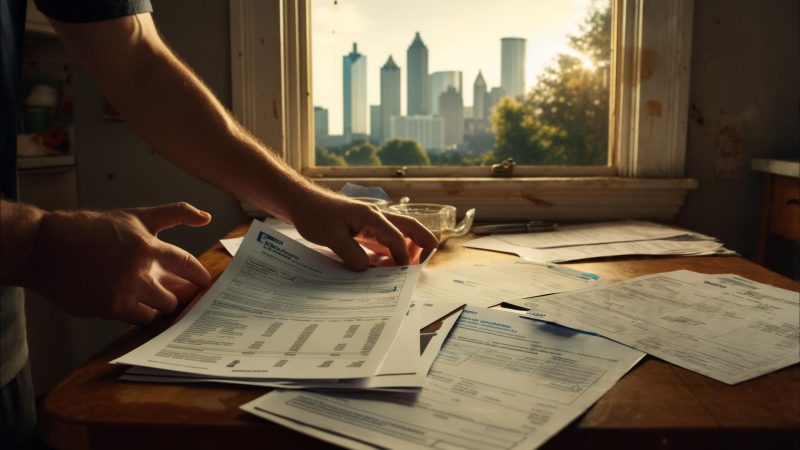
Roughly 56% of Americans between ages 55 and 64 have less than $50,000 saved for retirement, according to federal survey data — a number that sounds abstract until you’re sitting across from someone living inside it. That’s where I found myself on a cold Tuesday morning in late February 2026, at a free tax preparation clinic in the Eastland neighborhood of Charlotte, North Carolina, watching Felicia Tran pull a crumpled folder of documents from a canvas tote bag.
I had been covering the swirling uncertainty around the proposed $2,000 tariff dividend checks for weeks. Felicia, as it turned out, had been thinking about almost nothing else.
A High Income That Somehow Leaves Nothing Behind
Felicia Tran is 64 years old, a legal secretary at a mid-size Charlotte law firm, and she earns approximately $78,000 a year — a salary that, on paper, places her well above the median American household. When I sat down with her at a folding table in the clinic’s back room, she laughed at the gap between what her income suggests and what her bank account reflects.
“People hear what I make and they assume I’m fine,” she told me, smoothing a W-2 against the table. “But I have zero in retirement. Zero. My husband and I just — we always said we’d start saving next year.”
Her husband Marcus, 61, had been a logistics coordinator at a regional distribution company. He was laid off in January 2026 when the company restructured after absorbing months of tariff-related shipping cost increases. His salary had been roughly $52,000. Combined, the Tran household had been pulling in about $130,000 — enough to live comfortably, not enough, it turned out, to weather a sudden $52,000 hole.
Felicia told me she avoids looking at her bank statements — “it’s a habit I know I need to break” — and that irregular billing cycles at the law firm mean her take-home pay fluctuates by as much as $800 from one paycheck to the next. With Marcus now bringing in nothing, the math had become undeniable even for someone practiced at not looking at it.
When the $2,000 Promise Entered the Picture
President Trump first floated the idea of a $2,000 tariff dividend check in November 2025, framing it as a way to return tariff revenue directly to American households. He suggested the payments would arrive “probably in the middle of next year” — a timeline that, as of early 2026, according to reporting from the El Paso Times, remained entirely unconfirmed by any formal legislative action.
Felicia heard about it on the radio during her commute sometime in December. She went home and told Marcus. “I said, ‘Two thousand dollars — that could be two months of groceries and utilities if we’re careful,'” she recalled. “I know that sounds small. But when you’re already scared, small sounds like a lot.”
What the Legislation Actually Says — and Doesn’t
The policy picture is genuinely murky. Members of Congress have introduced bills that could send tariff-linked rebates to some Americans, but no legislation has passed. According to recent reporting on the tariff rebate bills, eligibility criteria, payment amounts, and timelines remain unresolved in committee.
Complicating matters further: the Supreme Court ruled that portions of Trump’s tariff framework were illegal, which directly affects the revenue stream the dividend checks were supposed to draw from. As the Austin American-Statesman noted in March 2026, that ruling throws the entire funding mechanism into question.
When I explained the legislative status to Felicia in plain terms — that there was no bill signed, no IRS mechanism in place, no confirmed date — she went quiet for a moment. “I figured as much,” she said. “I just didn’t want to believe it.”
The Real Cost of Waiting on a Promise
What struck me most about Felicia’s situation wasn’t the uncertainty itself — it was how the possibility of a check had subtly changed her behavior. She told me she had delayed calling their landlord about a broken HVAC unit because “I kept thinking, wait until the check comes, then we’ll handle it properly.” She put off a conversation with her firm’s HR department about adjusting her tax withholding for the same reason.
This is the underreported harm of policy ambiguity: it doesn’t just leave people without money, it gives them a reason to defer the difficult decisions that might actually help them.
As Felicia explained, the anxiety doesn’t come from not knowing whether the check is coming. “The anxiety is that I let myself start counting on it,” she said. “That’s on me. I know that. But when someone in the White House says it out loud — $2,000, middle of next year — what are you supposed to do with that?”
Leaving the Clinic With Less Certainty Than She Arrived With
By the time the volunteer tax preparer finished reviewing the Trans’ return, Felicia learned she and Marcus were likely due a modest federal refund — approximately $640, based on overwithholding earlier in the year. Not the $2,000 she’d been quietly hoping for, but real money arriving on a real timeline.
She folded the estimate sheet carefully and slid it into her canvas bag. “Six hundred forty dollars,” she said, almost to herself. “That’s not nothing.” She looked up with the particular smile of someone practicing gratitude through gritted teeth.
Walking out of the clinic into a gray Charlotte morning, I thought about the gap between the way stimulus proposals get announced — press conferences, social media posts, breathless headlines — and the way they land in people’s actual lives. For Felicia, a $2,000 check was never abstract policy. It was a broken HVAC unit she hadn’t fixed, a conversation she hadn’t had, a piece of mental furniture she’d arranged her near-term future around.
The check may still come. It may not. But the hope it generated already did its work — and not entirely in ways that helped her.
Related: A Freelance Designer Bet Her Credit Card Debt on a 2026 Stimulus Check That May Never Come



Leave a Reply