

The 2026 tax filing deadline is April 15, and for millions of Americans still sorting through benefit changes, stimulus rumors, and shifting IRS rules, the window to act is closing fast. When Randall Guzman reached out to me in late March, he had less than three weeks left to file — and a story he had never told anyone out loud.
Randall had read a piece I published last fall about a Charlotte-area teacher who nearly lost her Recovery Rebate Credit because of an identity verification error. He sent a short email: “Something similar happened to me, but worse. I don’t know where to start.” We scheduled a phone call, then a longer conversation at a diner near his home in Raleigh, North Carolina, a few days later.
A Situation That Compounded Quietly for Two Years
Randall Guzman is 60 years old, a warehouse supervisor for a regional logistics company, and a single father raising a 13-year-old son. He has worked for the same employer for eleven years. By most measures, he describes himself as someone who has “always managed.” What he means is that he has never asked for help.
The first blow came in March 2023. Randall noticed two credit card accounts on his report — accounts he had never opened. Someone had used his Social Security number to open lines of credit totaling roughly $11,400 at two retailers and one travel card issuer. He filed an FTC identity theft report immediately, but the damage to his credit was already done. His score fell from 681 to 519 within 60 days.
“I was embarrassed to tell anyone,” Randall told me, stirring his coffee without drinking it. “I know people who’ve talked about money problems like it’s nothing. I’m not that person. I just kept thinking I’d fix it quietly.”
He spent about eight months disputing the fraudulent accounts. Two were eventually removed. One charge — $2,200 at a travel card issuer — remained on his report while an investigation dragged on. As of April 2026, that dispute is still unresolved.
When the Insurance Switch Made Everything Worse
In January 2025, Randall’s employer switched health insurance carriers. The new plan technically covered him, but the formulary — the list of covered drugs — had changed significantly. His blood pressure medication and his metformin, which he takes to manage Type 2 diabetes, were both moved to a non-preferred tier.
He tried skipping doses. He tried stretching a 30-day supply to 45 days. By April 2025, his doctor had noted his A1C was climbing. “My doctor asked me point blank if I was taking my medication,” Randall said. “I lied and said yes. I felt like an idiot.”
He earns approximately $58,000 a year — enough to be ineligible for Medicaid in North Carolina, not enough to absorb a sudden $229-per-month increase in medical costs on top of supporting a teenager alone. His credit, still damaged from the identity theft, meant he couldn’t qualify for the pharmacy financing plan his doctor’s office suggested.
The 2026 Tax Filing Season and What Randall Didn’t Know
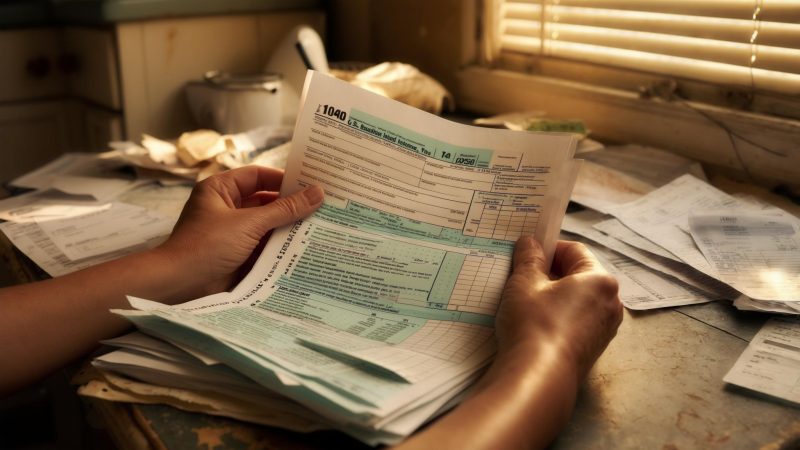
Randall had always filed his taxes himself using a basic online service. He had never claimed anything beyond the standard deduction and his filing status. He didn’t know he might qualify for the Earned Income Tax Credit. He also didn’t realize that unreimbursed medical expenses exceeding 7.5% of his adjusted gross income could be itemized as a deduction.
When he read my earlier story — which touched on how a single overlooked credit had produced a $1,400 difference for a reader — he started wondering what he might have missed. According to the IRS, a tax credit is a dollar-for-dollar reduction in what a taxpayer owes — meaning it directly reduces the bill, or increases a refund, rather than just lowering taxable income. That distinction matters enormously for someone in Randall’s income range.
Randall sat down with a volunteer tax preparer through a local VITA (Volunteer Income Tax Assistance) site in late February 2026 — a resource he found only after a coworker mentioned it offhandedly. It was the first time he had let anyone else look at his finances in years.
What the Numbers Actually Looked Like
As Randall explained it to me, the VITA preparer walked him through a process he had never attempted. After accounting for his pre-tax retirement contributions — he puts 6% of his salary into a 401(k) to capture the employer match — his adjusted gross income came in at roughly $54,400 for 2025. That still cleared the EITC threshold for a single filer with one child.
But the preparer also flagged his unreimbursed medical expenses. Randall had paid approximately $3,200 out of pocket for prescriptions and two specialist visits in 2025. The 7.5% AGI threshold on his income worked out to roughly $4,080 — so his expenses didn’t cross the itemization bar on their own. Still, the preparer identified a Child Tax Credit Randall had been underutilizing and helped him correctly document his head-of-household filing status, which he had been filing incorrectly for two years.
The combined effect of the corrected filing status, the properly claimed Child Tax Credit, and several smaller adjustments produced a federal refund of $2,140 — compared to the $310 refund he had received the prior year. According to reporting by CNBC, broader changes in the 2026 filing season are producing larger average refunds for middle-income filers, a trend consistent with what Randall experienced.
“When the preparer showed me the number, I actually asked her to check it twice,” Randall told me. “I’ve been filing my own taxes for thirty years. I had no idea I was leaving money on the table.”
The Outcome — and What’s Still Broken
Randall used the $2,140 refund to pay three months of prescription costs in full and set aside roughly $800 toward the still-disputed $2,200 fraudulent charge on his credit report. His credit score, last checked in March 2026, has climbed from 519 to 574 — still far from where it was before the theft, but moving in the right direction.
He is back on his medications consistently. His doctor reported an improvement in his A1C at his March visit. Those are not small things.
There is still the question of next year. The insurance formulary hasn’t changed. The prescriptions will cost him the same $267 a month unless something shifts. He’s now looking into whether North Carolina’s state-level pharmaceutical assistance programs apply to his income bracket — something the VITA preparer pointed him toward but couldn’t advise on directly.
As for the stimulus payments that have been the subject of widespread rumors throughout 2025 and into 2026 — a topic Randall had seen discussed online — he was realistic. According to a Fox 5 Atlanta fact-check, many of the circulating claims about new IRS direct deposits and tariff dividend checks have not been confirmed by Congress. Randall said he had seen a few posts claiming new $2,000 checks were coming. “I didn’t count on it,” he told me. “I’ve learned not to count on things I can’t control.”
What Randall’s Story Reflects About This Filing Season
Randall’s experience sits at the intersection of two problems that are far more common than most people admit: the gap between what tax credits exist and who actually claims them, and the cascading damage that identity theft inflicts on people who have no financial cushion to absorb it.
According to the IRS, tax credits reduce what a taxpayer owes dollar-for-dollar — but only if they’re claimed. Millions of eligible filers leave the Earned Income Tax Credit and the Child Tax Credit unclaimed each year, often because they file independently and don’t know what they qualify for. The VITA program, which offers free in-person tax preparation for households earning roughly $67,000 or less, exists specifically to close that gap — but its reach depends entirely on people knowing it exists.
Randall told me he wished someone had told him about VITA years ago. He also said he still hasn’t told any of his friends about what he went through. “They’d probably say something supportive and I just — I can’t do that yet,” he said. “Maybe next year.”
When I left the diner, Randall had a to-do list on his phone: follow up on the disputed credit charge, look into state pharmaceutical assistance, and set a calendar reminder for next January to find the nearest VITA site again. It was a modest list. For where he was eight months ago, it was a long way forward.
(function(){var w=document.getElementById(‘pvv-scenario-s1775657178115uzl3’);if(!w)return;var btns=w.querySelectorAll(‘button[data-choice]’);btns.forEach(function(b){b.addEventListener(‘click’,function(){if(w.dataset.revealed)return;w.dataset.revealed=’1′;btns.forEach(function(x){x.style.opacity=x===b?’1′:’0.45′;x.style.cursor=’default’;x.style.transform=’none’});var o=document.getElementById(‘s1775657178115uzl3-out-‘+b.dataset.choice);if(o){o.style.display=’block’}});b.addEventListener(‘mouseenter’,function(){if(!w.dataset.revealed){b.style.borderColor=’#38bdf8′;b.style.transform=’translateX(4px)’}});b.addEventListener(‘mouseleave’,function(){if(!w.dataset.revealed){b.style.borderColor=’#334155′;b.style.transform=’none’}})})})();
.pvv-faq-section details summary::-webkit-details-marker{display:none}.pvv-faq-section details summary::marker{display:none;content:””}.pvv-faq-section details[open] summary .pvv-faq-arrow{transform:rotate(90deg)}



Leave a Reply